
Misattributed Career Quotes: Confucius Never Said It
Confucius never said choose a job you love. Churchill and Jefferson never said theirs either. Steve Jobs did say his, at Stanford in 2005. Every attribution traced.

Contents · 7 sections
Three of the most repeated career quotes in circulation were never said by the men they are credited to, and in two of those cases the institution devoted to that man's legacy is the one saying so. Confucius did not say "choose a job you love, and you will never have to work a day in your life." Churchill did not say "success is going from failure to failure without losing your enthusiasm." Jefferson did not say the one about luck and hard work.
Steve Jobs did say "the only way to do great work is to love what you do." He said it at Stanford on 12 June 2005, and Stanford publishes the prepared text, so that one you can check in a minute.
What follows traces each fake back to where it came from, gives the genuine quotes with the speech or the page they came from, and covers the research on whether reading any of this changes what you do next.
The 3 career quotes nobody said
Each of these circulates constantly, and each one falls apart on inspection. The provenance is worth reading, because the pattern repeats: an ordinary author says something useful, the saying travels, and somewhere along the way it acquires a famous name it never had.
"Choose a job you love, and you will never have to work a day in your life"
Credited to Confucius. Quote Investigator traced the earliest strong match to the Princeton Alumni Weekly in 1982, where a philosophy professor named Arthur Szathmary used the saying and credited it only to an unnamed "old-timer". The Confucius attribution turns up in print in June 1985, in a Computerworld piece by the journalist Glenn Rifkin, who ran it as an epigraph. Harvey Mackay popularised it in the late 1980s without originating it, and Quote Investigator's conclusion is that no substantive support exists for the Confucius attribution at all.
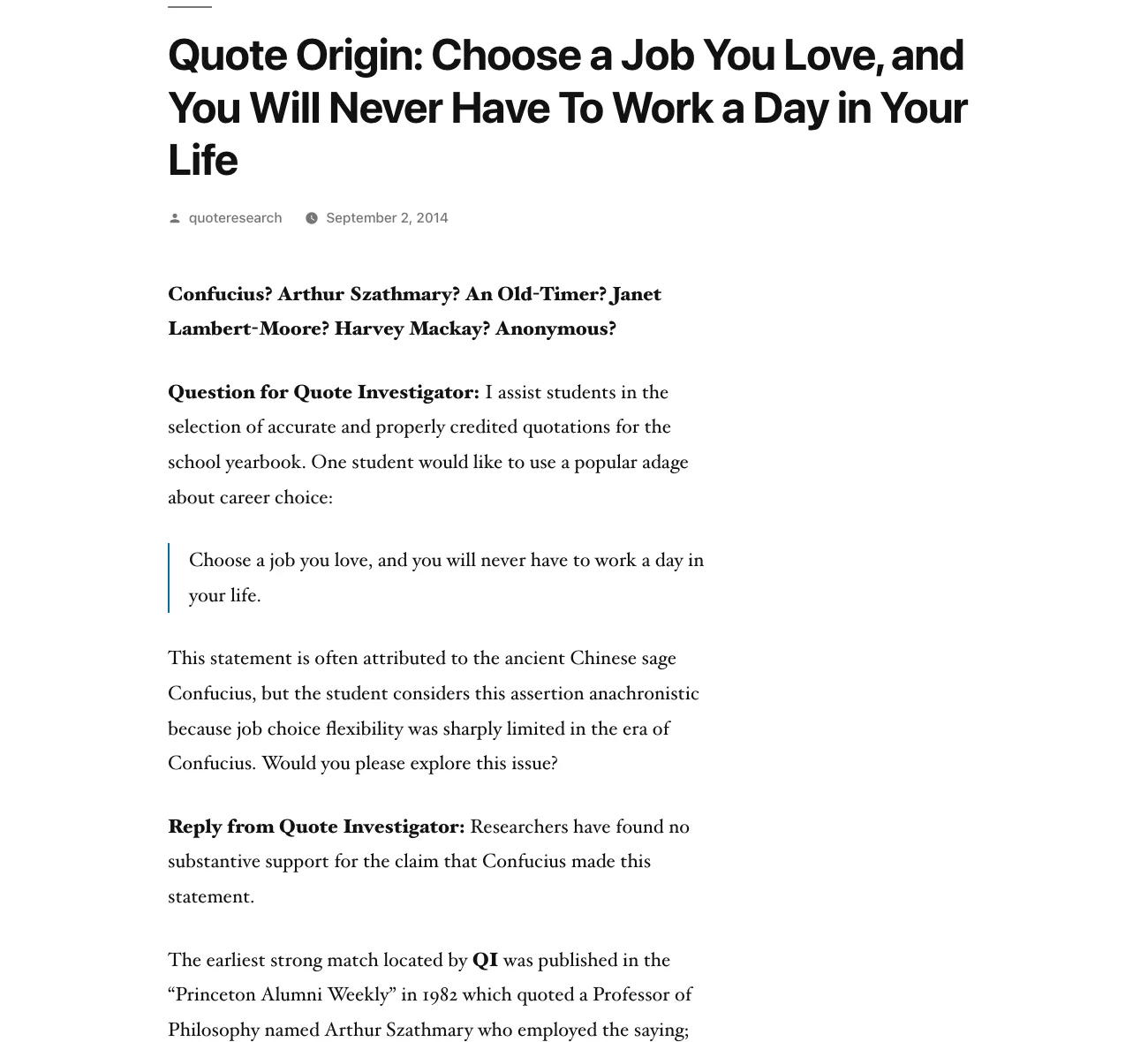
Look at the gap. Three years separate a saying credited to an anonymous old-timer from a saying credited to a philosopher who died around 479 BC. No manuscript was found in between. The name was simply upgraded, and the upgrade stuck.
"Success is going from failure to failure without losing your enthusiasm"
Credited to Winston Churchill. The International Churchill Society lists it among quotes falsely attributed to him, in unusually blunt terms: "We can find no attribution for either one of these, and you will find that they are broadly attributed to Winston Churchill. They are found nowhere in his canon, however." The "either one" covers "success is not final, failure is not fatal", which fails in the same way.
The society adds a detail worth keeping: equal numbers of sources credit these lines to Abraham Lincoln, and no verified attribution exists in the Lincoln record either. Two famous names, one saying, no source under either of them. That is the tell.
"I am a great believer in luck, and I find the harder I work, the more I have of it"
Credited to Thomas Jefferson. The Thomas Jefferson Foundation files it under spurious quotations, as "a quotation commonly misattributed to Thomas Jefferson."
This one has the most satisfying resolution of the three, because the line does have an author. Quote Investigator found the earliest match in a 1922 collection called Listen to This by Coleman Cox, phrased slightly differently: "I am a great believer in luck. The harder I work, the more of it I seem to have." The Jefferson version spread later, after the quotation compiler Laurence J. Peter credited the saying to him in Peter's Quotations: Ideas for Our Time in 1977.
So Coleman Cox wrote a good aphorism in 1922 and has been losing the credit for it for roughly 50 years.
| The quote | Credited to | Verdict | Where it came from |
|---|---|---|---|
| "Choose a job you love, and you will never have to work a day in your life." | Confucius | Misattributed | Princeton Alumni Weekly, 1982, credited to an unnamed "old-timer"; Confucius attached in Computerworld, Jun 1985 |
| "Success is going from failure to failure without losing your enthusiasm." | Winston Churchill | Misattributed | No source found under Churchill or Lincoln; "found nowhere in his canon" per the International Churchill Society |
| "I am a great believer in luck, and I find the harder I work, the more I have of it." | Thomas Jefferson | Misattributed | Coleman Cox, Listen to This, 1922; credited to Jefferson by Laurence J. Peter in 1977 |
| "The only way to do great work is to love what you do." | Steve Jobs | Genuine | Stanford commencement address, 12 June 2005, prepared text published by Stanford |
"The only way to do great work is to love what you do" is genuine
This is the career quote people check most often, and it survives the check. Jobs delivered it in his commencement address at Stanford on 12 June 2005. Stanford published the prepared text, and the line sits inside a longer passage that nearly every quote list cuts short:
"You've got to find what you love. And that is as true for your work as it is for your lovers. Your work is going to fill a large part of your life, and the only way to be truly satisfied is to do what you believe is great work. And the only way to do great work is to love what you do. If you haven't found it yet, keep looking. Don't settle." Steve Jobs, Stanford commencement address, 12 June 2005
The compression is what does the damage. Standing alone, the sentence reads as a rule that the love has to arrive first, before the work is any good. In the passage it comes with an instruction attached, which is to keep looking, and it is addressed to graduates who have not found it yet. That is a description of a search, and it is a much more usable idea than the fragment.
Stanford's own recording of the address. The 'love what you do' passage comes in the second of the three stories, the one about getting fired from Apple.
Career quotes that check out, with the page they came from
Every quote below names the book, speech, or page it came from. If the source could not be found, it is not on this list.
When you are stuck and going in circles
"How we spend our days is, of course, how we spend our lives." Annie Dillard, The Writing Life (1989)
The most useful sentence on this page, because it refuses the abstraction. "What should I do with my life" is unanswerable and therefore comfortable to think about forever. "What did I do with Tuesday" is answerable and uncomfortable, which is the point. Being stuck is rarely a shortage of ambition. It is usually a career-sized question being asked at a career-sized altitude, where it cannot be tested.
When you are switching careers
"Compelling careers often have complex origins that reject the simple idea that all you have to do is follow your passion." Cal Newport, So Good They Can't Ignore You (2012), p. 6
This one earns its place by contradicting nearly every other quote in the genre. Newport's argument is that people who love their work mostly did not identify it in advance and then go get it; they got good at something, and the autonomy and meaning followed the skill. If you are mid-switch and stalling because you cannot name your one true calling, the instruction is not to search harder. It is to move while remaining willing to be wrong. Related: what your work values cost you, which is the same argument from the other end.
When you are starting out with no direction
"Again, you can't connect the dots looking forward; you can only connect them looking backward. So you have to trust that the dots will somehow connect in your future." Steve Jobs, Stanford commencement address, 12 June 2005
Worth quoting in full, because the versions in circulation tend to smooth it into a promise. Jobs is not saying the dots will connect. He is saying you cannot see the pattern from the front, so waiting for it to appear before you move is a strategy that never terminates. This is survivorship-shaped advice from a man with an unusual outcome, and it is still the right instruction for someone at 22 with no data about themselves yet.
When you have too many interests
"The best moments in our lives are not the passive, receptive, relaxing times... The best moments usually occur when a person's body or mind is stretched to its limits in a voluntary effort to accomplish something difficult and worthwhile." Mihaly Csíkszentmihályi, Flow: The Psychology of Optimal Experience (1990), p. 3
For anyone juggling six interests, the operative word is voluntary. Csíkszentmihályi's whole body of work says the good state comes from difficulty you chose, and that gives you a filter: of your six interests, which ones do you keep doing when the difficulty arrives and nobody is making you? That question separates a hobby from a direction faster than any amount of ranking. More on reading that signal in intrinsic motivation and your career.
Why the fake quotes travel further than the sourced ones
The misattributions are not harmless trivia, for two reasons.
The first is that the fake ones tend to be the load-bearing ones. "Choose a job you love and you will never work a day in your life" is arguably the single most destructive sentence in career advice: it sets the bar at never working, promises that outcome comes from choosing correctly at the start, and then borrows the authority of a philosopher who died 2,500 years ago and said no such thing. People measure genuinely good careers against that sentence and conclude they chose wrong. The Cox line about luck has the opposite effect, which may be why it needed a founding father's name to travel.
The second is that attribution is a cheap signal about the source. A page that hands you 65 quotes and cannot tell you where a single one came from did not check any of them. That is worth knowing before you take the rest of its career advice, and it is the reason this page is shorter than the lists it sits next to on the results page.
Checking an attribution is not pedantry about dead men. A saying with a known author sits in a context you can read, and the context is usually where the useful part is. The Jobs passage is the clearest case on this page: the fragment and the full paragraph give different instructions.
What the research says about reading quotes at all
Worth knowing before you take any of the sourced ones to heart.
Gabriele Oettingen and Doris Mayer separated two kinds of thinking about the future in a 2002 paper in the Journal of Personality and Social Psychology. One is expectation: judging a desired outcome as likely, based on your track record. The other is fantasy: experiencing the images and thoughts of that outcome positively, right now. They look similar from the inside. They do the opposite thing.
Their finding, in the paper's own words: "Positive expectations (judging a desired future as likely) predicted high effort and successful performance, but the reverse was true for positive fantasies (experiencing one's thoughts and mental images about a desired future positively)."
The four studies covered graduates looking for a job, students with a crush, undergraduates before an exam, and hip-replacement patients. Effort and performance were measured weeks or months later, in one case up to two years. The people who most enjoyed imagining the good outcome did worse at getting it.
A motivational quote is a fantasy delivery mechanism. That is its whole design: it hands you the feeling of the destination in eleven words, at no cost. Which explains the thing you have already noticed, that you can be moved by a quote on Monday and be in the same job, with the same untouched plan, on Friday. The quote paid the emotional dividend up front, so the debt never came due.
Take the quote, then finish three sentences.
- The quote says: "How we spend our days is, of course, how we spend our lives."
- The obstacle in my way this week is: not the economy, not my degree. Something specific and true, like "I have not opened the portfolio file in nine days."
- The one action I will take against that obstacle, before Friday, is: also specific. Not "work on portfolio." Something like "Wednesday 8pm, one page, badly."
If step two or three will not fill in, the quote was entertainment. That is allowed. Just do not file it as progress.
How to use a quote so it does not replace the work
Oettingen's later work calls the fix mental contrasting: hold the desired future against present reality rather than enjoying it on its own. The three-sentence version in the box above is a crude implementation, and it takes about two minutes.
The pattern holds for every sourced quote on this page. Csíkszentmihályi's line is a prompt to name the difficulty you would choose. Newport's is a prompt to name the skill you would build. Dillard's is a prompt to look at Tuesday. On its own each is a pleasant sentence, and against a named obstacle each becomes a question you can answer this week. If the obstacle you name is exhaustion, no quote will touch it, and the moves that prevent burnout are the more useful read.
The bottom line
Of the four career quotes checked here, three have no source under the name attached to them, and one of those three has a source under a name nobody repeats. Jobs said his, at Stanford, on 12 June 2005, and the full passage is better than the fragment.
If the reason you searched for the attribution is that the quote was going to decide something, that is the part worth attention. The MyPassionAI quiz takes under 10 minutes, sorts you by where you are stuck rather than by mood, and returns your archetype, career matches with fit scores, and the first concrete steps for your situation. If the sticking point is meaning rather than direction, the purpose quiz approaches it from that side. If you can picture the job you want but cannot tell whether wanting it is nostalgia or fit, the dream job quiz is built for that gap. And if the honest answer is that you have already decided to go, the should-I-quit-my-job quiz pressure-tests the decision before you hand anything in. If the flatness has lasted longer than a bad week, 13 signs of career burnout is the diagnostic and struggling to find career passion the mismatch version. If a quote is needed because an interviewer asked the question, how to answer "what is your passion" is the practical script.
Or keep the Dillard line and skip everything else here. How you spend Tuesday is how this goes.
Frequently Asked Questions
Ready to find your passion career?
The free under-10-minute quiz maps your childhood patterns and flow triggers to one of 20 archetypes, then gives you matched careers and a 7-day first-step plan.
Take the Free Career QuizRelated Articles
Trusted by 14,000+ career-quiz takers across 166+ countries · Methods covered in