
Original Research
Passion vs Money: What 7,000+ Career Seekers Actually Chose
Passion vs money: first-party data from 439 surveyed workers and 6,800+ quiz responses on what people choose, and what happens to those who chose money alone.
8 min read

Original research from 13,200+ quiz responses and a 439-worker survey, science-backed guides, and practical advice on finding work that actually fits.
Trusted by 13,600+ career-quiz takers across 166+ countries · Methods covered in



What 6,837 people told us about being lost in their careers. Twelve findings, embeddable charts, and the open dataset.
Data hubTwelve citable statistics from first-party data, each with its base stated. Free to reuse with attribution.
Passion vs money: first-party data from 439 surveyed workers and 6,800+ quiz responses on what people choose, and what happens to those who chose money alone.

How many times does the average person change careers? Our survey of 439 workers shows 66.3% have changed at least once and 38.5% more than once. See the data.

What does Gen Z want in a job? First-party data from a 439-worker survey and 6,800+ career quiz responses: meaning AND income, autonomy, and visible learning.

The informational interview script was written for students. Here is the version for someone fifteen years in, and the step that has to come before it.

Gallup puts US engagement at 32%. Our data on 10,115 career changers shows disengagement climbing with experience, not falling. What quiet quitting signals.
CareerFitter's career list costs $19.95 for one year of access, and refunds close 24 hours after purchase. What the free summary shows, tested to the paywall.

Paid well and want out anyway? Half the people whose core struggle is boredom have 8+ years in post. The exit sequence, priced with BLS wage data.

The official MBTI costs $59.95 to $99.95. Its own publisher says it does not predict job performance. What the $79.95 career version buys, priced out.

Find which part of the job you hate, then use a dated plan to protect your energy and build the way out while you still need the paycheck.
Low-stress high-paying jobs, measured: O*NET deadline, error and hours data for 724 occupations crossed with BLS pay, and which ones a mid-career switcher can reach.
Passed over for promotion? The title you missed may not have fixed the problem. How to separate a role decision from a work problem, with the data.

Told you are overqualified for a job? The standard fix is to trim your CV and apply down. A résumé audit of 9,396 applications shows what that costs.

Six months of expenses is an unemployment rule, not a career change rule. Size the number to the income gap your move creates, then shrink the gap.

A layoff gives you money and time at once. Count the weeks it buys, then size the career change to that number, using the published displaced-worker data.

A career change runs three clocks: deciding, qualifying, hiring. The one survey with a published base puts a finished move at 11 months of searching.

Are career tests accurate? The four claims graded against published evidence, including why the US Department of Labor retired its own ability test in 2021.

How to explain a gap in employment, with a script for each reason. Two field experiments show where an explanation moves the callback rate and where it does nothing.

Transferable skills for a career change are not a checklist, they are a price. A 3-question test, the US government's own transfer dataset, and BLS wage bands.
The career change success rate everyone quotes traces to a homepage link. The one figure with a published base: 82% of 405 over-45 changers succeeded.
How big is the career change pay cut? The traceable numbers: 51% of reemployed US workers earn less, a 14% average cut in the UK, then pay grows 2.9x faster.

Returning to work after a career break? Callback studies show where the gap costs you and where it does not. A 4-route plan priced against BLS wage bands.

Four interest inventories appear on nearly every college resource page. Two are the same instrument, one publishes its coefficients, and two disclose no price.

Can you afford to quit your job? A runway number is only half the answer. Here is the second number, your floor salary, and the 3 costs your payslip hides.

Tech careers that need no code, with current BLS pay and growth figures, the four roles wrongly sold as code-free, and a way to match roles to how you work.

Passion vs purpose, defined the way researchers test them, with quiz data on which one people are usually missing and a 4-question check to find out which is yours.
Most lists of the best jobs for teens rank by pay. This one groups them by personality pattern, using 2,545 quiz responses and the hours you can legally work.

About 30% of students change their major within three years. Which fields lose the most students, why the standard advice fails at 18, and how to pick for reversibility.

An evidence-first comparison of AI and traditional career assessments, written by someone who builds one, including the cases where the older test wins.

Every guide to choosing a career opens with self-assessment. Data from 3,953 career-quiz respondents shows that is exactly where most people are stuck.

Advice on what to do with your life assumes one kind of stuck. Data from 6,812 career-quiz respondents shows four situations, each with a different first move.

Gallup's own guidance says CliftonStrengths will not tell you what job to take. What the 34 themes settle, what the tiers cost in 2026, and what to pair it with.

62% of high school completers enrol in college. What the other 38% do, what each route costs you, and the question that ranks the options for your situation.

The O*NET Interest Profiler publishes its reliability data. Alphas of .93 to .96, retest .81 to .92. What those numbers license, and what they do not.

Purpose research treats having meaning and searching for it as two near-separate variables. What that finding changes about the question, and what moves it.
A hands-on Sparketype test review: what the 10 types measure, why the free result is genuinely good, the 24-hour discount window, and the question it leaves open.

Confucius never said choose a job you love. Churchill and Jefferson never said theirs either. Steve Jobs did say his, at Stanford in 2005. Every attribution traced.

What work values are, the six the US government uses, and why your ranked list of values is usually wrong. With original data from 439 career-quiz respondents.

A Red Bull Wingfinder documentation review, checked against Red Bull's live pages: what the four areas measure, the one-shot limit nobody mentions, and why it is free.

A career change from law starts with which part of law drained you versus pulled you. Here are the strongest alternatives, grouped by fit, and how to pick without wasting your degree.

What does a flow state at work look like in practice? Twenty concrete examples across different jobs, the condition behind each, and how to read which fit you.

How do AI career tools actually work? A founder opens the hood: what they read in your answers, how they match you to careers, and how to judge the result.

Changing careers as an introvert is not about finding jobs that avoid people. It is about matching the move to your energy pattern. Here is how, with sourced roles.

Your childhood interests do predict work you'll love, but not the way most advice says. The science, the reframe, and how to decode your own early signals.

The highest-paying careers without a degree in 2026, with verified BLS salaries, and how to pick the one that fits your pattern so the money doesn't drain you.

Career change with no degree is more possible than it feels. Here is how to pick a no-degree path that fits your strengths and build proof instead of credentials.

Careers that make you happy are not a fixed list. Happiness at work comes from matching the job to your flow triggers, energy, and values. Here is how to read yours.

Most best AI career assessment lists rank recruiter tools. This one ranks the AI tools that help you find your own direction, tested and honestly compared.

A flow state career is work that reliably absorbs you, not just a job you are good at. Here is how to read your own flow signal and choose a direction around it.

Is it too late to change careers? No. The factors that decide it are how much runway you have and whether the new direction fits, not your age. A realistic guide.

A 2026 guide to a career change from engineering: the strongest alternatives with verified BLS salaries, why your analytical thinking transfers, and how to pick the one that fits.

How to find a job you love without waiting to discover a passion: read your own flow and energy signals, build love through skill, and keep money in the picture.

Intrinsic motivation at work is a pattern you can read, not a feeling you wait for. The two-week energy audit that surfaces yours, and how to act on it.

Most jobs-that-make-a-difference lists hand you nurse, teacher, firefighter. Here are 20 roles grouped by where impact comes from, and how to find yours.

Career change at 60 is not a long shot. You hold 35 years of evidence on what energises you, plus advantages a 30-year-old does not. A direction-first guide.

The most common career change for nurses, from 2024 NCSBN and O*NET data, plus alternative careers for RNs and BSN holders, with BLS pay and licence notes.

Is personality.co legit? It is a registered company, but €1.95 turns into €49.95 every 4 weeks. We took the test to the paywall. How to cancel and get a refund.

The best jobs for career changers reuse the skills you already have and fit what you want from work now. A direction-first guide, not another salary ranking.
An honest 2026 ranking of 7 career aptitude tests, scored by whether they measure ability or just personality, with a deep look at each tool.

12 realistic career change ideas, sorted by the transferable strengths each one rewards, so you can pick the path that fits what you already do well.
JobTest.org review: the questions are free, your results are not. What the CAPBOI test measures, what the paywall and upsells cost, and when to skip it.

A 2026 guide to a career change from accounting: the strongest alternatives with verified BLS salaries, the skills that transfer, and how to pick the one that fits you.

The best second career ideas are not the highest-paid jobs on a list. They are the ones that fit what you want from work now. A direction-first guide.

An honest 2026 review of the HIGH5 strengths test: its 120 questions, 20 strengths, the free vs $29.99 report, and the career-direction alternative.

12 jobs for former teachers with BLS pay, the remote and edtech roles that hire ex-teachers, and O*NET data on which exits keep the part of teaching you liked.

Crystal Knows review: the free DISC test, how it predicts strangers' profiles from LinkedIn, how to read its accuracy numbers, and the job it is not built for.
An honest 2026 review of the pymetrics test: its games, the 91 traits it scores, how employers use the results, and the self-serve career-discovery alternative.

A 2026 guide to the RIASEC test: what your three-letter Holland Code means, where to take it free, and the career question an interest code cannot answer.

Most fun-jobs lists give everyone the same 20 careers. Fun is the match between the work and what pulls you into flow. See well-paid careers by type of fun.

Google Career Dreamer is free, US-only, and links to no job postings. What the 15-minute Gemini tool actually produces, who it fits, and where it stops short.

Most lists give you 50 random intrinsic motivation examples. This one groups 25 by the inner driver behind them and shows you how to spot your own.

Most jobs-for-introverts lists rank roles by how little you talk. Here are 20, grouped by what gives you flow, plus how to tell which group fits you.

An honest YouScience review: the 11 timed exercises, the $49 price (down from ~$200), who Discovery fits, and the career question aptitude can't answer.

Is the 16Personalities career test accurate? What the free type gets you, what Premium costs, and the 50% retest problem its MBTI lineage carries.

An honest 2026 ranking of the 8 best career quizzes by use case, not affiliate commission. Methodology gates plus deep-dive review for each.

Most 'find your passion' advice assumes you can hear your own signal. If you have been trying and failing, the signal is not missing. Something is blocking it. Run the 5-question diagnostic, identify which of four blocks is yours, and clear that one first.

Most student-burnout advice gives you a sleep-and-self-care checklist. It misses the diagnostic step: is your burnout overload or misfit? Two different problems, two different recovery plans.

Apt AI costs $9.99 to $29.99 a month, shown only after a 34-question chat. We took it to the paywall and read all 200 recent Trustpilot reviews.

A mid-life career change quiz plus the career change at 40 playbook: the runway around a mortgage and kids, the first age screen, and the fields that pay.

Five word-for-word example answers to 'What is your passion?', a 4-step method to build your own, what to cut, and what to say if you genuinely don't know yet.

How to prevent burnout before it starts: 4 moves that work for everyone, 3 that depend on which archetype you are, and the diagnostic to tell them apart.

A 2026 career change at 50 quiz playbook anchored on 6,800+ quiz responses. Honest data, archetype-specific framework, and the encore-decade tradeoffs nobody else covers.

MAPP career test review: what the free truncated version actually gives you, what the paid tiers cost, and whether a 1995-vintage motivation test still earns it.
Honest Truity career test review: the 94-question profiler, the $29 full report, where Big Five + Holland Code excel, and the one thing they can't measure.

The 13 signs of burnout, grouped by Maslach's three WHO-recognised dimensions, plus how to tell whether yours is recoverable in place or structural.

Most burnout advice assumes the same fix works for everyone. It does not. Learn how to tell whether your burnout is structural or recoverable, then run the right playbook.

Career change at 30, grounded in data: what surveys of career changers show about success rates, pay, and timing, plus the honest tradeoffs nobody else writes about.
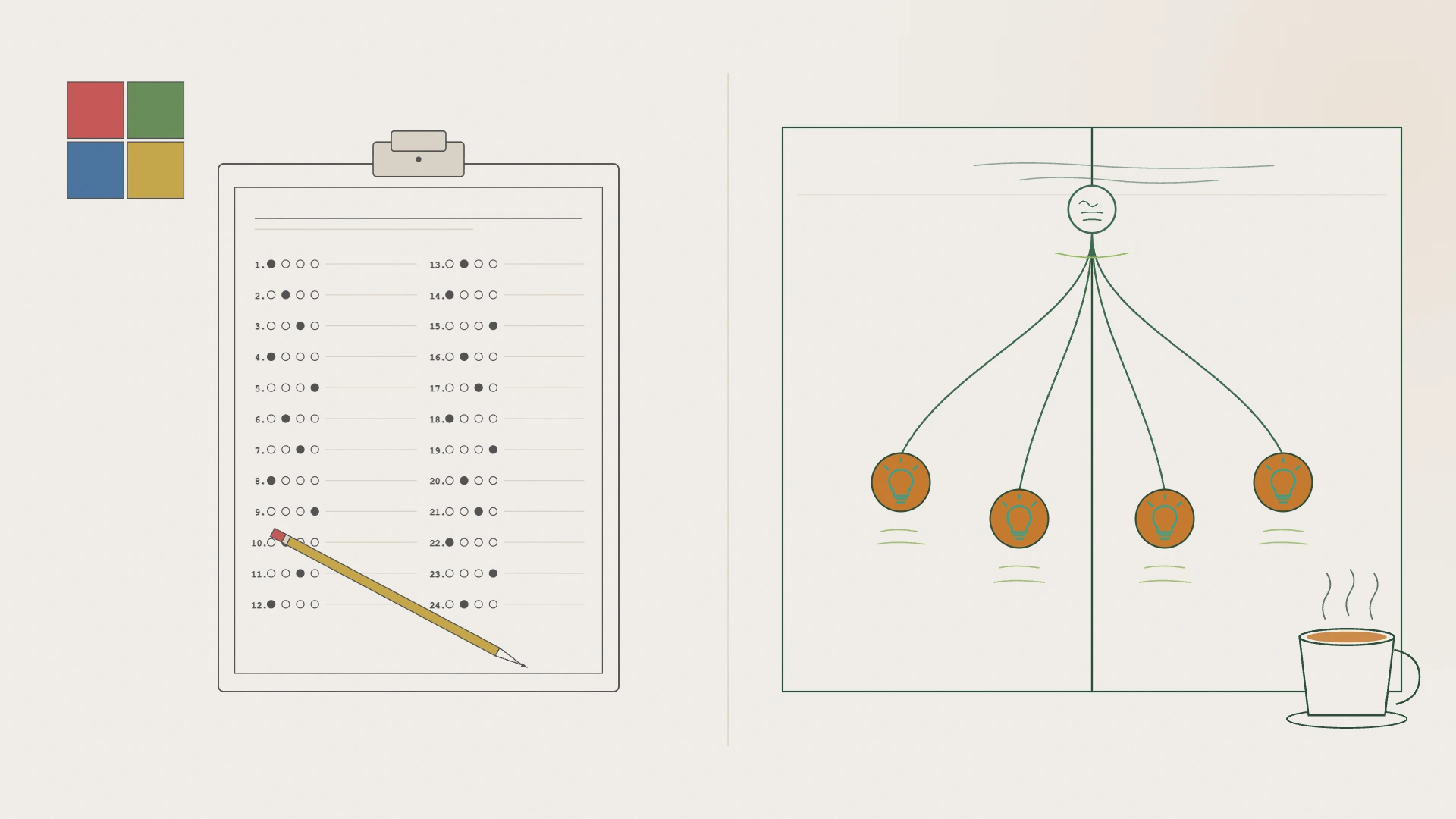
The Princeton Review career quiz now asks 30 questions and shows a free 3-letter interest code. The career list needs an account with your phone number. Old colors explained.

Sokanu is now CareerExplorer. An honest review: the free test, its Big 5 + Holland Code base, the 60-90 minute reality, and its overly literal matching.

How to find your passion (and your career passion when you already have a job): a science-backed pattern method, a 20-archetype system, and a 7-day in-job audit.
The quiz maps your childhood patterns and flow triggers to one of 20 archetypes, then surfaces detailed career matches with fit scores.
Take the Free Career Quiz