
Jobs for Former Teachers: 12 Roles, Remote and EdTech (2026)
12 jobs for former teachers with BLS pay, the remote and edtech roles that hire ex-teachers, and O*NET data on which exits keep the part of teaching you liked.


Contents · 10 sections
The best jobs for former teachers reuse what you already do every day, and most of them pay above the classroom median in current Bureau of Labor Statistics data. The harder question is which one you will still want in three years, because leaving teaching for a role with the same drain and a new title is the most common way this goes wrong. These twelve roles hire ex-teachers again and again, and several are routinely advertised as remote:
- Instructional designer or curriculum developer: lesson design, sequencing and assessment, pointed at adults or at a product, and the closest one-to-one match.
- Corporate trainer or L&D specialist: delivering instruction and reading a room, for a company's employees.
- Training and development manager: where L&D goes after a few years, running the training function.
- Technical writer: explaining complex material to people who have not met it yet.
- Project management specialist: planning a term and running deadlines, renamed for a business.
- Human resources specialist: coaching, difficult conversations and people development.
- Academic advisor or school counselor: guiding students through choices, though counseling roles usually need a master's.
- Adult education or ESL instructor: teaching adults, and one of O*NET's listed related occupations for secondary teachers.
- Tutor, online or in person: the same teaching one student at a time, usually for less pay.
- Customer success or implementation specialist (edtech): training schools on a product and keeping them using it.
- Assessment and test item writer: writing questions that measure what was taught, often sold per project.
- Education sales and partnerships: selling to schools you understand from the inside.
The best jobs for former teachers, with verified pay
This guide gives you those twelve roles with verified pay, a section each on remote work and edtech, and what teachers themselves say about where they would look, from a Pew Research Center survey of 2,531 public school teachers. Then it uses O*NET's interest codes to show which exits keep the part of teaching you liked, which is the part most job lists never address.
Each role reuses a specific part of the teaching job. Where the Bureau of Labor Statistics tracks the occupation directly, the table below shows current pay against the high school teacher baseline in the first row, including the 25th to 75th percentile span, since a single median hides how wide some of these roles pay.
| Role | 25th percentile | Median | 75th percentile | What carries over from teaching |
|---|---|---|---|---|
| High school teacher (your baseline) | $59,980 | $72,040 | $92,570 | The comparison point for every row below |
| Instructional designer / curriculum developer | $60,780 | $77,440 | $98,820 | Lesson design, sequencing, assessment, for adults or for products |
| Corporate trainer / L&D specialist | $50,110 | $69,280 | $95,050 | Delivering instruction, reading a room, coaching |
| Training and development manager | $101,850 | $133,000 | $176,870 | Where L&D goes after a few years; runs the training function |
| Technical writer | $70,880 | $90,390 | $115,510 | Explaining complex material to people who have not met it yet |
| Project management specialist | $78,440 | $102,320 | $133,100 | Planning a term, running deadlines, juggling competing demands |
| Human resources specialist | $58,610 | $75,940 | $99,380 | Coaching, difficult conversations, people development |
| Academic advisor / school counselor | $51,270 | $64,330 | $82,870 | Guiding students through choices; counseling roles usually need a master's |
| Adult education / ESL instructor | $49,100 | $61,540 | $77,690 | Teaching adults; O*NET lists it among the closest related occupations |
| Tutor (online or in person) | $35,000 | $43,350 | $54,860 | The same teaching, one student at a time; usually pays below the classroom |
| Customer success / implementation (edtech) | No single BLS occupation | Training schools on a product and keeping them using it | ||
| Assessment and test item writer | No single BLS occupation | Writing questions that measure what was taught | ||
| Education sales and partnerships | No single BLS occupation | Selling to schools you understand from the inside | ||
Annual wages from the U.S. Bureau of Labor Statistics Occupational Employment and Wage Statistics program, May 2025 release. Half of workers in a role earn more than the median; the 25th to 75th percentile span shows how wide the role pays. To see where your current salary sits in your own occupation, use the free salary benchmark.
Instructional design is the closest match on the list: the work is the one you already know, lesson design and assessment, pointed at adults inside a company or at a product instead of a syllabus. Training and development specialists are the other close match, and the manager row above shows where that track goes once you run the function rather than deliver sessions. The tutoring row is there for honesty. It is the easiest move and the one most likely to cost you money.
Three rows have no BLS occupation because the job titles sit across several codes. Treat any single salary figure you see for them online as one employer's number.
Remote jobs for former teachers
The roles most often advertised as remote share one trait: the output is a file or a call, so nobody needs you in a building. From the list above, that means instructional designer (often posted as learning experience designer), curriculum writer, assessment and test item writer, technical writer, online tutor, and customer success or implementation specialist at an edtech company.
How to find them without wasting evenings:
- Search the exact titles with a remote filter. Recruiters rarely write "jobs for former teachers" in a posting; they write "instructional designer, remote".
- Target remote-first employers. A hybrid posting two states away is not a remote job, and filtering those out early saves most of the frustration.
- Lead with the portfolio. A remote posting is open to applicants from every state, so one finished sample, a short e-learning module or a rewritten help article, does more than a longer CV.
- Consider contract work first. Curriculum writing and item writing are often sold per project, which lets you test the work over a summer while still under contract at school.
The trade-off worth naming: remote roles give you back your commute and your evenings, and they take away the room full of people. Many teachers find the social half of the job was the part they liked most, which the O*NET section below makes visible.
EdTech jobs for former teachers
Education technology companies hire former teachers because a teacher knows what a vendor cannot learn from a slide deck: how a school adopts a tool, which features a tired teacher will use in week six, and why most tools get abandoned. The roles fall into five groups:
| EdTech role | What you do | Why a teacher has the edge |
|---|---|---|
| Customer success / educational success | Keep schools using the product and renewing | You know what a struggling adopter looks like |
| Implementation and onboarding | Train school staff to set the product up | It is professional development, delivered to colleagues |
| Curriculum and content | Write the lessons and questions the product teaches | Standards, sequencing and assessment are your daily work |
| Sales and partnerships | Sell to schools and districts | You speak the buyer's language and know their calendar |
| Support and training | Answer teachers' questions, run webinars | Explaining under time pressure is the job you already do |
Customer success and implementation are the easiest edtech roles to argue for, because the skills transfer almost without translation. Curriculum roles draw heavy competition, since they are the obvious first application for most teachers leaving the classroom.
Jobs for former teachers outside of education
Inside or outside education is the first fork, and the teachers most likely to leave lean outward. In Pew Research Center's survey of public K-12 teachers, conducted in late 2023, those who said they were at least somewhat likely to look for a new job were asked where they would look:
| Answer | Share |
|---|---|
| A job outside education | 40% |
| A non-teaching job in education | 29% |
| Teaching at another public K-12 school | 18% |
Outside education, four exits hold up best: technical writing, project management, human resources, and corporate learning and development, where training a sales team replaces teaching a class. The pay table above covers all four. Each asks you to rename experience you already have: "planned and delivered a year-long curriculum for 120 students across five sections" is a project plan with stakeholders, deadlines and a measurable outcome, written in a vocabulary a hiring manager outside schools does not yet recognise. Before settling on HR, read what people leaving human resources report about the daily conflict the role carries, since that is often the part a teacher is trying to leave.
Which exits keep the part of teaching you liked
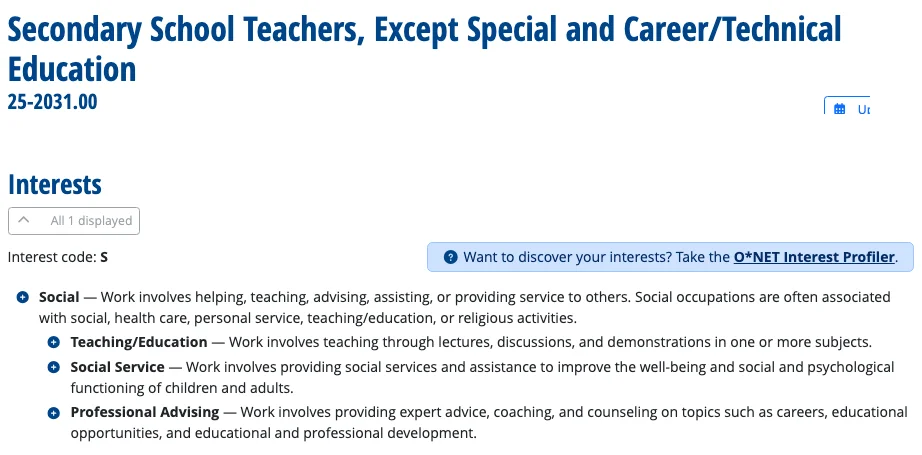
Here is the question job lists skip. The U.S. Department of Labor's O*NET database gives every occupation an interest code built on John Holland's six RIASEC types, and it gives secondary school teaching a single letter: S, for Social. The exits sit at different distances from that corner.
| Letter | Type | Core interests |
|---|---|---|
| R | Realistic | Hands-on work: tools, machines, the physical world |
| I | Investigative | Research, analysis, working with ideas |
| A | Artistic | Design, writing, performance, open ends |
| S | Social | Teaching, care, service to people |
| E | Enterprising | Leading, selling, starting things |
| C | Conventional | Systems, data, order, getting details right |
The hexagonal model comes from John Holland’s theory of vocational choice (1959), the framework underneath the U.S. Department of Labor’s O*NET database.
| Occupation (O*NET) | Interest code | How far from teaching |
|---|---|---|
| Secondary school teachers | S | The starting point |
| Training and development specialists | SI | Closest: Social first, adds analysis |
| Instructional coordinators | SEI | Social first, adds leading and research |
| Human resources specialists | ECS | Social drops to third, business moves first |
| Project management specialists | EC | No Social letter: coordination and business |
| Technical writers | CAI | Furthest: systems and writing, no Social letter |
Read the table against why you are leaving. If the people were the part you loved and the system was the problem, training and instructional design keep the Social core and change the conditions around it. If the people were what drained you, a C- or E-led role like technical writing or project management moves you away from constant interaction on purpose. The code is a map of where attention goes each day, and choosing an exit that sits on the opposite side of the hexagon from what energises you is how a former teacher ends up leaving a second job. For the skills side of the same decision, the guide to transferable skills at mid-career shows how to name them for a hiring manager.
Before you apply: is it the job or the career?
Name the problem first, because it changes the answer. The same Pew survey found that teachers describe the job this way:
| Answer | Share |
|---|---|
| Job is frequently stressful | 77% |
| Their school is understaffed | 70% |
| Job is overwhelming | 68% |
| Would not advise a young person to teach | 52% |
| Satisfied with their pay | 15% |
Question 1
Would a different school, subject or year group fix what is wrong?
Yes: It is a job problem. Try a move inside education first: another school, or the edtech and advising roles above.
No: Go to the next question.
Question 2
Were the students and colleagues the part you liked most?
Yes: Keep the Social core: instructional design, corporate training, L&D or adult education.
No: Move away from constant interaction: technical writing, project management or another C- or E-led role.
The first question separates a job problem from a career problem. The second uses the O*NET interest codes above to pick the exit.
The test is short. If a different school, subject or year group would fix it, you have a job problem, and a move inside education, including the edtech and advising roles above, may be enough. If the constraints are structural, the pay curve, the load, the lack of control over your own day, then they follow you to every school, and an exit is the right call. If the stress itself is the push, the O*NET data on jobs with less deadline and error pressure that still pay well shows which exits carry less of it. Pew also found 56% of teachers still find the work fulfilling often or extremely often, which is why the decision feels so hard: the work and the conditions are pulling in opposite directions.
Which one fits you
A list of twelve roles tells you what is possible. It says nothing about which of them will hold your interest after the first year. That depends on two things a salary table cannot see: what is pushing you out now, and what you want the next role to give you.
This is the gap career change quiz is built for. Two of its 26 questions do most of the work: one asks when you completely lose track of time, the other what you would get up for if money were settled. It combines those with your current struggle and priority to place you in one of 20 archetypes. A burned-out teacher who wants stability reads differently from one who wants creative control, even with an identical CV, and the matched careers follow from that. The Strategic Shifter and the Freedom Seeker, for example, both leave the classroom, and they rarely want the same role.
What experienced career changers want next is less about title than you might expect. In the Career Changer Index, quiz takers with four or more years of experience put flexible or remote work they enjoy first for the next six months, well ahead of earning more, which is the same pull that sends so many teachers toward the remote and edtech roles above.
| Answer | Share |
|---|---|
| Flexible or remote work they enjoy | 41.7% |
| Passion projects part-time | 24.7% |
| Earn more, even if it means grinding | 17.5% |
| Any stable job to get started | 16.1% |

How to make the switch
Once the direction is set, the mechanics are the same across every role on this page:
- Pick one target role. "Something in tech" gives you nothing to act on; "instructional designer at a mid-size software company" tells you which portfolio piece to build and which people to contact.
- Translate your experience into that role's language. Rewrite your CV and LinkedIn so a hiring manager sees the job they are filling. Curriculum design becomes learning design; parent conferences become stakeholder management. If an application comes back marked "overqualified", the guide on being told you are overqualified shows what trimming your CV to apply down tends to cost.
- Build one piece of proof. An e-learning module, a documented project plan, two writing samples. One finished artifact carries more weight than a paragraph of claims.
- Add a certification only if postings ask for it. Read twenty job ads for your target role and count how many name a credential. That count decides it.
- Talk to people already doing it. Referrals move many of these hires, and a twenty-minute conversation also tells you what the day looks like, which no job ad does.
- Use the calendar. Teaching gives you a summer. Contract curriculum work or a short trial project in June and July tests a direction before you resign.
Expect the search to take a few months. Timing the move to the end of a school year gives it a natural deadline and a clean notice date.
The guilt, and what to do with it
Salary tables and skills maps both miss this part. For many teachers the job is an identity, and leaving feels like abandoning students. That guilt keeps good people in roles that are wearing them down.
The years in the classroom stay with you. The students you helped were helped, and the skills that did it go with you into the next role. Choosing work you can sustain is what makes the next decade possible. When the decision is made, the free resignation letter generator turns it into a clean letter your school can file, notice date included.
Where to start
If you are still deciding whether to leave at all, the career change guide covers the general sequence from naming the driver to testing a direction. The cross-field version of this shortlist, sorted by what you want the move to give you, is in best jobs for career changers. Teaching is one of three professions where the credential itself starts to feel wasted; the other two are covered in career change from nursing and career change from law.
If you already know you are leaving and the open question is where to, start with fit. The quiz takes a median of 6 minutes 53 seconds, and it returns your archetype, matched careers with fit scores, and the directions that most often pull teachers back into the same burnout under a new title. More than 15,000 people have taken it so far.
You spent years helping other people work out what they are capable of. This is the part where you do it for yourself.
Frequently Asked Questions
Ready to find your passion career?
The free under-10-minute quiz maps your childhood patterns and flow triggers to one of 20 archetypes, then gives you matched careers and a 7-day first-step plan.
Take the Free Career QuizRelated Articles
Trusted by 15,000+ career-quiz takers across 168+ countries · Methods covered in