
Apt AI Career Test Review (2026): Is It Worth $30 a Month?
Apt AI costs $9.99 to $29.99 a month, shown only after a 34-question chat. We took it to the paywall and read all 200 recent Trustpilot reviews.


Contents · 16 sections
Apt AI costs $9.99 a month on the annual plan its paywall preselects (charged as $119.88 up front), $19.99 a month quarterly, or $29.99 month to month, and you see those prices only after a 34-question chat. The free preview gives you personality types; the career list is locked. The subscription bundles the test with an AI career coach, a résumé tool, LinkedIn help, interview prep and a job board. If you are mid-application and want that workflow in one place, the bundle can earn its price. If you want a career assessment once, you are buying a subscription to get a one-off, and the refund terms are the part to read first.
On reviews, one number explains most of what you will find online. On Trustpilot, the reviews Apt invited average 4.67 stars; the ones people wrote without being asked average 1.60.
The science is the weaker half. Apt markets itself with two numbers that are hard to verify: 100 billion data points and 1.8 trillion data points, both live on the marketing pages as of July 2026 without methodology to back either figure. An "89% accuracy" figure circulated in earlier marketing and still appears in third-party reviews, but no longer appears on the main pages.
So I took the test up to the paywall (twice now, most recently on 25 September 2026), read every methodology page Apt makes public, tallied the 200 most recent Trustpilot reviews by how they were collected, examined the top organic search results for "apt ai career test reviews," and compared the product to the alternative I know best.
A note on framing. I am the founder of MyPassionAI, the comparison product in this review. I gave Apt close attention, named its load-bearing strengths, and kept every claim to what you can verify in Apt's own pages or in independent third-party material. Where a claim could not be verified, I labelled it as a marketing claim rather than a fact.
TL;DR comparison
| Dimension | Apt AI Career Test | MyPassionAI |
|---|---|---|
| Founded | Apt AI (tryapt.ai), team and founding date not prominently disclosed on the marketing pages | 2025 by Marco Kohns |
| Users (publisher claim) | "Trusted by 1,000,000+ people" (homepage); "Join 50 million+ people" (same paywall) | Smaller: 6,837 responses across 156 countries in our published research dataset |
| Questions | 34 open-ended questions in a chat, typed answers (our run, 25 Sep 2026) | 26, branching (situational, set by your opening answer) |
| What it measures | Results screens name Holland Code, Enneagram, Big Five, Myers-Briggs and DiSC, inferred from the chat | Struggle type, priority type, flow markers, values |
| Time to complete | Advertised as 10 minutes; several Trustpilot reviewers describe about an hour | under 10 minutes |
| Commercial model | Subscription bundle (test plus coach plus resume plus LinkedIn plus job board) | One-off purchases, no subscription: free archetype, a paid report, and the Career Switch Kit |
| Pricing transparency | Prices shown only on the paywall after the chat: $9.99, $19.99 or $29.99 a month by plan length | Free archetype, current full report price at mypassion.ai/pricing |
| Bundled features | AI career coach, resume generator, LinkedIn tools, interview prep, job board with daily updates | Career Switch Kit: experience translated for the new field, CV rewritten for the matched path, LinkedIn headline and About, 10 outreach messages, a 4-week plan, unlimited AI coach. No job board, no interview prep |
| Methodology transparency | Frameworks named, no published method or validation; volume claims ("1.8 trillion data points") | Four signals named, 5x4 matrix structure documented |
| Best for | Job seekers about to apply who want the assessment-plus-job-search bundle in one subscription | People changing careers who want the direction and the switch materials, paid for once |
Everything below is the work behind that table.
What the Apt AI career test is
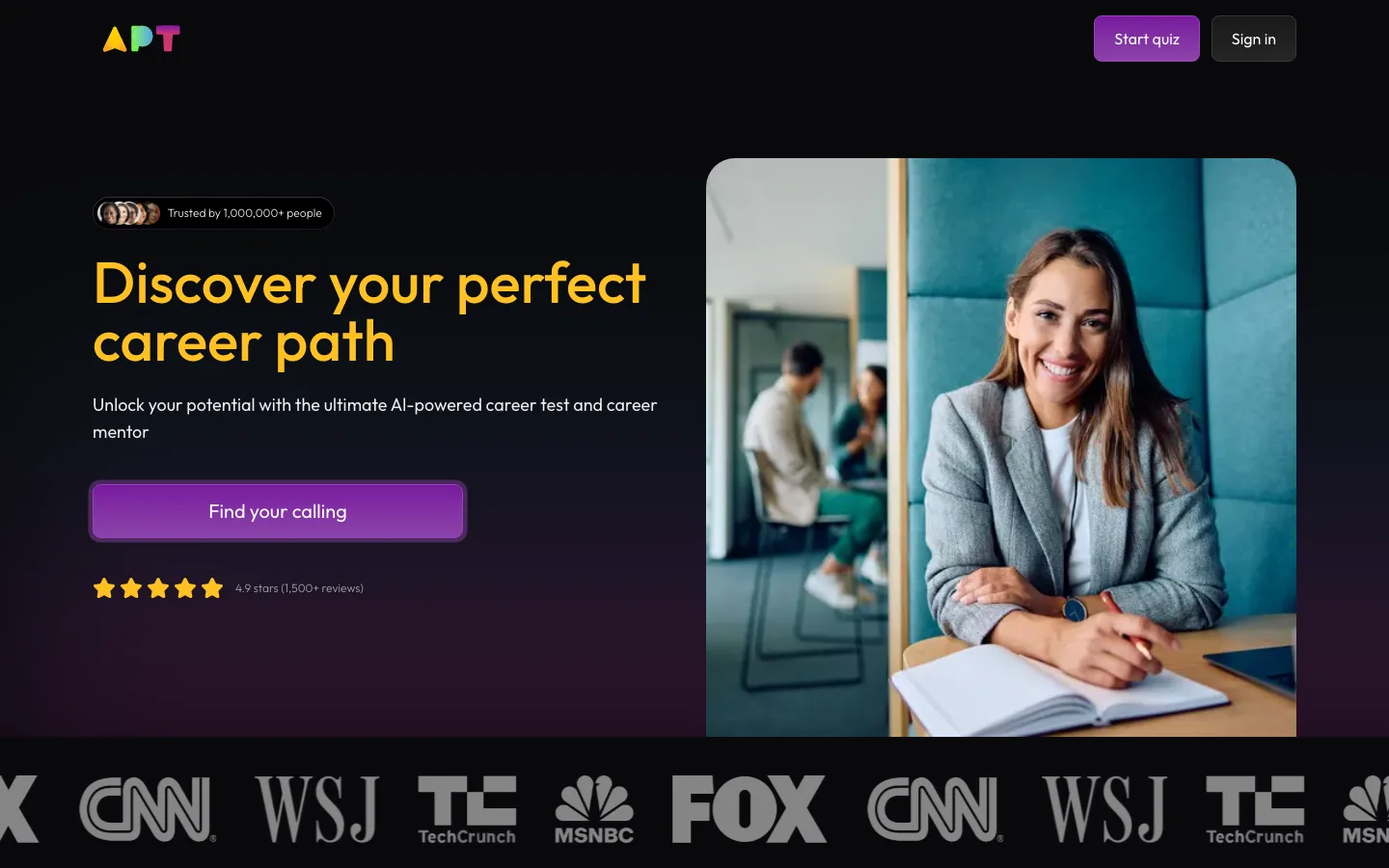
Apt is a consumer AI career-assessment product operating at tryapt.ai. The marketing pages report more than one million users, lead with the hero promise "Discover your perfect career path," frame the product as an AI-powered career test and career mentor in one, and surface a single primary CTA across the site ("Take the career test").
The instrument. Apt advertises "1 test, 10 minutes." When I took it on 25 September 2026 it was a chat: 34 open-ended questions, each answered by typing a sentence, with a progress bar across the top. The questions mix situational prompts ("you finally get a free Saturday: friends and plans, or quiet?") with practical ones (your city, your salary floor, remote or office). Two of them ask for your email and your first name, and both can be skipped. The chat format is engaging, and it is not 10 minutes of multiple choice. Several Trustpilot reviewers describe it as closer to an hour.
The framework. The marketing pages still speak of "proven personality and aptitude science" without naming instruments. The product itself now does. The loading screen after the chat draws a radar with five labelled points: Holland Code, Enneagram, Big Five, Myers-Briggs and DiSC. The free preview then returns Big Five percentages for all five traits, a Myers-Briggs type, an Enneagram type and a DiSC profile.
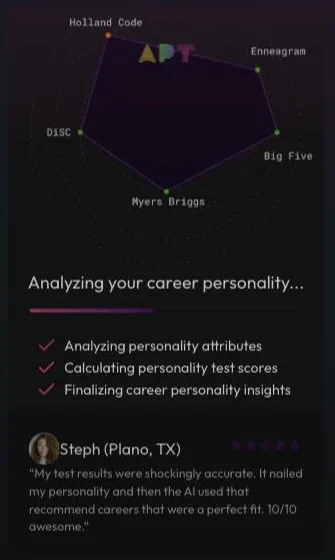
What Apt still does not publish is how it gets from 34 free-text answers to a Big Five percentage or a Myers-Briggs letter. Truity scores Big Five and Holland Code from a fixed questionnaire and says so on its product pages, and CareerExplorer / Sokanu does the same for RIASEC plus Big Five on its methodology page.
The volume language. Apt's accuracy framing leans heavily on data-point counts rather than psychometric validation. The marketing pages reference "100 billion data points" in one place and "1.8 trillion data points" in another (both re-verified on the live pages in July 2026); an "89% accuracy in predicting career satisfaction" figure attributed to follow-up studies circulated in earlier marketing and third-party reviews, though it no longer appears on the main pages. None of those numbers links to a published methodology, sample design, or follow-up study you can read.
This matters because consumer career tests sit on a credibility spectrum. At one end are instruments with named, validated frameworks and traceable test-retest reliability (Big Five, Holland Code). At the other end are marketing-shaped products that talk about accuracy through volume metrics. Apt's public-facing science is closer to the second end.
The bundle. Apt is not just a career test. The subscription includes an AI career coach with "24/7 guidance," a Job Opening Finder, salary coaching, interview prep, a resume generator, LinkedIn tools, career-exploration content, and a job board with daily updates. The career test is the entry point; the rest of the product is what the subscription pays for.
The pricing. The homepage shows no price. The prices appear on the paywall once the chat ends, and the next section shows exactly what is on it.
What Apt shows you before you pay
I took the test to the payment screen on 25 September 2026 and stopped there. This is everything Apt showed, in the order it showed it.
How much does Apt AI cost? Three plans, all quoted per month: $9.99 on the annual plan, $19.99 on the quarterly plan, and $29.99 month to month. The annual plan is ticked when the page loads and carries the "Most popular" label. The paywall never prints its total; the Stripe checkout behind it does: $119.88 due today, billed annually.
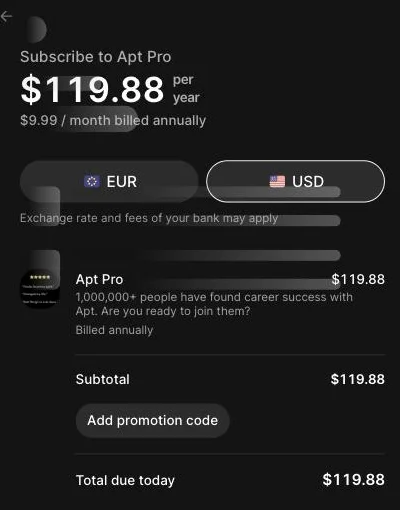
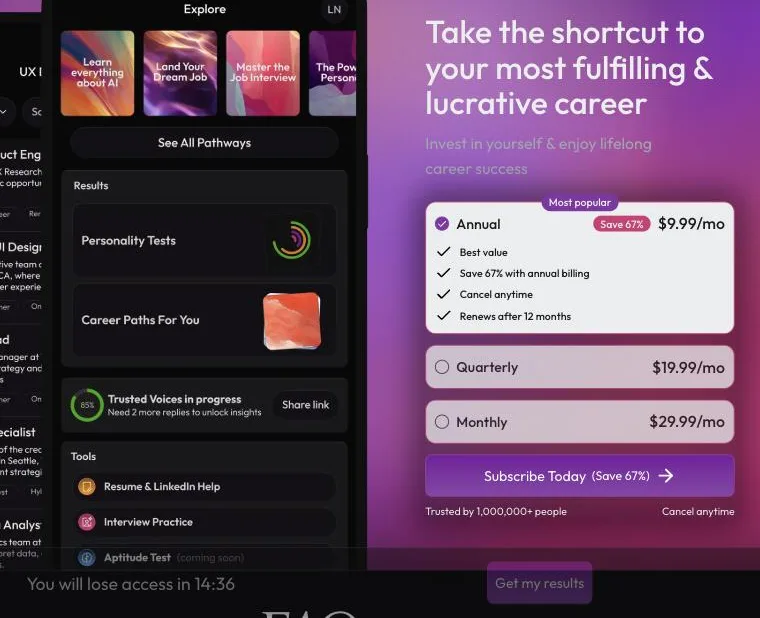
Is Apt AI free? The test is, and so is a preview. You get the personality read (Big Five percentages, Myers-Briggs, Enneagram, DiSC), two career titles teased in a headline, and five local job listings with a match percentage. The ranked career list, which is the thing most people take a career test for, is locked.
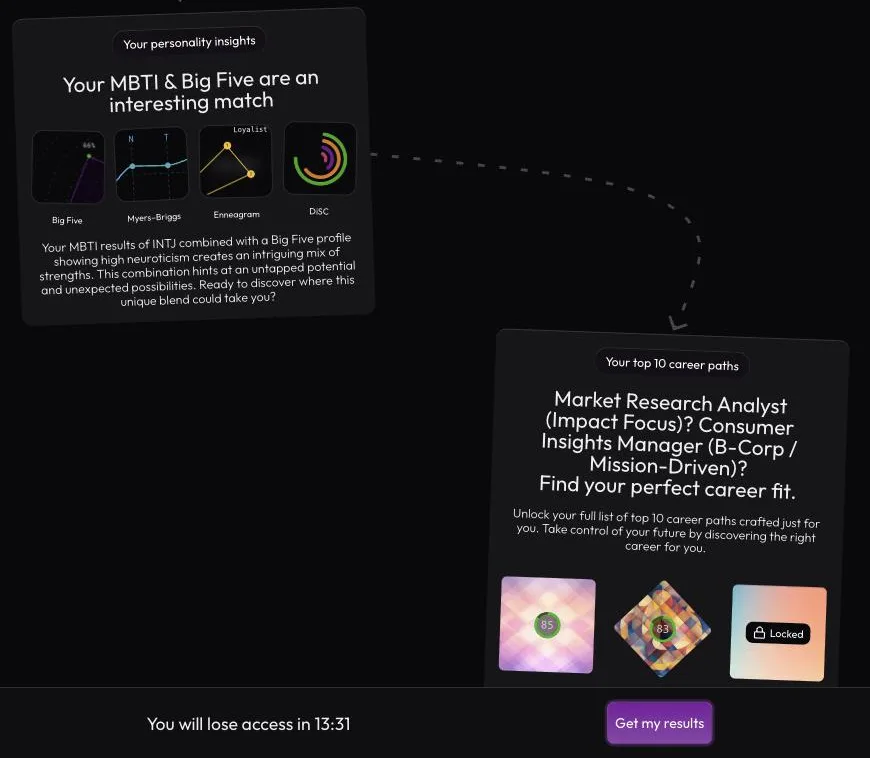
Is there an Apt AI promo code? The Stripe checkout has an "Add promotion code" field, so codes exist, but Apt publishes none that we could find. The "2026 Sale, save up to 67% off" banner is not a code: it is the annual plan measured against the monthly one ($9.99 against $29.99), the ordinary difference between plans.
Can you get a refund? Apt's terms say subscription fees are non-refundable except where the law requires, with refunds granted case by case at the company's discretion, and plans renew automatically on the same terms. That clause matters more than any feature, because refunds are the most repeated complaint in the reviews below.
What Apt AI reviews say when Apt did not ask for them
Search "apt ai reviews" and you meet two kinds of source: affiliate sites (covered further down) and Trustpilot. Trustpilot is the useful one, but only once you split it. Each review there carries a label for how it was collected, and Apt's reviews fall into two groups that barely overlap.
The split is the finding. The 132 reviews Apt invited average 4.67 stars. The 68 written by people who went to Trustpilot on their own average 1.60. Inviting customers to review is normal and allowed. It also means the headline TrustScore blends two different populations: people Apt chose to ask, and people with a problem to report.
Read side by side, both groups are describing the same product. The praise is about self-insight and the résumé tools, which matches what the bundle is built for. The complaints are mostly about money: refunds, cancellation, and a price that appears only after the questionnaire. Nine low-rated reviewers say they could not log in or see their results after paying, which is the one complaint about the software itself.
One more check worth making: the "4.9 stars (1,500+ reviews)" on Apt's homepage names no platform, and there is no Apt app in the US App Store for it to come from.
The methodology gap: marketing science versus published psychometrics
This is the part of the review that matters most, and it is the part the affiliate-driven reviews largely refuse to discuss.
When a consumer career test markets itself with phrases like "100 billion data points" and "1.8 trillion data points," the implicit promise is that volume equals accuracy. The more data, the better the prediction. That intuition is correct in some machine-learning contexts and wrong in psychometric ones. A career-fit prediction is only as good as the construct it is measuring, the validity of the instrument that measures the construct, and the test-retest reliability of the result. None of those properties improve with data-point count alone, and all of them require a published methodology to evaluate.
Compare Apt's marketing with the methodology language used by competitors that do show their work:
- Truity names Big Five plus Holland Code, links to the academic literature, and reports its instrument is 94 Likert-scale questions.
- CareerExplorer / Sokanu names RIASEC plus Big Five and publishes the question count and the time commitment.
- The Strong Interest Inventory (a clinical instrument used by counsellors) publishes its underlying interest theory, its psychometric validation, and its norm groups.
Apt's results screens now name the five instruments: Myers-Briggs, Big Five, Enneagram, DiSC and Holland Code. What they do not do is administer them. Each of those frameworks is normally scored from its own fixed questionnaire; the Truity Career Personality Profiler needs 10 to 15 minutes of Likert items for Big Five plus Holland Code alone. Apt reads all five from one conversation of 34 typed answers. A language model can pick up personality signals from free text, but reproducing five validated scales from one chat would be a result worth publishing, and Apt publishes nothing on it.
The conservative read is that the five labels are an AI's interpretation of your chat, presented in familiar framework vocabulary, then fed into a recommendation engine that personalises the output. That is a defensible product design. It is not "five validated frameworks at psychometric depth."
If the named framework matters for your purpose (you are a career counsellor needing a defensible instrument, you are an HR practitioner buying a tool with documented methodology, or you simply prefer to read what is under the hood), Apt's transparency is materially weaker than Truity's or CareerExplorer's. If named frameworks do not matter and what you want is fast career suggestions plus a job board and interview prep, the methodology gap may not be the right reason to skip Apt.
The subscription model versus the one-off
This is the second structural difference, and it changes who Apt is the right answer for.
Most consumer career tests are one-off purchases. You pay $19 to $49 once, get a result (a 36-page PDF, a ranked career list, a detailed archetype reading), and the product transaction ends there. The career test is a piece of decision input you keep on file.
Apt is structured as a subscription. The career test is the lead magnet that opens the door to a monthly product (AI coach plus resume tool plus job board). The natural cadence is days and weeks of active use, not a single sitting. The financial commitment is recurring, and the value calculation depends on whether you keep using the bundled tools after you finish the test.
This is not a worse model. It is a different model. The right read is:
If you are actively job-hunting, the subscription bundle has reasonable unit economics. A month or two at $29.99 buys the test, the AI coach, the resume and LinkedIn help, and the job board concurrently. If those tools materially shorten your search, the subscription pays for itself in time saved.
If you are not job-hunting and only want the career test, the subscription is the wrong shape of purchase. You are paying for a job board you will not use, a resume tool you do not need, and an AI coach for a question that is more about direction than tactics. A one-off career assessment that returns the same kind of result is cheaper for that specific purpose.
Put the two models on the same axis and the decision stops being about which product is better and starts being about how long you intend to keep paying.
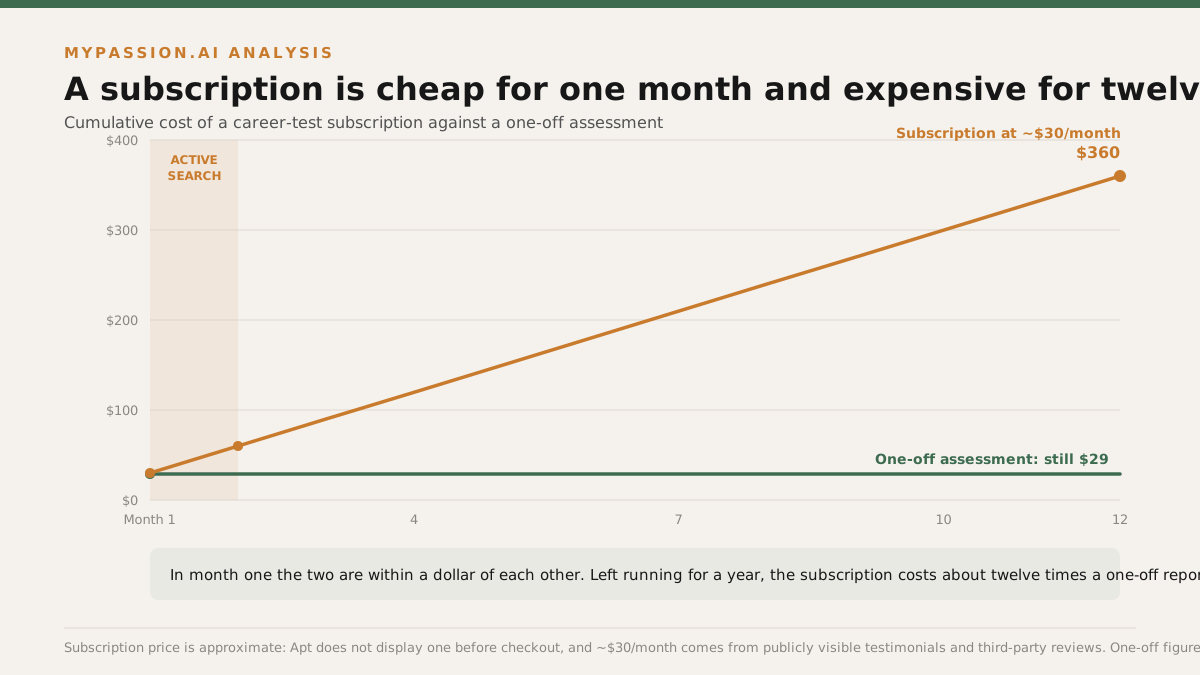
In month one, the two are within a dollar of each other, which is exactly why the bundle is defensible for someone about to apply. Left running for a year, the same subscription costs roughly twelve times a one-off report, for tools most people stop opening after the search ends. The number to be honest about is not the monthly price, it is how many months you will actually use it.
The annual plan changes that arithmetic. At $9.99 a month it is the cheapest per month, and it is the one the paywall preselects, but the checkout takes $119.88 at once and the terms make fees non-refundable. Seven of the 63 low-rated Trustpilot reviews describe an annual or unexpected charge, and twenty describe trouble cancelling. The friction is the gap between "I just want the career test" and "I just bought a subscription that auto-renews." Check which plan is ticked before you pay.
The bundled-product question
A second framing worth pulling out: Apt is not primarily competing with single-shot career assessments. It is competing with the unbundled stack of a career test plus a resume tool plus LinkedIn optimisation plus an AI career coach plus a job board.
The legitimate question Apt's product design forces is: "Do I want all of these things in one subscription, or do I want to buy each piece from the best-in-class option?"
The unbundled stack might look like: Truity for the assessment ($29 one-off), a resume tool from a specialised vendor or a free template, LinkedIn directly, an AI coach from a free or low-cost chatbot, and LinkedIn or Indeed for the job board. Total upfront cost: $29 plus the time to integrate the pieces yourself. If the LinkedIn piece is the part you want, our free LinkedIn headline generator does that one job without a subscription.
Apt's bundle compresses that into one subscription at $9.99 to $29.99 a month depending on the plan length. For users who value the integration and are about to apply for jobs anyway, that bundle is a defensible buy. For users who specifically want a credentialed career assessment and not the rest of the stack, Apt is the wrong shape of product.
This is not a failure of Apt's design. It is the design. The question is whether the design matches what you are buying for.
The search-results problem: why most Apt reviews are affiliates
A pattern worth naming, because it is hard to spot from the Google results alone.
The top Google result for "apt ai career test reviews" is a single-author review site that ranks Apt as the number one career test of 2025. The author discloses, in the opening paragraphs of the page, an affiliate relationship with tryapt.ai (the disclosure appears twice). The review lists Apt's strengths in detail. It lists no weaknesses. The author has no formal counselling or psychometric credentials; the authority cited is "personal experience testing 50+ career assessments over one year."
This is not a unique pattern to Apt. It is the dominant economics of consumer-product review content on the public internet. A site ranks an affiliate-partnered product first, the partnership pays the site a commission for every signup, and the review's job becomes capturing the click rather than informing the reader. The user reading the review usually cannot tell whether they are reading an independent assessment or a paid affiliate placement.
The right defensive read: when you encounter a strongly positive review of any consumer career test, scroll to the disclosure section. Most affiliate sites disclose because the FTC requires them to. The disclosure language is usually short and easy to miss ("I am an affiliate of X" or "this post contains affiliate links"). If you find it, the review's structure (no weaknesses, top ranking, strong CTA) is the affiliate format, not the editorial format.
Independent reviews of Apt do exist, but they are harder to find because they do not rank as well. Trustpilot is the most direct source, with one caveat covered above: filter to the reviews Apt did not invite, because the invited ones average three stars higher.
I bought the worse end of this market before I built anything
There is a tier below Apt that deserves a direct warning, because I paid for it myself, in full, before MyPassionAI existed.
Apt is a working product with a subscription I have caveats about. The funnels I mean are a different animal: ad-driven career-and-personality quizzes that hide your result behind a small "7-day access" charge of around €1.95, then auto-renew at roughly €30 to €48 every four weeks if you do not cancel inside the window. I bought and used the full product on three of them, yourselfirst.com, blossomup.co, and personality.co, back when I was the customer rather than a founder. Their Trustpilot pages now carry thousands of reviews from people who missed the cancellation window and found an unexpected €45.99 or a $50 charge on their statement a week later. If you are mid-way through one of those funnels right now, our breakdown of whether personality.co is legit, and how to cancel it, has the billing math and the cancellation route.
I did not just hit the paywall and leave. I paid, I read every page of all three reports, and the product behind the funnel was the genuinely disappointing part. Recycled affirmations, advice generic enough to fit anyone, and nothing that read like it had looked at my answers. I had paid to be told things about myself I could have written in thirty seconds, wrapped in a checkout designed to keep charging me.
That experience is one of the reasons MyPassionAI exists. I did not build a career quiz because the category was empty. I built one because it was full of products that took money well and helped poorly, and someone should ship the honest version: a result you can read for free, a paid report that is a one-time purchase with no subscription and no auto-renew, and an output specific enough that it could only have come from your own answers. Whether I pulled that off is yours to judge, but the motivation was sitting on my own card statement.
So if your search has put any of those three in front of you, read the renewal terms and the Trustpilot reviews before you enter a card. Apt is not in that tier, and the rest of this review treats it on its own terms.
What the MyPassionAI career quiz is
A disclosure before this section: I am the founder of MyPassionAI, so the operator-level detail you are about to read comes from owning the code, and the bias that comes with that is unavoidable. The honest counter is to publish the comparison anyway, with verifiable claims and the unflattering bits about my own product included (the "What MyPassionAI gets uniquely wrong" section is below).
I launched MyPassionAI in late 2025 after a decade of optimising a career for the wrong target. The thesis of the product is state-dependent: career fit is not a stable function of personality alone. It is a function of where you are right now (current life stage and current struggle), what you want to optimise for next (priority type), and how the stable signals (flow, values) interact with both. Two people with similar personality profiles can need different careers if one is a 22-year-old graduate and the other is a 35-year-old burnt-out parent.
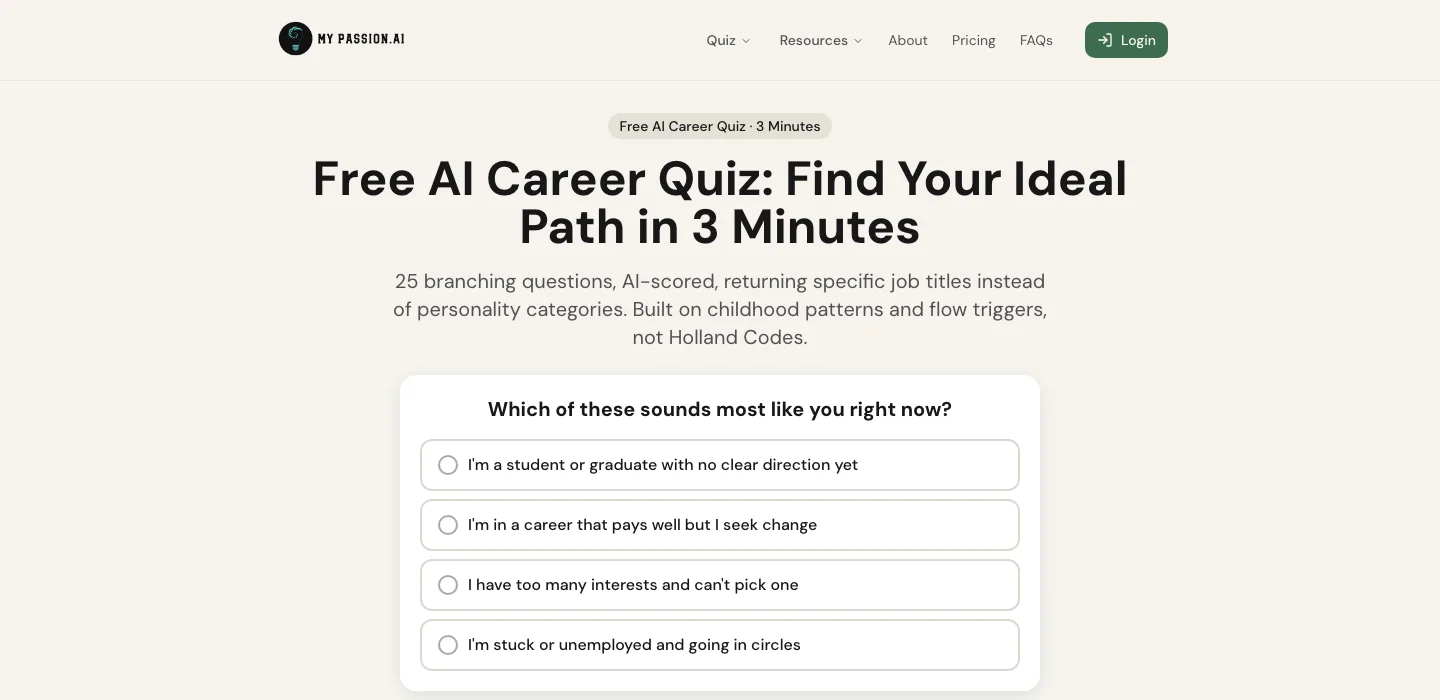
The instrument. 26 questions, branching from the opening question. The first question asks which of four statements best describes your current situation: a student or graduate with no direction, someone in a paying career who wants change, someone with too many interests, or someone stuck or unemployed. Your answer to that opening question decides what you see next. The branching is not cosmetic, because it changes the signal we extract from the early questions.
The framework. The output is one of 20 named archetypes produced by a 2D matrix: five struggle types on one axis, four priority types on the other. The archetype name encodes both what is currently hard and what you want next, and both axes are designed to change as your life changes.
What you need next →
| Income-Focused | Lifestyle Seeker | Stability First | Experimenter | |
|---|---|---|---|---|
| Career Switcher | Ambitious Pivoter | Freedom Seeker | Strategic Shifter | Curious Transformer |
| Grad Explorer | Rising Achiever | Modern Explorer | Foundation Builder | Open-Minded Starter |
| Multi-Passionate | Renaissance Earner | Creative Polymath | Focused Generalist | Passion Collector |
| Purpose Seeker | Impact Driver | Meaningful Creator | Mission Seeker | Values Explorer |
| Explorer | Emerging Achiever | Authentic Seeker | Grounded Explorer | Curious Adventurer |
↓ What is hardest right now
Highlighted: Career Switcher crossed with Income-Focused resolves to The Ambitious Pivoter. Source: the live MyPassion.ai archetype matrix.
That is the whole framework, published. It is a low bar, and it is the bar Apt's own pages do not clear.
What the quiz measures. Four signals are named explicitly on our methodology and in the test design: situational struggle (the branching opener), flow markers (when you lose track of time), values (what you would do if money were no object), and priority type. The flow framing draws on Csíkszentmihályi's foundational work on the psychology of optimal experience. The intrinsic-motivation framing draws on Self-Determination Theory.
The data behind it is published. Since the complaint above is that Apt markets accuracy without showing its work, it is only fair to hold this product to the same test. The Career Change Report 2026 publishes the full anonymised dataset behind our archetypes under CC BY 4.0, with the base for every figure and an explicit self-selection statement, and the career change statistics hub lists the citable numbers with their bases. The Career Changer Index breaks the same kind of data out for takers with four or more years of experience. You can check the claims rather than take them.
The commercial model. The free quiz returns your archetype and a personalised reading. The full report is a one-off payment with detailed career matches and fit scores. The Career Switch Kit, also a one-off payment, is the part that does the switching for you, built from your answers and your report's matches:
- your existing experience translated into the language of the new field, with a positioning statement you can use in any conversation about the move
- your CV rewritten for the matched path, using the tasks that occupation is defined by
- your LinkedIn headline and About section written, without announcing to your employer that you are leaving
- 10 outreach messages to people in the roles you are moving toward, plus where that work is concentrated
- your first four weeks planned in 10 to 20 minute moves
- an AI career coach that has read your results, unlimited
Current pricing at mypassion.ai/pricing. There is no subscription and nothing renews.
The structural difference with Apt is not that one has tools and the other does not. Both go past the test. Apt's tools serve an active job search (a job board, interview prep, résumés tailored per application) and charge monthly while you use them. The Kit serves the career change itself (translating your background, repositioning you, opening conversations in the new field) and charges once. That difference shows up in everything from the test design to the cancellation policy.
What Apt gets uniquely right
Honest section, because Apt does several things meaningfully better than most consumer career quizzes.
1. The bundle is genuinely useful for active job-seekers. If you are about to start applying, having the test, the AI coach, the resume tool, and the job board in one subscription saves the time and cognitive cost of stitching five separate tools together yourself. A bundle that removes that integration cost has obvious value.
2. The chat is genuinely engaging. The conversational format reflects your previous answer back before asking the next question, the interface is clean, and the design is at the top of the category. Positive reviewers single this out ("asked a lot of good questions"), and most psychometrically rigorous instruments are not built to this level of finish.
3. The AI career coach is a useful adjunct. A 24/7 AI coach that answers questions about specific roles, helps interpret your result, and gives application advice is a meaningfully different product than a static PDF report. The accuracy of the coach is constrained by the underlying language model, but the format is novel and the response is fast.
4. The user base is large enough to validate that the product runs. The one-million-users claim is a marketing number, but a million paying customers (even if half churn after one month) is a credible signal that the basic transactions work. The product is not vaporware.
5. Resume and LinkedIn tools are increasingly the bottleneck in applications. The bundle correctly identifies that the assessment is upstream of the actual job search, and the job-search tools are where most candidates spend the most time. Putting them under one roof is a defensible design choice even if the methodology behind the assessment piece is light.
What MyPassionAI gets uniquely wrong, honestly
1. No job board and no interview prep. The Career Switch Kit rewrites your CV and LinkedIn and writes your first outreach, but it does not list openings, tailor a résumé to each posting, or rehearse interviews with you. Apt does all three. If you are already in the application phase and want those tools in one place, Apt covers ground we do not.
2. Smaller user base, less marketing validation. Apt's one-million-users claim is larger than ours. If "lots of people use it" is a meaningful trust signal for you, Apt wins on that axis, and we earn that trust over time rather than today.
3. Newer framework, less longitudinal validation. Our struggle-priority matrix is informed by Self-Determination Theory, flow research, and our published research dataset (6,837 responses in the Career Change Report 2026). It has not been peer-reviewed. If you specifically want a peer-reviewed instrument with decades of validation, Truity (Big Five plus Holland Code) is the stronger choice over both of us.
4. We do not get you the job. The Kit writes the materials that decide whether you get read (how your background is described, how your profile reads, the first message). Applying and interviewing stay yours. Anyone promising more is selling something else, and that includes the job-placement language common in this category.
Who should take which
Take Apt if any of these apply:
- You are actively job-hunting in the next 30 to 60 days and want the test plus coach plus resume plus job board in one subscription
- You value the bundle and would otherwise stitch the same tools together yourself
- You are comfortable with a monthly subscription model and have read the cancellation policy
- You do not need the underlying psychometric frameworks named, and a fast personalised recommendation is enough for your purpose
- You want a consumer-grade interface and a sub-15-minute test
Take the MyPassionAI career quiz if any of these apply:
- You are making a direction decision (which career fits the version of you that exists today, given your current struggle and priority), not preparing for next month's job applications
- You want a state-dependent archetype reading, not a stable-personality snapshot
- You prefer a named methodology over volume marketing
- You want a one-off purchase, not a recurring subscription
- You have under 10 minutes and want the fastest version of a state-dependent career-fit reading
There is nothing stopping you from doing both. Take MyPassionAI first to establish the direction and, if you want the switch materials, the Career Switch Kit. If you then want a job board and interview prep during the application phase, a month of Apt's monthly plan covers that. The two do not collide; they are aimed at different stages of the same arc.
If neither fits
Six other Quiz Comparisons in the silo are worth a glance:
- The Truity career test review and comparison if you want a peer-reviewed methodology (Big Five plus Holland Code) and a $29 one-off 36-page report
- The Princeton Review career quiz comparison if you want a free, 5-minute, broad-strokes alternative for a high-school or early-college audience
- The Sokanu / CareerExplorer review if you want a RIASEC plus Big Five instrument with a 1,500+ career database and have 60 to 90 minutes available
- The MAPP career test review if you want a forced-choice motivation instrument rather than a Likert-scale or AI-driven one
- The JobTest.org review if you are weighing another AI-layered test, and want to know before you start that the questions are free and the results are not
- The Sparketype review if you want the work-you-are-wired-for framing rather than a scored instrument
If burnout is the immediate blocker for your decision, the burnout recovery diagnostic comes before any career-quiz signal can be trusted. If you are 30 or near it, the career change at 30 dataset is a closer read than any quiz comparison. The conceptual foundation for why state-dependent signal matters is in how to find your passion.
The bottom line
At $9.99 to $29.99 a month depending on the plan, Apt earns its price during an active job hunt and does not earn it otherwise. It is a working product with a clean interface, carrying the methodology transparency of a consumer marketing page rather than a psychometric instrument. The 34-question chat produces a free personality preview and, behind the paywall, personalised career suggestions; the AI coach answers questions in plain language; the resume, LinkedIn, and job-board tools are functional in the subscription flow. For a reader who is about to apply and wants that workflow in one place, the bundle has defensible value.
The honest caveats are structural and worth naming. Apt's marketing leans on volume language ("100 billion data points," "1.8 trillion data points") rather than on named, validated psychometric frameworks. The results name five frameworks and publish no method for reading all five from one chat. The top organic review of Apt online is an affiliate placement that lists no weaknesses, and on Trustpilot the reviews Apt invited average 4.67 stars against 1.60 for the rest. The subscription model produces a different commercial relationship than a one-off assessment: fees are non-refundable under Apt's terms, and refunds and cancellation are the most repeated complaints. If those structural facts matter for your purpose, the right read is to weigh them against the bundle's workflow benefits rather than dismiss either.
MyPassionAI is built the other way round. Branched, situational questions in under 10 minutes. An archetype matrix that combines current struggle and current priority into one named result, on top of stable signals like flow and values. A one-off report with detailed career matches and fit scores, and a one-off Career Switch Kit that does the switching work: your experience translated for the new field, your CV rewritten for the matched path, your LinkedIn written, 10 outreach messages, a four-week plan and an unlimited AI coach that has read your results. No subscription, nothing that renews. The tradeoffs are a smaller user base, no peer-reviewed methodology, and no job board or interview prep.
If you are mid-search and want a job board and interview prep on a subscription, take Apt. If you are changing careers and want the direction plus the CV, LinkedIn, outreach and coaching for the switch, paid once, take MyPassionAI. If your life is in motion and the direction question comes first, take MyPassionAI now and revisit Apt the month before you actively start applying.
Apt is one of three tools marketing themselves on AI in this category. The other two are covered in our Google Career Dreamer review and Jobtest.org review, ranked together in the best AI career assessment tools roundup, with the underlying mechanics in how AI career tools work. If the prior question is whether to take an AI test at all, AI vs traditional career assessment weighs both families on the evidence each actually has, including the three cases where the older instrument wins.
I wrote this review knowing I benefit from you clicking the second link. I tried to earn the click anyway.
Written by Marco Kohns, founder of MyPassion.ai, former Growth Product Manager at a venture-backed consumer startup operating in 100+ countries, ex-Techstars Berlin consultant, author of a Journal of Business Research paper on generative AI for growth hacking (MSc NOVA IMS Lisbon, 18/20).
What changed
25 September 2026. Retook Apt's test to the paywall and replaced every estimate with what the page showed: the three plan prices, the 34-question chat format, the email and name questions (both skippable), the free preview, the locked career list and the countdown timer. Corrected the framework section, since Apt's results screens now name the five frameworks this review previously said went unnamed. Added the Trustpilot breakdown of the 200 most recent reviews by how they were collected, Apt's refund terms, and answers on cost, the free tier, promo codes and refunds. Updated our own dataset figure to the published research base, and described MyPassionAI's Career Switch Kit (CV, LinkedIn, outreach, four-week plan, AI coach), which the comparison previously left out. Later the same day, opened the Stripe checkout (no card entered): the annual plan charges $119.88 up front, and the checkout has a promotion code field.
Frequently Asked Questions
Ready to find your passion career?
The free under-10-minute quiz maps your childhood patterns and flow triggers to one of 20 archetypes, then gives you matched careers and a 7-day first-step plan.
Take the Free Career QuizRelated Articles
Trusted by 12,200+ career-quiz takers across 165+ countries · Methods covered in