
Sokanu Career Test Review (2026): Is CareerExplorer Worth 90 Minutes? Accuracy, Cost, and Limits
Sokanu is now CareerExplorer. An honest review: the free test, its Big 5 + Holland Code base, the 60-90 minute reality, and its overly literal matching.


Contents · 12 sections
The Sokanu career test, now called CareerExplorer, advertises a roughly 30-minute assessment. Independent reviewers who complete it report 60 to 90 minutes, and the most consistent complaint in those reviews is walking away with a long ranked list of career matches and no clearer sense of what to do next.
That pattern is one of the reasons MyPassionAI exists. This review works from what CareerExplorer publishes about the test and from independent reviews of it, not from a sitting of my own. I respect what the Sokanu team built (legitimate data and methodological lineage), and I think they have an architectural failure mode worth naming. This review covers both sides.
TL;DR
| Dimension | Sokanu / CareerExplorer | MyPassionAI |
|---|---|---|
| Original name | Sokanu (founded 2012) | MyPassionAI (launched 2025) |
| Questions | Not publicly listed, structured across 5 assessment sections | 25, with situational branching |
| Methodology | Big 5 + Holland Code + machine-learning matching | Archetype matrix: 5 struggle types × 4 priority types = 20 combinations |
| Time to complete | About 30 min advertised; reviewers report 60 to 90 min in practice | under 10 min |
| Price | Free core assessment (account required); check careerexplorer.com for current premium tier status | Free archetype result; full report behind a one-off paywall (current price at mypassion.ai/pricing) |
| Career matches | Long list ranked by fit percentage (database size per CareerExplorer's marketing) | Detailed matches with fit scores and supporting context |
| Best for | Someone with 60 to 90 minutes who wants breadth | Someone with under 10 minutes who wants a focused result |
Everything below is the work behind that table.
What the Sokanu career test is
CareerExplorer, originally Sokanu, is one of the most methodologically ambitious career assessments on the public internet. Its team has been shipping iterations of the product since 2012, and it is the assessment most often linked from university career-advising pages.
The instrument. The full test runs across five assessment sections, including Interests, Personality, Workplace preferences, and History. CareerExplorer's own marketing has at various points referenced "140+", "150+", or "186 traits" measured across the assessment, with somewhat different numbers appearing on different pages. The exact question count is not publicly published, but reviewers consistently report a long-form experience.
The framework. The methodology is a blend of three well-known instruments, per CareerExplorer's own description:
- The Big Five personality model, an empirically supported personality framework in psychology
- Holland Codes (RIASEC), developed by John Holland in the 1950s to map interests to career clusters
- A machine-learning matching engine, which CareerExplorer's own marketing states is trained on 500 million answered questions (an attributed marketing claim, not an independently verified figure)
If you care about methodological lineage, Sokanu's stack is one of the strongest in consumer career testing. The distance between that defensible base and the marketing wrapped around it is visible on the homepage itself:
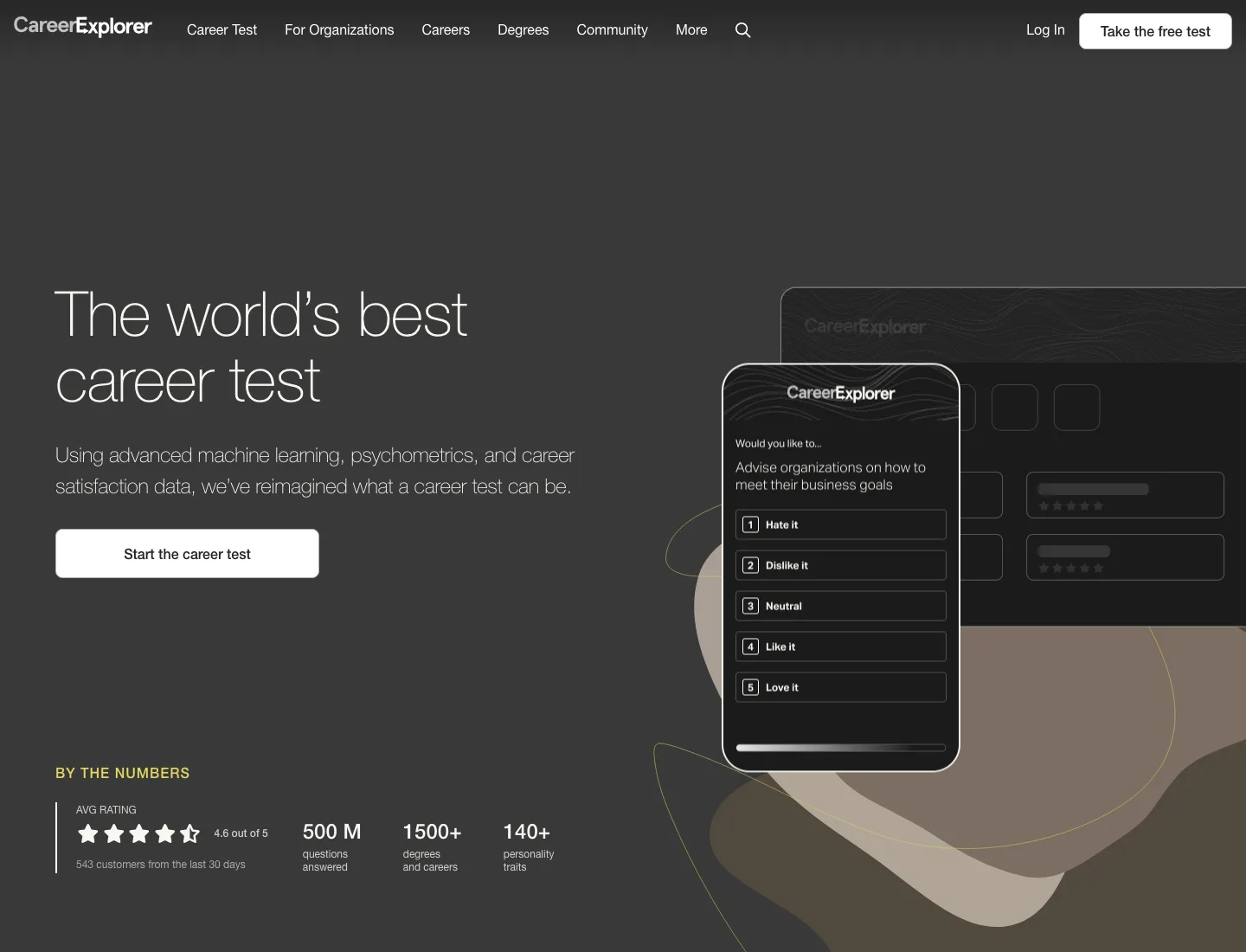
If the 60 to 90 minutes is the blocker and the interest layer is what you are after, our free RIASEC test covers that layer in about four minutes. It gives you the three-letter code and per-area scores without the personality sections or the 1,500-profile database, so it is a smaller answer delivered faster.
Data sources. CareerExplorer's own marketing states the career database includes 1,500+ career profiles, with data drawn from sources such as the US Department of Labor's O*NET Database. Each profile typically includes a day-in-the-life description, salary information, and skills associated with the role.
Archetypes. CareerExplorer groups users into personality archetypes (Scholar, Groundbreaker, Mastermind, Visionary, and others). The archetype frames the rest of the report.
The monetisation. Account creation is required to take the assessment. CareerExplorer markets the core assessment as free and has at points offered paid premium tiers; check the current state on their site when you visit, as their pricing model has evolved over time.
What you leave with. A personality archetype, a ranked list of career matches starting with the top tier and extending well beyond it, and Holland Code scores across the interest categories. For someone treating the quiz as a research tool, the output is among the richest available.
The team clearly cares about psychometric quality in a way most consumer career quizzes do not.
What the MyPassionAI career quiz is
A disclosure before this section: I am the founder of MyPassionAI, so the operator-level detail you are about to read comes from owning the code, and the bias that comes with that is unavoidable. The honest counter is to publish the comparison anyway, with verifiable claims and the unflattering bits about my own product included (the "What MyPassionAI gets uniquely wrong" section is below).
I launched MyPassionAI in late 2025 because long-form career tests keep producing the pattern described above: an hour in, a long ranked list out, no clearer next step. The thesis of the product is the inverse of Sokanu's: optimise for the minimum signal you need to make a decision soon, not the maximum signal you could theoretically extract.
The instrument. 26 questions total. The first question asks which of four statements best describes your current situation: a student or graduate with no direction, someone in a paying career who wants change, someone with too many interests, or someone stuck or unemployed. Your answer to that opening question decides what you see next. A burned-out professional gets asked which moments in their last job made them forget the clock. A graduate gets asked what they spent hours on as a kid that felt like play. The branching is not cosmetic, it changes the signal we extract from the early questions.
The framework. The output is one of 20 named archetypes produced by a 2D matrix:
- 5 struggle types (y-axis): Career Switcher, Grad Explorer, Multi-Passionate, Purpose Seeker, Explorer
- 4 priority types (x-axis): Income-Focused, Lifestyle Seeker, Stability First, Experimenter
The archetype name encodes both what is currently hard and what you want next. The reading and framing for each cell are hand-written, not generated by a template engine.
What the quiz measures. Four layers: the situational struggle (from your opening answer), flow markers (from the questions about which activities energise you), values (the core-values question), and priority type (from the question on what matters most in the next role). Those layers feed a consistency-bonus calculation that adjusts your fit score based on answer-pattern coherence. Coherent answers lift the score. Contradictory ones lower it. This is a simple model, not a validated psychometric, but it is more than a lookup table.
The monetisation. The free quiz returns your archetype and the written reading for your cell. The full report is a one-off payment and includes detailed career matches with fit scores and supporting context per match. The one-off Career Switch Kit then does the switching work: your experience translated for the new field, your CV rewritten for the matched path, your LinkedIn headline and About written, 10 outreach messages, your first four weeks planned, and an unlimited AI coach that has read your results. Current pricing at mypassion.ai/pricing.
What you leave with. On the free quiz: your archetype name, the written reading for your cell in the 20-archetype matrix, and a career-match preview. On the full report: the detailed matches, fit scores, and supporting context for each.
The design difference with Sokanu is not cosmetic. It is the whole product decision.
Quiz structure, side by side
| Structural element | Sokanu / CareerExplorer | MyPassionAI |
|---|---|---|
| Total items | Not publicly listed; structured across 5 sections | 25 |
| Branching logic | No (all users see the same sections) | Yes (situational branching, set by your opening answer) |
| Question formats | Mixed Likert, multiple choice, forced-choice | Conditional multiple-choice + open-text prompts |
| Dimensions measured | Big 5 + Holland Code + proprietary, per CareerExplorer | Struggle + priority + flow + values |
| Output unit | Personality archetype + long ranked match list | 1 named archetype + detailed matches with fit scores |
| Consistency check | Proprietary, not disclosed | Yes, consistency bonus for coherent answer patterns |
| Career database | Broad, per CareerExplorer's marketing | Curated detailed matches per archetype |
| Designed for retake | Not explicitly highlighted | Yes, situational branching means a retake reflects your current situation |
Two things matter inside that table. First, Sokanu optimises for breadth (a broad career database, machine-learning matching, decades of research lineage) and MyPassionAI optimises for focus (one archetype, detailed matches, fit scores per match). Those are not the same goal. Second, neither product promises the other's strength. Sokanu does not promise an under-10-minute decision. MyPassionAI does not promise a sprawling career atlas. Picking between them is a product question, not a quality question.
The "hobby as career" failure mode
The most important thing to know about the difference between the two products is a pattern critique that shows up consistently in independent reviews of CareerExplorer, including a detailed analysis by career coach Philippe Vivier, who reports that his results "matched what I already did" and surfaced activities that were already in his life.
The pattern: long-form quizzes that weight stated current interests heavily can blur the line between "I enjoy doing X" and "X is a candidate for my career." For many activities those signals are correlated. For activities most people enjoy as a release from work (cooking, gardening, reading), they may not be. Wanting to cook dinner on Thursday is not the same as wanting to run a kitchen for twelve hours on Saturday.
MyPassionAI was designed with an answer to that. The quiz does not ask "do you enjoy X" as a standalone question. It anchors in childhood patterns (what you did unsupervised before economics and family pressure filtered your choices), flow markers (activities that make you lose track of time in your current work), and values (what you would wake up excited to do if money were solved). Those three questions target a different signal than current-hobby endorsement: the pattern that existed before performative adulthood overwrote it.
This is part of why an under-10-minute quiz can produce a tighter result than a 90-minute one. The question selection is doing some of the filtering that a longer battery tries to do statistically.
What the Sokanu career test gets uniquely right
Three things genuinely worth naming.
1. Methodological lineage. Big Five plus Holland Code is one of the more serious stacks in consumer career testing, and CareerExplorer layers a machine-learning matching engine on top of it. If you value psychometric lineage, this stack has it.
2. Career database breadth. The career library draws profile content from sources including the US Department of Labor's O*NET database, and its breadth is the product's core asset. That depth is expensive to build and few alternatives match it.
3. A free, account-saved core experience. CareerExplorer markets the core assessment as free, and creating an account lets you save your progress and return to your results. For a student with time and limited budget, that combination is hard to beat.
What the Sokanu career test gets uniquely wrong
Three weaknesses documented across multiple independent reviews.
1. The 30-minute promise stretches in practice. CareerExplorer advertises about 30 minutes. Independent reviewers, including career coaches who completed the full assessment, report total times in the 60 to 90 minute range. That gap matters because the longer a quiz runs, the more likely a user is to drop off before seeing results.
2. Output blurs hobby with career. The pattern described in the section above (current interests being weighted heavily enough to push people toward jobs that map to their hobbies) shows up in independent reviews including Vivier's. It is one of the more common critiques among people who finish the assessment.
3. A giant match list is breadth, not a decision. CareerExplorer ranks matches by fit percentage, but the tail is long. Reviewers consistently describe the output as overwhelming and report scrolling through many options without meaningful filtering beyond the top tier. Decision paralysis is an output-quality problem, and a list that size leans into it.
What MyPassionAI gets uniquely right
1. Time-to-result is under 10 minutes, not 60 to 90. A typical user takes the quiz, sees the archetype, and has a decision input in less time than it takes to read this paragraph twice. The advantage comes from fewer, better-chosen questions, not from skipping work.
2. Branching questions reflect different life stages. A student and a burned-out 34-year-old are asked structurally different questions after the opening one. Sokanu treats all users as the same starting point. We do not.
3. The output goes deeper than a long ranked list. The full report includes detailed career matches with fit scores and supporting context per match, instead of asking the reader to wade through a sprawling ranked list to find a meaningful next step.
4. Archetype signal is separated from hobby noise by design. This is the inverse of the pattern described above. By anchoring the quiz in childhood patterns, flow markers, and values rather than stated current interests, we sidestep the systematic bias that pushes hobby answers into career suggestions.
What MyPassionAI gets uniquely wrong, honestly
1. No sprawling career database. Sokanu's career database is broader than ours. We go deep on a focused set of matches per archetype. They go wide. If breadth is what you want, we lose on that axis.
2. No application-stage integrations. If you are already past the "what direction" question and want to move toward specific roles you can apply to today, CareerExplorer's broader career library is closer to that workflow than our archetype-focused report.
3. Newer framework, less longitudinal validation. Big Five has decades of academic validation behind it. Our struggle-priority matrix is newer, informed by Self-Determination Theory and flow research, but not peer-reviewed. Worth knowing going in.
4. It points a direction, not a finished plan. The free archetype and reading give you a genuine read on where you are and what fits, and the full report adds detailed career matches with fit scores, but the work of testing a path and making the move is still yours. The quiz is the starting input to that decision, not a substitute for doing it.
Who should take which
Take the Sokanu career test if any of these apply:
- You have 60 to 90 minutes and want breadth across hundreds of career options
- You care about methodological lineage (Big 5 + Holland Code is a meaningful asset)
- You are a student with time, no budget, and academic inclination
- You want a career atlas more than a single decision
Take the MyPassionAI career quiz if any of these apply:
- You have under 10 minutes, not 90
- You are 25 or older and suspect a meaningful misfit between your current career and your underlying pattern
- You have tried Sokanu (or a similar long-form quiz) and felt overwhelmed by the long ranked list
- You want a focused set of detailed career matches with fit scores, not a sprawling atlas
- You have the problem reviewers keep describing: too much information, no clearer direction. See also our Princeton Review comparison if you have tried that one.
There is nothing stopping you from taking both. About 100 minutes for the two combined, and you only pay for the full MyPassionAI report if the free archetype result feels worth going deeper on.
Should I take Sokanu if I already know the general direction?
Probably no. Sokanu's structural strength is breadth and database richness. If you already know the direction, the 30 to 90 minutes it takes to confirm what you already suspect is time that would be better spent reading a day-in-the-life for your specific target role, talking to someone who currently does it, or (this is the pitch I am obliged to make) taking the under-10-minute MyPassionAI quiz to get a second archetype data point without losing an afternoon.
I wrote the conceptual foundation for why passion is a pattern and not a feeling in how to find your passion, which is the best starting read if you are earlier in the process. If you are already employed and the question is more specifically about whether the misfit is fixable in your current job, the 7-day in-job audit on career passion is the action playbook. If burnout is the immediate blocker, the burnout-recovery diagnostic comes before any quiz signal can be trusted. If your situation specifically maps to a career change at 30, that is the dataset-backed treatment.
The bottom line
The Sokanu career test, now CareerExplorer, is one of the most methodologically ambitious and data-rich career quizzes available. It has legitimate strengths: a Big Five plus Holland Code lineage, a machine-learning matching layer, a broad career database, O*NET-sourced career data, and thoughtful archetype labels. Its weaknesses are a 30-minute promise that stretches to 60 to 90 minutes in practice, an output that can blur hobby with career, and a result set so large it becomes a research project rather than a decision.
MyPassionAI is the deliberate inverse. Fewer, branched questions. An operator-authored archetype matrix. A result designed to be focused enough to act on. It does not have Sokanu's breadth or O*NET-backed career depth. It does have what independent reviews consistently flag as missing: a tighter, focused next step.
If you have 90 minutes and want an atlas, take Sokanu. If you have under 10 minutes and want a focused result, take MyPassionAI. If you are genuinely stuck, take both.
Sokanu's closest comparisons are the other long-form paid instruments: Truity and MAPP. For the free end of the same shelf, O*NET Interest Profiler covers the government option and Google Career Dreamer the newest free AI entry, both ranked in best AI career assessment tools. The mechanics behind that newer generation are set out in how AI career tools work. The DISC branch of the consumer market is reviewed in Crystal Knows.
Frequently Asked Questions
Ready to find your passion career?
The free under-10-minute quiz maps your childhood patterns and flow triggers to one of 20 archetypes, then gives you matched careers and a 7-day first-step plan.
Take the Free Career QuizRelated Articles
Trusted by 15,000+ career-quiz takers across 168+ countries · Methods covered in