
Princeton Review Career Quiz (2026): The New 30-Question Test, Your Interest Code, and the Old Colors
The Princeton Review career quiz now asks 30 questions and shows a free 3-letter interest code. The career list needs an account with your phone number. Old colors explained.


Contents · 13 sections
The Princeton Review career quiz is one of the oldest and most-taken free career quizzes online. It is also the one my own users mention most when I ask what they tried before MyPassionAI. So I took it twice (most recently on 25 September 2026, when it had changed completely), read every methodology disclosure I could find, and compared it head to head against MyPassionAI, the alternative I know best.
A note on format. I gave both products roughly equal attention, called out unique strengths and unique weaknesses for each, and kept every claim to what you can verify in the live products, the companies' own pages, or third-party reviews. Where a row in a table would have required guessing, I dropped the row instead of filling it in.
TL;DR comparison
| Dimension | Princeton Review Career Quiz | MyPassionAI Career Quiz |
|---|---|---|
| Questions | 30, identical for every user | 26, branching (situational, set by your opening answer) |
| Format | Rate each activity on five faces, from strongly dislike to strongly like | Conditional multiple-choice + open text |
| Methodology | Six RIASEC interest areas, credits O*NET Web Services (earlier: Birkman-inspired colors) | Archetype matrix: 5 struggle types × 4 priority types = 20 combinations |
| Time to complete | 5 to 10 minutes (its own label) | under 10 minutes |
| Price | Free; career list needs an account with name, email and phone | Free archetype; one-off full report and Career Switch Kit (current prices at mypassion.ai/pricing) |
| Output | 3-letter interest code on the page, career list after sign-up | Named archetype, detailed career matches with fit scores, and with the Kit: CV, LinkedIn, outreach messages, a 4-week plan and an AI coach |
| Best for | High-school and early-college students exploring broad directions | Mid-career professionals and graduates who suspect a meaningful misfit |
Everything below is the work behind that table.
What the Princeton Review Career Quiz is
The Princeton Review is a 45-year-old test-prep brand best known for SAT, ACT, and graduate-admissions tutoring. The career quiz is an auxiliary product. It sits at princetonreview.com/quiz/career-quiz and it exists because career exploration is adjacent to their core service, college and graduate-school matching.
The instrument, as of 25 September 2026. The quiz was rebuilt. A "Career Assistant" in a chat layout asks 30 questions of the form "How much would you like to... build kitchen cabinets?", and you answer on five faces from Strongly Dislike to Strongly Like. The page labels it "About 5 to 10 minutes, 30 quick questions, no right or wrong answers", and a sidebar fills in six interest bars as you go. The instruction is to rate how much you would like the activity, "don't worry about whether you'd be good at it or what it pays", which does the same job as the old equal-pay instruction: it keeps status out of the answers.
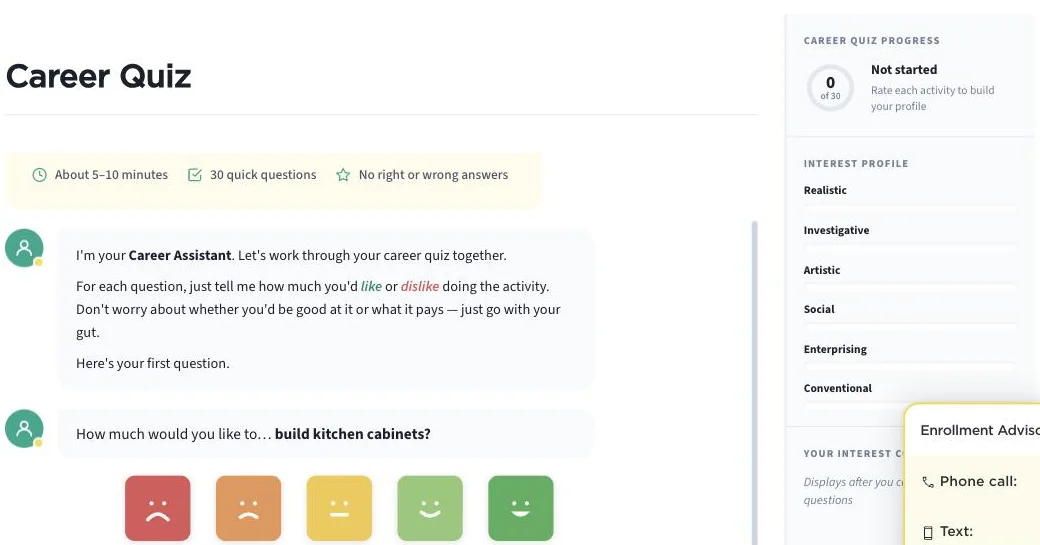
The framework. The six areas are John Holland's RIASEC model (Realistic, Investigative, Artistic, Social, Enterprising, Conventional), the same model behind the O*NET Interest Profiler, and the page credits "O*NET Web Services, U.S. Department of Labor". Your top three areas make your interest code. Ours came out CSR: Conventional, Social, Realistic.
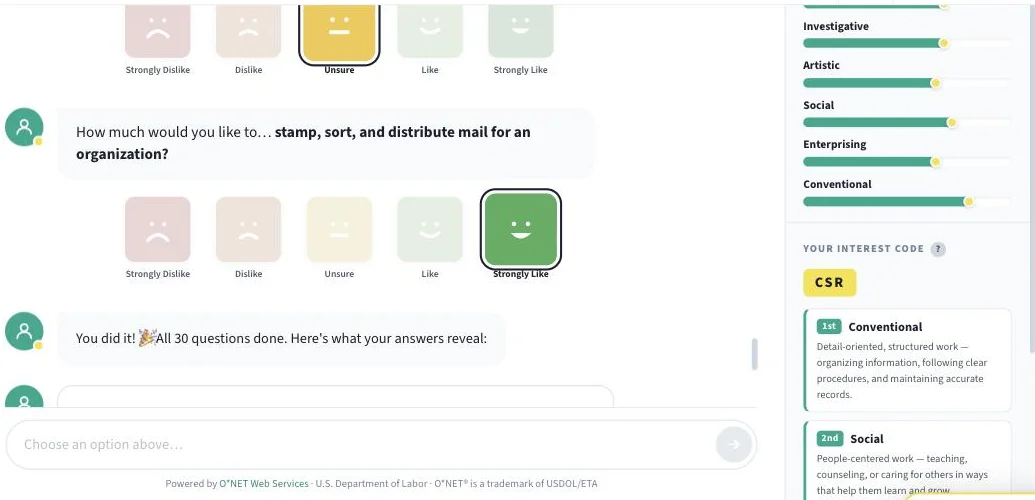
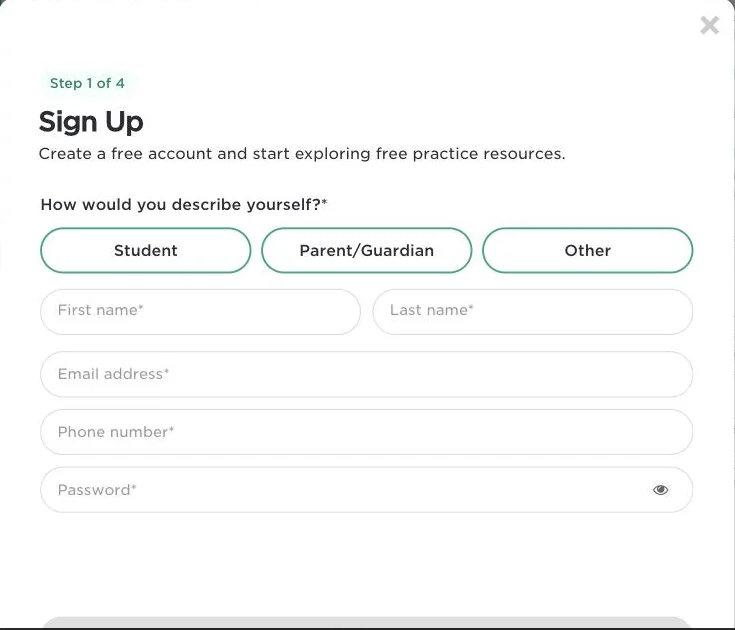
What you leave with, and what it costs you. The code is free. The careers are not shown until you sign up: the "Show my career results" button opens a four-step form that requires your first and last name, email, phone number and a password. There is no payment anywhere; the Princeton Review's revenue is test prep, tutoring and admissions, and an enrollment-advisor phone box sits on the page throughout.
The old Princeton Review career quiz colors, explained
Many guides, and many people searching "Princeton Review blue careers" or "yellow careers", still describe the earlier version. It asked 24 forced-choice questions, each a pair of statements ("I would rather be a wildlife expert" or "a public relations professional"), with the instruction to "assume that all jobs are of equal pay and prestige."

That version was widely reported, including by university career centers such as Arcadia's Career Launchpad, to be "based on the Birkman Method," a mid-twentieth-century assessment developed by organizational psychologist Roger Birkman. The output uses four color categories:
- Red, Expediting: hands-on, tangible, builder-style work
- Green, Communicating: persuasive, people-facing, relationship work
- Blue, Planning: creative, analytical, long-horizon work
- Yellow, Administrating: structured, detail-oriented, systems work
Each respondent got two colors: one for interests (what you are drawn to) and one for style (how you like to work). That gave 16 possible pairs, and each pair yielded a page of matched career examples. A Yellow-Yellow reader, for instance, got "research, banking, accounting, systems analysis, tax law, finance, government work, and engineering." A Red-Green reader got a different list.
Independent reviewers of that version, including Scholarship Institute (who called the result "sparse" and "generic") and Hiration, described a thin result. The rebuild answers part of that: a named interest model and a clearer result screen, at the price of a sign-up for the careers.
What the MyPassionAI career quiz is
A disclosure before this section: I am the founder of MyPassionAI, so the operator-level detail you are about to read comes from owning the code, and the bias that comes with that is unavoidable. The honest counter is to publish the comparison anyway, with verifiable claims, links to the live products, and the unflattering bits about my own product included (the "What MyPassionAI gets uniquely wrong" section is below, and it is the one I would read first if I were you).
I launched MyPassionAI in late 2025 because I had watched enough people, and enough versions of myself, waste years on careers chosen by optimisation for external approval rather than internal fit. The quiz is the top of the product. You can take it at mypassion.ai/career-quiz.
The instrument. 26 questions, but the structure is the point. The first question asks which of four statements best describes your current situation: a student or graduate with no direction, someone in a well-paying career who wants change, someone with too many interests who cannot pick one, or someone stuck or unemployed going in circles. Your answer to that opening question decides which version you see. A career switcher gets asked which moments in their last job made them forget the clock. A graduate gets asked what they spent hours on as a kid that felt like play. Someone with too many interests gets asked which interest they would least regret committing to.
This branching is load-bearing. A 34-year-old burned-out product manager and a 19-year-old undeclared major need different questions, and the Princeton Review asks them both the same 30. This branching is not cosmetic. It changes which signal we can extract from the 2nd-most-important question in the quiz.
The framework. The output is one of 20 archetypes in a 5x4 matrix:
- Struggle type (y-axis): Career Switcher, Grad Explorer, Multi-Passionate, Purpose Seeker, Explorer
- Priority type (x-axis): Income-Focused, Lifestyle Seeker, Stability First, Experimenter
A Career Switcher who is Income-Focused ("You're ready to escape and earn what you deserve") gets a different reading, a different career list, and a different framing than a Multi-Passionate Experimenter ("You're exploring how to combine your passions"). The matrix is the backbone of how the report is personalised.
The monetization. The free quiz returns your archetype and the written reading for your 5x4 cell, with no account needed to see it. The full report is a one-off payment and includes detailed career matches with fit scores and supporting career context for each. The Career Switch Kit, also one-off, does the switching work: your experience translated for the new field, your CV rewritten for the matched path, your LinkedIn headline and About written, 10 outreach messages, your first four weeks planned, and an unlimited AI coach that has read your results. Current pricing at mypassion.ai/pricing.
What you leave with. On the free quiz: your archetype, the written reading for your 5x4 cell, and a preview of the career matches. On the full report: the detailed matches, fit scores, and supporting context per match. With the Kit: the materials to act on them.
The thing I most want you to understand about the report is that it is designed to be acted on this week, not filed for later. That is the specific problem I was trying to solve.
Quiz structure, side by side
| Structural element | Princeton Review | MyPassionAI |
|---|---|---|
| Question count | 30 | 26 |
| Question format | Rate each activity on five faces | Conditional multiple-choice, with open-text prompts on key items |
| Branching logic | None (everyone answers the same 30) | Yes (situational branching, set by your opening answer) |
| Dimensions measured | Six RIASEC interest areas | Struggle type + Priority type + Values alignment + Flow markers |
| Output | A 3-letter code from six areas (120 possible orders) | 20 archetypes (5 struggle × 4 priority) |
| Personalization of output copy | One line per interest area | 20 distinct reading variations, written per archetype |
| Fit score or consistency score | Not published | Yes, consistency bonus for answer patterns (e.g. Creator/Builder, Helper/Connector, Explorer/Learner) |
| Designed for retake | Not explicitly | Yes, the branching means your retake reflects your current situation |
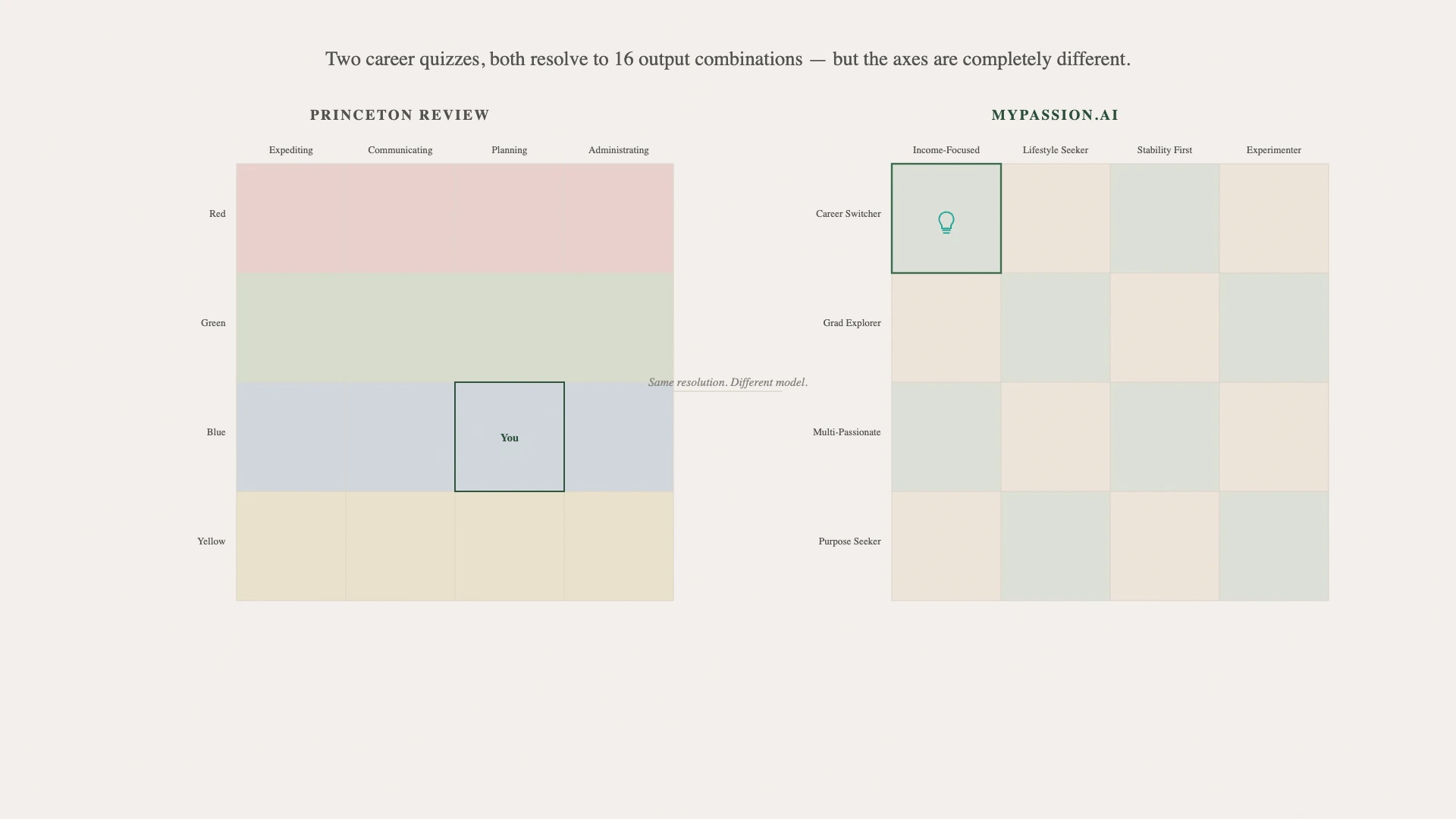
The previous Princeton version's 16 color pairs against MyPassionAI's 20 archetypes. The current version swaps colors for a RIASEC code, but the axes still differ in the same way: interests describe what you are drawn to, the archetype matrix describes what is hard right now and what you need next.
The important point inside that table: the Princeton Review's result is a code plus one line per interest area, whereas the MyPassionAI result runs an additional consistency check on your answer pattern and adjusts the fit score accordingly. That is the difference between a lookup table and a simple model.
Pricing, access, and what you get for the money
| Princeton Review | MyPassionAI | |
|---|---|---|
| Basic quiz | Free (interest code) | Free (archetype and reading, no account) |
| Career list | Free account required: name, email, phone, password | Preview free; detailed matches in the one-off full report |
| Switch materials | Not offered | One-off Career Switch Kit: CV, LinkedIn, outreach messages, 4-week plan, AI coach |
| Money-back | Not applicable | Yes, on every purchase |
The honest read: Princeton Review wins on raw price (zero is unbeatable), though it asks for your phone number instead. MyPassionAI charges for the full report because it goes deeper than an interest code and a career list, with detailed matches and supporting context per match. Which matters depends on what you plan to do with the result. A high-schooler browsing directions does not need that depth. A 31-year-old paying to reshape their next five career years probably does.
What the Princeton Review gets uniquely right
A vendor writing about a competitor is obliged to lay out the competitor's actual strengths, not a strawman version. Here are four the Princeton Review genuinely earns.
1. Speed and a free code. 30 quick questions, 5 to 10 minutes, no payment, and your interest code on the page. For a first orientation, that is about as low-friction as it gets, until you want the career list.
2. Name recognition lowers the trust barrier. Princeton Review is a DR 80-plus brand. A 17-year-old who sees the Princeton name trusts the result faster than they trust a new domain. That trust halo converts, and my own product does not have it yet.
3. The "don't worry about whether you'd be good at it or what it pays" framing. The instruction keeps ability and status out of the answers, so you rate interest alone, which is what the result is meant to measure. The old version did the same with "assume all jobs are of equal pay and prestige." Most career quizzes skip this and get noisier data.
4. A well-researched model underneath. Holland's RIASEC model is one of the most studied frameworks in vocational psychology, and the O*NET program publishes the career data it maps to. The Princeton Review does not publish validation for its own 30-item version, but the foundation is sound. Many newer quizzes, mine included, rest on frameworks with less historical validation.
What the Princeton Review gets uniquely wrong
And now the unflattering side, written by a competitor who has every incentive to overstate it, which is why I am going to keep it to what is verifiable in the product.
1. No personalization of questions. A 45-year-old ex-lawyer considering a career change is answering the same 30 activity ratings as a high-school junior. The product treats career exploration as a fixed stage of life, which it stopped being thirty years ago.
2. No action plan. The result tells you what categories fit. It does not tell you what to do on Monday morning. For someone already exploring, that is the moment of peak motivation, and the Princeton Review quiz does not capture it.
3. The career list costs you a phone number. The code is free, but the matched careers need an account with your name, email, phone number and a password, on a site that runs an enrollment-advisor phone line on every page. If you do not want sales calls, screenshot your code and look it up in the free O*NET Interest Profiler instead.
4. A thin result, still. The most consistent critique of the old version was that the output felt shallow. The rebuild gives a clearer code, but the free result is still one line per interest area. The infrastructure of the Princeton Review brand could support a much richer result. This is the gap every alternative quiz, including mine, is built to close.
What MyPassionAI gets uniquely right
1. Branching questions reflect different life stages. The opening fork means a graduate and a burned-out professional are answering adjacent but different instruments. The cost of this is higher-effort quiz design, the benefit is we extract more signal per question.
2. The output goes deeper than an interest code and a career list. Each career match comes with a fit score and supporting context, so the reader can compare matches against their archetype rather than guessing why a category appeared. That is the gap most free quizzes leave open.
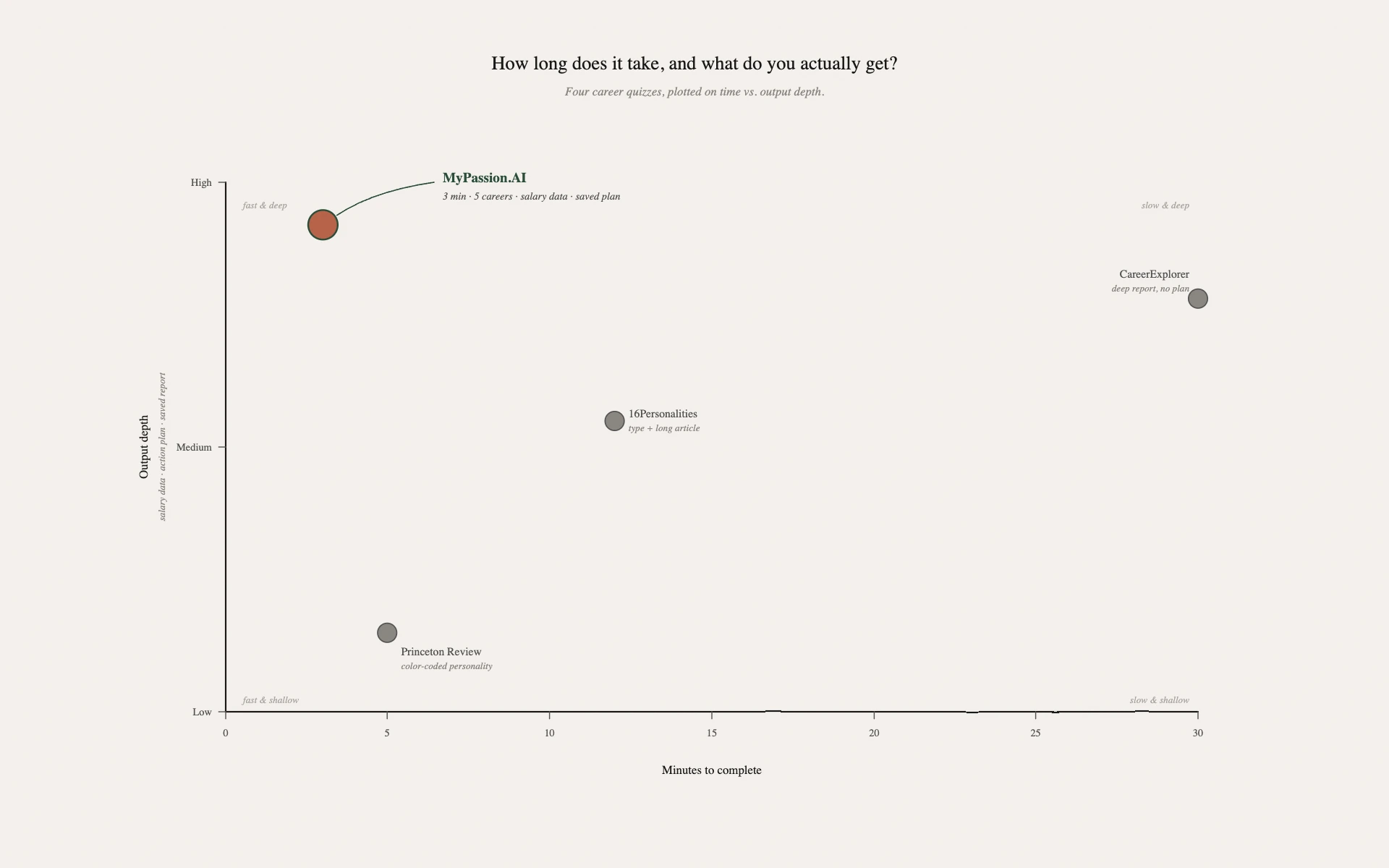
3. Labour-market context shipped with the matches. The full report includes labour-market context for each matched career, because the most common reason people don't act on career-quiz results is that the result lives in an information vacuum. Closing that vacuum is part of why the report is paid.
4. Operator-authored content and archetypes. The archetype copy, the priority-type labels, and the consistency-bonus logic were written by me based on the actual conversations I had during 10 executive-education seminars and hundreds of 1:1 career conversations. That is also the bias in the product (see next section).
What MyPassionAI gets uniquely wrong, honestly
1. No decades-long brand halo. "MyPassion.ai" does not yet carry the trust that "Princeton Review" does. A first-time visitor pays the trust tax, and we have to earn it over time with good output and third-party validation.
2. Payment gate on the full report. A small one-off is still not zero, and that matters for some users. Princeton Review's zero-dollar price point is a meaningful edge for early-stage exploration. The paywall is the cost of keeping the report durable and high-quality, but the tradeoff is honest.
3. Newer framework, less independent validation. The Struggle × Priority archetype matrix is my own synthesis, informed by Self-Determination Theory and flow research, but it has not been peer-reviewed. Holland's RIASEC model has decades on us.
4. Operator bias. The content was written by a founder who has opinions about which careers correlate with which archetypes. I try to hold those opinions lightly and update the copy as live quiz data comes in (the fit-score consistency logic is already answer-pattern-driven, not author-asserted), but any founder-authored instrument has author fingerprints. This is worth knowing.
Who should take which
Take the Princeton Review career quiz first if any of these apply:
- You are in high school or the first two years of college
- You have never done any career self-assessment before
- You want a free 5 to 10 minute directional nudge, not a decision input
- You are fine creating an account with your phone number to see the career list
- You are in the Princeton Review ecosystem already (tutoring, admissions)
Take the MyPassionAI career quiz first if any of these apply:
- You are 25 or older and suspect a meaningful misfit between your current career and your underlying pattern
- You have already tried two or more free career quizzes and found them underwhelming
- You want a deeper output than an interest code and a career list, with fit scores per match
- You want the switch done with you: CV, LinkedIn and outreach written for the matched path (the Career Switch Kit)
- You are mid-career and deciding whether a switch is worth the cost (see our career change at 30 post for the framework I use)
There is nothing stopping you from taking both. Eight minutes for the two quizzes combined, two data points, and you only pay for the MyPassionAI full report if the free archetype result feels worth going deeper on.
Should I take either if I already know what I want to do?
Probably yes, and for a non-obvious reason. Both quizzes are most useful as disconfirmation tools, not confirmation tools. If your archetype or your interest code matches the career you already intended to pursue, you have a mildly reassuring data point and you keep going. If it does not match, that is the more valuable result, because it is a cheap signal that your intended career might be fighting your underlying pattern. Cheap signals against expensive decisions are the whole point.
I write more about why passion is a pattern rather than a feeling in how to find your passion, which is the conceptual companion to this article. If your blocker is specifically about your current job rather than the broader career question, the 7-day in-job audit on career passion is the action playbook. If you are burnout-stalled before any quiz can give you a clean signal, start with the burnout playbook first.
The honest bottom line
The Princeton Review career quiz is now a competent, free RIASEC interest quiz with a brand that earns trust. The code is free; the careers cost you an account and a phone number. The result is still thin by the standards of 2026, and it was not designed for the mid-career user who is the most common career-quiz taker today.
MyPassionAI is a newer, operator-built, branching 26-question instrument with a 5x4 archetype matrix, a paid full report with detailed career matches and fit scores, and a Career Switch Kit that writes your CV, LinkedIn and outreach for the matched path. It does not yet have Princeton Review's brand halo, and the framework has fewer decades of validation behind it. It does produce a result you can act on.
If you have never taken a career quiz, take the Princeton Review one first, because free is free and the code alone is useful. If the result felt too shallow (most adults I speak to say it does), take the MyPassionAI quiz next and see whether the archetype output closes the gap.
If Princeton Review was your free starting point, the other free options worth knowing are the O*NET Interest Profiler, Red Bull Wingfinder for strengths, and HIGH5. The paid tier is covered in Crystal Knows and is Personality.co legit, and everything ranks together in the best career quiz roundup. If you are weighing a free classic instrument against one of the newer AI tools, how the two families of assessment compare is the direct answer.
Frequently Asked Questions
Ready to find your passion career?
The free under-10-minute quiz maps your childhood patterns and flow triggers to one of 20 archetypes, then gives you matched careers and a 7-day first-step plan.
Take the Free Career QuizRelated Articles
Trusted by 14,900+ career-quiz takers across 168+ countries · Methods covered in