
MAPP Career Test Review (2026): What the Free Version Shows, and Whether the ~$90 Report Is Worth It
MAPP career test review: what the free truncated version actually gives you, what the paid tiers cost, and whether a 1995-vintage motivation test still earns it.


Contents · 11 sections
The MAPP career test is one of the oldest career assessments still running on the public internet. It has been refined since 1995, the publisher's marketing claims more than 12 million users across 165+ countries (per the live site, July 2026), and it sits behind a paywall of $89.95 (verified on the live pricing page, July 2026) before you see your top career matches. So I read every page the publisher makes public on assessment.com, read three of the most-linked independent reviews, and compared it head to head against the alternative I know best. This review works from those public pages and reviews, and where a specific number comes from a reviewer, I say so at the point of use.
A note on framing. I am the founder of MyPassionAI, one of the alternatives mentioned at the end of this review. I gave MAPP roughly equal attention, called out unique strengths and unique weaknesses for each, and kept every claim to what you can verify in the publisher's own pages, the live products, or the third-party reviews linked below.
TL;DR comparison
| Dimension | MAPP Career Test | MyPassionAI |
|---|---|---|
| Founded | 1995 (Motivational Appraisal of Personal Potential) | 2025 |
| Users (publisher claim) | 12 million across 165+ countries (live site, July 2026) | smaller, growing fast |
| Questions | 71 forced-choice triplets, identical for every user | 25, branching (situational, set by your opening answer) |
| Format | Reflexive likes-and-dislikes ranking | Conditional multiple-choice + open-text prompts |
| What it measures | Motivation across 9 work-related categories | Struggle type, priority type, flow markers, values |
| Time to complete | ~22 minutes for the test, 25+ in practice | under 10 minutes |
| Free output | Truncated report, partial career list | Named archetype + career-match preview |
| Paid output | $89.95 full result, $159 Pro tier (live pricing, July 2026) | One-off for the full report (current price at mypassion.ai/pricing) |
| Career matches | Scored against 1,000+ jobs in the database | Detailed matches with fit scores and supporting context per match |
| Best for | Someone who wants a long, credentialed motivation report | Someone who wants a focused decision in under 10 minutes |
Everything below is the work behind that table.
What the MAPP career test is
MAPP, short for Motivational Appraisal of Personal Potential, has been published by Assessment.com since 1995. The publisher's marketing currently reports more than 12 million users in 165+ countries, and the assessment is used by what the company says is "thousands" of partner organisations including career counsellors, outplacement firms, high schools, and universities.
The instrument. MAPP is a 71-item forced-choice triplet test. You are shown three short statements describing work-related activities, and for each set you mark the one you would most prefer and the one you would least prefer, leaving the third unmarked. The publisher and most reviewers recommend answering reflexively rather than deliberatively, because the test is designed to capture instinct rather than reasoning. Total time on task is around 15 to 22 minutes for the questionnaire itself.
The framework. MAPP's output is organised into nine categories of work-related motivation, which the publisher groups under headings like Interest in Job Contents (the kinds of tasks you are motivated to perform), Temperament for the Job (how you prefer to perform tasks), Aptitude for the Job (mental, perceptual, and sensory-physical factors), and People (roles, relationships, and priorities). The full nine-category structure sits behind the paywall.
Validity. The publisher reports correlation studies against the Strong Interest Inventory and reliability data across repeat administrations. By the standards of consumer career quizzes online, that is a serious lineage and worth giving credit. By the standards of peer-reviewed psychometrics, it is publisher-reported rather than independently meta-analysed, and the ipsative forced-choice structure (you can only rank within a triplet, not against an external scale) makes some scoring approaches contested in academic psychometrics literature. Treat MAPP as a credentialed industry instrument, not as a clinical assessment.
The pricing. MAPP offers a free plan and two paid tiers, and the pricing section below documents the live page as of July 2026: the free plan shows matches 11 to 20 with the top 10 locked, the Complete MAPP Experience is $89.95, and Career Mastery Pro is $159. The publisher runs occasional discounts (one reviewer at Scholarship Institute reports paying $44.98 on a 50% off offer), so the checkout price can dip below the listed one.
What you leave with. A motivational appraisal across the nine categories, a list of careers ranked against the publisher's database of more than 1,000 jobs, and supporting commentary. The same Scholarship Institute reviewer reports a final report length of approximately 7,000 words. For a reader who wants a thick, sourced motivation profile, that is meaningful depth.
What the MyPassionAI career quiz is
A disclosure before this section: I am the founder of MyPassionAI, so the operator-level detail you are about to read comes from owning the code, and the bias that comes with that is unavoidable. The honest counter is to publish the comparison anyway, with verifiable claims and the unflattering bits about my own product included (the "What MyPassionAI gets uniquely wrong" section is below).
I launched MyPassionAI in late 2025 after a decade of optimising a career for the wrong target. The thesis of the product is the inverse of MAPP's: motivation alone is one of three signals that matter for career fit, and a career quiz that measures only motivation can be precise about what you like, while still pointing you at the wrong direction.
The instrument. 26 questions total. The first question asks which of four statements best describes your current situation: a student or graduate with no direction, someone in a paying career who wants change, someone with too many interests, or someone stuck or unemployed. Your answer to that opening question decides what you see next. A burned-out professional gets asked which moments in their last job made them forget the clock. A graduate gets asked what they spent hours on as a kid that felt like play. The branching is not cosmetic, because it changes the signal we extract from the early questions.
The framework. The output is one of 20 named archetypes produced by a 2D matrix:
- 5 struggle types (y-axis): Career Switcher, Grad Explorer, Multi-Passionate, Purpose Seeker, Explorer
- 4 priority types (x-axis): Income-Focused, Lifestyle Seeker, Stability First, Experimenter
The archetype name encodes both what is currently hard and what you want next.
What the quiz measures. Four signals: the situational struggle (from your opening answer), flow markers (when you lose track of time), values (what you would do if money were no object), and priority type. Those signals feed a consistency-bonus calculation that adjusts your fit score based on answer-pattern coherence. Coherent answers lift the score, contradictory ones lower it. This is a simple model rather than a validated psychometric, but it is more than a lookup table.
The pricing. The free quiz returns your archetype and a personalised reading. The full report is a one-off payment and includes detailed career matches with fit scores and supporting context per match. Current pricing at mypassion.ai/pricing.
The structural difference with MAPP is not cosmetic. It is the whole product decision.
The structural critique: motivation is one signal of three
This is the part of the comparison that matters most, and it is also where I have to argue against MAPP rather than just describe it. Take the criticism for what it is, which is operator opinion rather than peer-reviewed dispute.
MAPP measures motivation through reflexive preferences. That is one signal, and it is a useful one. The structural problem is that motivation, on its own, can be a high-fidelity measurement of the wrong thing. I spent ten years optimising a career for a metric I no longer believed in. My motivation scores during that decade would have looked clean: I was reliably motivated to do the work in front of me, because I had been trained to be motivated by the work in front of me. The motivation reading was accurate. The career direction it would have endorsed was wrong.
For a career quiz to catch that, it needs at least two more signals.
Signal one: childhood patterns. Activities you pursued without external pressure as a child are evidence of where attention goes when nobody is shaping it. The MyPassionAI quiz's values prompt (what you would do if money were no object for life) is the adult version of that question, and it is in the quiz specifically because preference-under-pressure and preference-under-no-pressure can give meaningfully different readings. MAPP, by design, only measures the first. We make the conceptual case for this in how to find your passion.
Signal two: flow triggers. Flow, as defined in Csíkszentmihályi's foundational work on the psychology of optimal experience, is the state where challenge and skill match, time distorts, and self-consciousness fades. Activities that produce flow for you are predictive of work that will sustain energy rather than drain it. The MyPassionAI quiz probes this directly, asking when you lose track of time. MAPP infers task preference from like-or-dislike rankings, which is not the same measurement. You can prefer a task and still never enter flow doing it.
The third signal, motivation, is what MAPP measures. The product critique is not that motivation is unimportant. It is that a career quiz built only on motivation gives you a precise answer to one third of the question.
This was the operating insight that made me build something else. If you have ever been motivated to do work that drained you, you have already encountered the failure mode I am describing.
The "1,000-match list" failure mode
The second pattern critique is one I have made before in the Sokanu / CareerExplorer comparison and it applies to MAPP for the same structural reason.
When a career assessment scores you against a database of 1,000+ jobs and shows you a long ranked list, the rank ordering is doing useful information work. It is also doing one specific kind of damage. The longer the list, the more decision work you do after the quiz, not before it. A list of 50 plausible matches is a research project. A list of 6 with fit scores and supporting context is closer to a decision input.
To be fair to MAPP, the publisher does not require you to read all 1,000+ matches. The report focuses on the top results. But once the database is that large, the fit signal is necessarily compressed: the difference between job rank #4 and job rank #14 is small percentages, and small percentage differences in a model that was inferred from 71 ipsative answers are within the noise floor. The output looks more decisive than it is.
This is not a knock on MAPP specifically. It is a shape that long databases combined with short questionnaires consistently produce, and one MyPassionAI deliberately avoided. Our report stops at a focused set of detailed matches with fit scores rather than scoring you against 1,000.
The pricing math (verified on the live site, July 2026)
We checked the pricing page directly rather than relying on reviews, because MAPP's tiers have shifted over the years. As of 30 July 2026, assessment.com lists three packages:
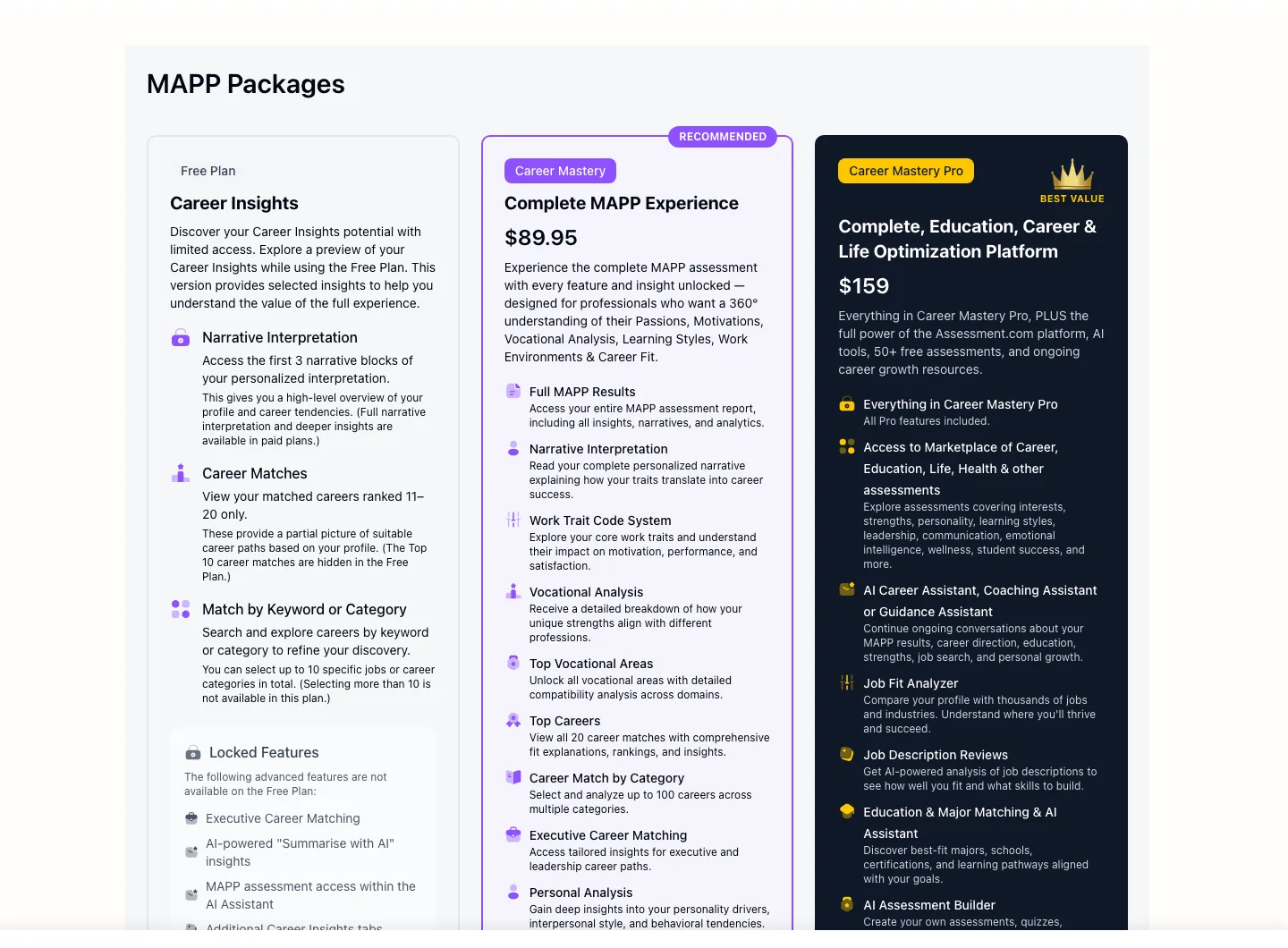
The floor for the full result is $89.95 (the "Complete MAPP Experience"), with a $159 "Career Mastery Pro" tier above it that bundles AI assistants and a marketplace of additional assessments. That squares with the ~$90 starter figure independent reviews have reported for years, and it retires the older $30/$60 add-on structure those reviews describe. The free plan is a preview by design: matches 11 through 20, with the top 10 hidden.
The MyPassionAI free quiz returns the archetype. The full report adds detailed career matches with fit scores. The archetype is free; the full decision input sits behind a small one-off paywall (current price at mypassion.ai/pricing).
There is a defensible reason MAPP is more expensive. It has been on the market since 1995, has a longer-running database, has correlation data against established psychometric instruments, and is bought by partner organisations as a service rather than just by individuals. Some of that cost is the lineage you are paying for. None of it is unjustified.
But for a person comparing the two as an individual deciding what to do next with their career, the cost-per-actionable-output math is straightforward. A small one-off buys detailed matches with fit scores from MyPassionAI. About $90 buys a 7,000-word motivation appraisal scored against 1,000+ jobs from MAPP. They are different products optimised for different decisions, and the pricing reflects that.
What MAPP gets uniquely right
Honest section, because nothing in this review should read as me dismissing what MAPP does well. Four things stand out.
1. Methodological lineage. Three decades of refinement, publisher-reported correlations against the Strong Interest Inventory, and reliability data across repeat administrations is a stronger track record than almost any consumer career quiz. If you care about provenance, MAPP has it.
2. Forced-choice format reduces social-desirability bias. Asking you to rank "most preferred" and "least preferred" within a triplet is a deliberate design choice, and a sound one. It reduces the bias where people answer Likert-style questions in the direction they think makes them look good. That is a meaningful psychometric advantage.
3. The category-based output is structured. The nine-category appraisal gives you a more detailed map of motivational dimensions than most consumer quizzes produce. If you want to understand which kinds of tasks, environments, and people configurations motivate you, MAPP's output is structured for that question.
4. Partner-organisation distribution. MAPP is used by counsellors, outplacement firms, schools, and universities. If you are working with a coach or counsellor who already uses MAPP, the output is going to plug into a workflow they know. That ecosystem is a meaningful advantage and one MyPassionAI does not have.
What MyPassionAI gets uniquely wrong, honestly
1. Newer framework, less longitudinal validation. MAPP has 30 years of correlation data behind it. Our struggle-priority matrix is informed by Self-Determination Theory and flow research, but it has not been peer-reviewed and the corpus of users is smaller. Worth knowing going in.
2. Smaller career database. MAPP scores you against 1,000+ jobs. We focus on a curated set of detailed matches per archetype. If breadth across hundreds of role options is what you want, we lose on that axis.
3. No partner-organisation network. MAPP is institutionally embedded with thousands of counsellors, schools, and outplacement firms. We are not. If your career advisor or campus career office already uses MAPP, that workflow will be smoother for you on their side.
4. Leaner output by design. MAPP's nine-category appraisal and partner-counsellor workflow give you a longer paper trail. Our free archetype is a genuine under-10-minute read, and the full report adds detailed career matches with fit scores, but if you want an exhaustive multi-page motivational appraisal to work through with an advisor, MAPP is built for that and we are deliberately more focused.
Who should take which
Take the MAPP career test if any of these apply:
- You want a long-form motivation appraisal with documented psychometric lineage
- You are working with a career counsellor or outplacement firm that already uses MAPP
- You have around $90 to spend and want a 7,000-word report to digest
- You specifically want a forced-choice instrument that reduces social-desirability bias
- You are researching career assessments academically, not just trying to make a decision
Take the MyPassionAI career quiz if any of these apply:
- You have under 10 minutes, not 25, plus reading time for a 7,000-word PDF
- You want a focused archetype and a curated set of detailed matches with fit scores, not a 1,000-match ranked list
- You suspect motivation alone is not telling you the whole story (especially if you have ever been deeply motivated to do work that drained you)
- You want a result you can act on within a week, not a 7,000-word reading project
- You want childhood-pattern signal and flow-trigger signal on top of motivation, not motivation in isolation
There is nothing stopping you from taking both. The combined time commitment is roughly 30 minutes of questions. You only pay for the MyPassionAI full report if the free archetype result feels worth going deeper on, plus whatever MAPP tier you choose.
If neither fits
The two MyPassionAI quiz comparisons that ship alongside this one are worth a glance:
- The Princeton Review career quiz comparison if you want a free, 5-minute, broad-strokes alternative for a high-school or early-college audience.
- The Sokanu / CareerExplorer review if you specifically want a Big Five plus Holland Code instrument with a 1,500+ career database, and have 60 to 90 minutes available.
- The Sparketype review if MAPP's motivation framing appeals but you would rather have the plain-language version than a scored appraisal.
- The JobTest.org review if you are comparing paid instruments and want to know what each paywall actually opens.
- Is personality.co legit? if a cheap-looking personality test has already taken your card details and you need the cancellation route.
- The free Holland Code career test if you want an interest reading in four minutes rather than a motivation appraisal, with nothing behind a paywall.
If burnout is the immediate blocker for your decision, the burnout recovery diagnostic comes before any career-quiz signal can be trusted. If you are 30 or near it, the career change at 30 dataset may be a closer read than any quiz comparison.
The bottom line
The MAPP career test is one of the most established motivation instruments in consumer career assessment. Three decades of refinement, a publisher-claimed 12 million users across 165+ countries, publisher-reported correlation studies against the Strong Interest Inventory, and a partner-organisation distribution network are meaningful assets. As a measurement of work-related motivation through reflexive likes and dislikes, it is a serious tool, and the structured nine-category output gives you a deeper read of motivational dimensions than most quizzes produce.
Its limitations are structural and worth naming. Motivation is one signal of three, not the whole picture. A 1,000+ job ranked list is closer to a research project than a decision input. The price floor of around $90 is high relative to the actionable output, especially if motivation turns out to be the wrong signal to optimise on for you, which is the failure mode that ten years of my own career proved firsthand.
MyPassionAI is the deliberate inverse. Branched, situational questions in under 10 minutes. An archetype matrix that combines struggle type and priority type into one named result. A focused report with detailed matches and fit scores instead of a 1,000-line ranked atlas. Childhood-pattern and flow-trigger signals on top of motivation, not motivation in isolation. The tradeoffs are smaller career database, newer framework, and no partner-organisation network.
If you want a long, credentialed motivation appraisal and the price is fine, take MAPP. If you want a focused next step and under 10 minutes is closer to your time budget than 25 plus reading, take MyPassionAI. If you have ever been deeply motivated to do work that drained you, the second product was built for you specifically.
MAPP is usually shortlisted against the other paid consumer instruments. Both are reviewed here: Truity Career Personality Profiler and CareerExplorer (Sokanu), with the ranked view in our best career quiz roundup. If ability rather than motivation is the signal you came for, best career aptitude test covers the instruments that actually measure it. And before paying for any of them, when a traditional instrument beats an AI one names the three situations where the older, validated test is the right call.
I wrote this review knowing I benefit from you clicking the second link. I tried to earn the click anyway.
Frequently Asked Questions
Ready to find your passion career?
The free under-10-minute quiz maps your childhood patterns and flow triggers to one of 20 archetypes, then gives you matched careers and a 7-day first-step plan.
Take the Free Career QuizRelated Articles
Trusted by 11,900+ career-quiz takers across 136+ countries · Methods covered in