
16Personalities Career Test Review (2026): Accuracy, Premium Cost, and the MBTI Problem
Is the 16Personalities career test accurate? What the free type gets you, what Premium costs, and the 50% retest problem its MBTI lineage carries.

Contents · 12 sections
The 16Personalities career test promises that a 10-minute questionnaire will reveal which careers fit your personality type. The product is the most-trafficked personality assessment on the internet, with marketing pages reporting over a billion total tests taken across the platform's lifetime. The career-specific premium add-on, the Premium Career Suite, extends that personality typing into job-fit recommendations, workplace-strength readings, and "transformative career insights" gated behind a one-off paid tier.
The test is fast, the result is satisfying, and the platform is polished to a degree most competitors cannot match. The structural problem is older than the product: 16Personalities runs on a Myers-Briggs lineage that mainstream psychometrics has spent three decades critiquing, and that critique matters most precisely when you are about to use a type-based result to make a career decision.
So I took the test, read the methodology pages 16Personalities publishes, traced the model back to its MBTI origins and the peer-reviewed literature on MBTI reliability, and compared the product to the alternative I know best.
A note on framing. I am the founder of MyPassionAI, the comparison product in this review. The honest version of this disclosure is that I have a commercial reason to argue against 16Personalities as a career-decision tool, and I have an academic reason that exists separately. I kept every claim to what you can verify in 16Personalities' own pages or in peer-reviewed psychometric literature, and where MBTI-related critique gets technical I linked the primary sources.
TL;DR comparison
| Dimension | 16Personalities | MyPassionAI |
|---|---|---|
| Founded | NERIS Analytics Limited, 2011 (Cambridge, UK) | 2025 by Marco Kohns |
| Tests taken (publisher claim) | Over one billion across the platform's lifetime | 6,837 responses across 156 countries in our published research dataset |
| Questions | 60 statements on a seven-point agree-disagree scale | 26, branching from the opening question |
| What it measures | Four personality dimensions adapted from MBTI (Mind, Energy, Nature, Tactics) plus a layered Identity dimension | Situational struggle, priority type, flow markers, values |
| Output | One of 16 four-letter codes (e.g. INFJ-T, ENTP-A) plus a workplace personality group | One of 20 archetypes from a 5x4 struggle-priority matrix |
| Time to complete | About 10 minutes, per its homepage | under 10 minutes |
| Commercial model | Free type result; Premium Career Suite as a one-off paid tier | Free archetype, a one-off paid report, and the one-off Career Switch Kit (CV, LinkedIn, outreach, 4-week plan, AI coach) |
| Pricing transparency | €29 shown on the Career Suite page and at checkout (EU, 25 Sep 2026) | Free archetype; current prices at mypassion.ai/pricing |
| Scientific lineage | Based on MBTI (Myers-Briggs) with a Big-Five-style Identity dimension layered on; underlying type theory contested in peer-reviewed psychometrics | Self-Determination Theory and Flow theory; named frameworks |
| Best for | Self-reflection, shared vocabulary for personality conversations, entertainment | Career direction decisions where current life stage and priorities matter |
Everything below is the work behind that table.
What the 16Personalities career test is
16Personalities is a personality assessment product run by NERIS Analytics Limited, founded in 2011 and headquartered in the United Kingdom. The free test is the most-trafficked personality questionnaire on the public internet, the marketing pages report over one billion tests taken across the platform's lifetime, and the test ranks consistently in the top-tier results for "personality test" and "MBTI test" queries.
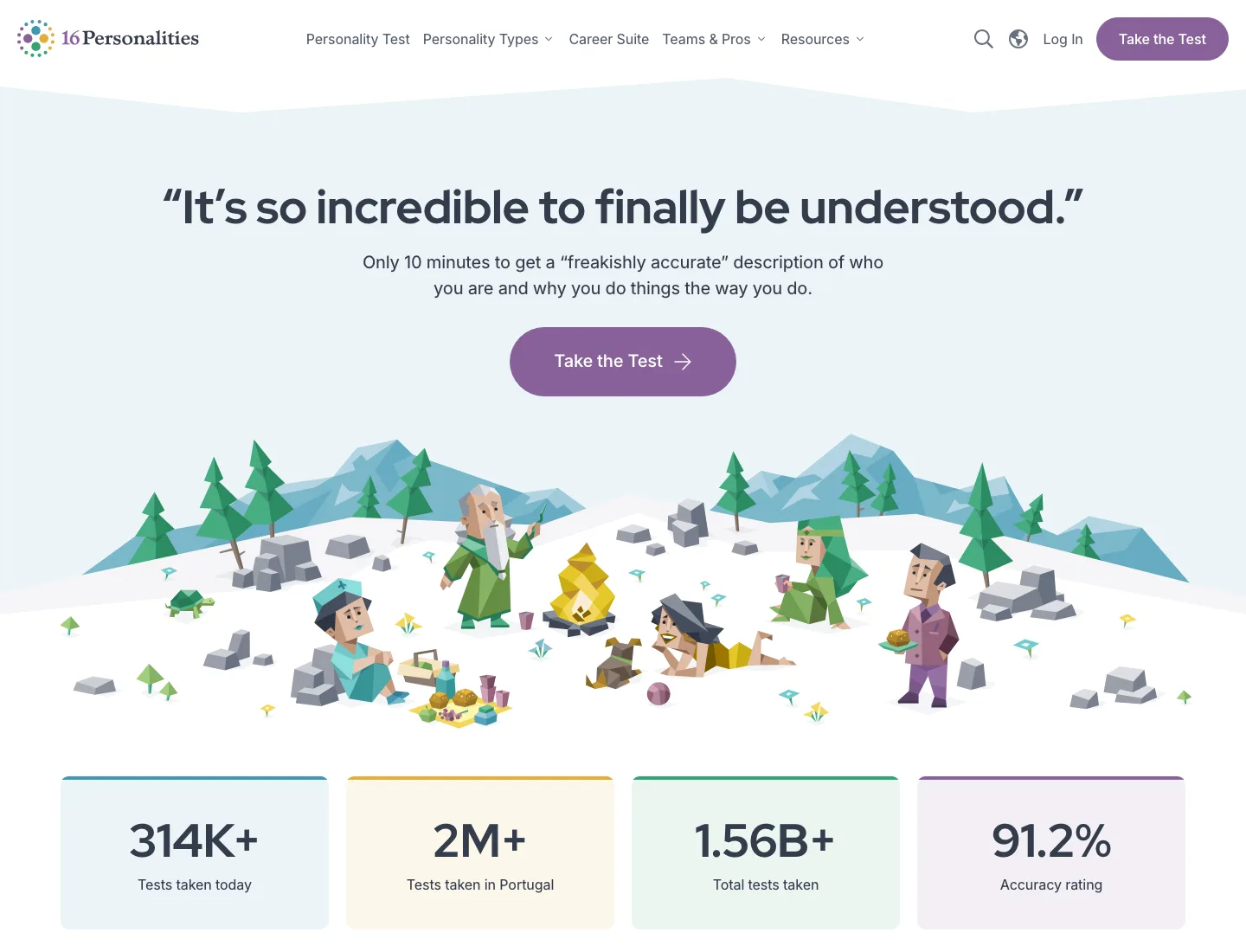
The instrument. The free test is 60 statements, six per screen, each rated on a seven-point scale from agree to disagree. After completion, the engine returns a four-letter type code and an Identity tag: INFJ-T, ENTP-A, ESTJ-T, and so on. The free result is detailed, well-written, and free.
The framework. 16Personalities markets itself as built on "an acronym format" first introduced by Carl Jung and later developed by Isabel Briggs Myers, plus a fifth dimension (Identity: Assertive or Turbulent) derived from contemporary trait research. In other words, the model is structurally MBTI with a Big-Five-style overlay. NERIS Analytics is transparent on its methodology page about the MBTI lineage, and the company correctly notes that the test is "inspired by" rather than a licensed instance of MBTI.
The Premium Career Suite. The career-specific premium tier extends the free type result into workplace-strength readings, career path recommendations, role descriptions tied to each type, and what the marketing calls "transformative career insights." The Premium Career Suite is the relevant product for the keyword "16Personalities career test," and it is a one-off paid tier: €29 on the Premium Career Suite page when we checked.
The volume of marketing. The free product is excellent on engagement, design, and the experience of taking a test that produces a satisfying result. The premium product layers career-specific content on top of the same four-letter type. The structural question this review needs to answer is not whether the experience is satisfying, because it plainly is, but whether the underlying type model is accurate enough to base a career decision on.
What 16Personalities shows you before you pay
I took the test on 25 September 2026, read the free result, and opened the Career Suite checkout without entering any payment details.
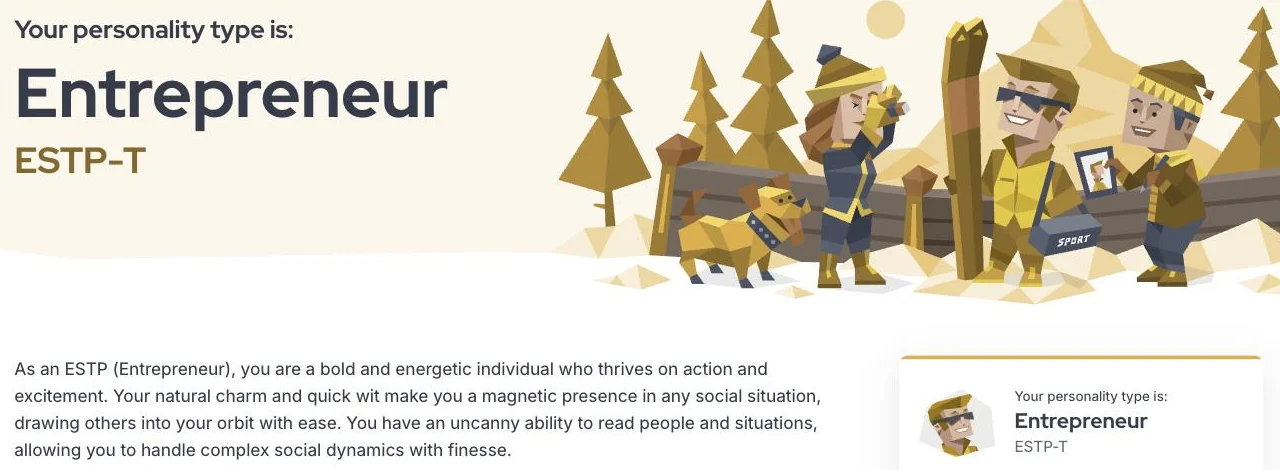
Is the 16Personalities test free? Yes, and so is the result. That is the difference from most funnels in this category: you get your type and a long profile before anyone mentions money. The paid tier is optional.
How much does the Premium Career Suite cost? €29, paid once. The page shows the price up front, and the checkout total matched it with nothing recurring.
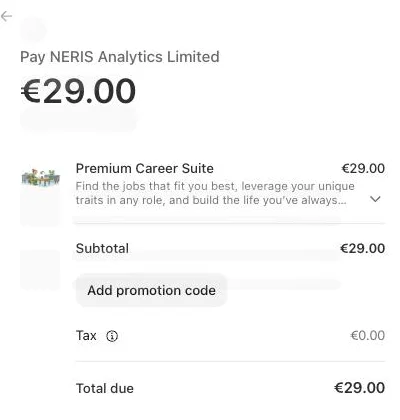
Is 16Personalities legit? Yes. The company is NERIS Analytics Limited in the UK, the test and result are free, and the paid tier is a single payment. If you arrived here because a "free" test charged you a small fee and then a subscription, check the site name on your statement: that pattern shows up in some 16Personalities Trustpilot reviews, but it is not how the 16Personalities test works, and it matches funnels like the one in our personality.co review.
Can you get a refund? The Career Suite page advertises a 30-day money-back guarantee. The Terms (last modified 9 September 2025) offer a refund within 30 days "subject to the provisions below", and one of those provisions excludes products you have already downloaded or accessed. Ask before you open the guide if a refund might matter to you.
What 16Personalities reviews say
The review record is small for a product this size: 28 reviews for a site claiming over a billion tests, all written without an invitation. Most of the low ratings are about money, and five of them describe a subscription that the 16Personalities checkout does not have. Read them as a warning about the category rather than about this product.
The MBTI lineage and what the peer-reviewed literature says
This is the part of the review that matters most, because it is the part 16Personalities does not lead with.
The four-dimensional type model the test produces (Mind, Energy, Nature, Tactics) is structurally identical to the four dichotomies in the Myers-Briggs Type Indicator (Extraversion-Introversion, Sensing-Intuition, Thinking-Feeling, Judging-Perceiving). MBTI has been the subject of sustained peer-reviewed critique for three decades, and the critique converges on three problems that bear on career decisions specifically.
Problem 1: poor test-retest reliability. Pittenger's 1993 paper reported that roughly 50% of test-takers receive a different type when retaking MBTI within five weeks. The figure has been replicated in subsequent reviews. A career-decision tool that produces a different answer on Wednesday than on Monday for the same person is, by definition, not telling you something stable enough to act on.
Problem 2: the dichotomies are artificial. Stein and Swan's 2019 review in Social and Personality Psychology Compass reports that the four MBTI dimensions are continuous in the underlying data, not bimodal. Most people fall near the middle of each dichotomy, not at the poles. Sorting near-middle scores into one of two opposite types (Introvert OR Extravert) inflates differences between similar people and erases differences between people who happen to fall on the same side. Career advice keyed to the resulting type is built on a forced sorting that the data does not support.
Problem 3: the constructs do not predict job performance. Boyle's 1995 review in Australian Psychologist documented that MBTI types correlate weakly with job-performance outcomes once you control for general personality traits captured by the Big Five. The four-letter type adds noise on top of trait-level signal rather than improving it.
16Personalities' Identity dimension (Assertive or Turbulent) is the company's response to the Big-Five critique. By layering a Neuroticism-adjacent dimension on top of the four MBTI dichotomies, the model picks up signal that pure MBTI misses, which is methodologically defensible and the right direction. The problem is that the four core dichotomies remain the load-bearing structure of the test, and the structural critique above applies to them whether the Identity dimension is layered on or not.
The conservative read of the science: 16Personalities is the best-designed product in the consumer personality category, and the type model it inherits is not the right instrument for a career decision you have not yet made.
The four-dimension trap, made concrete
The MBTI critique can sound academic, so here is the concrete version that matters for a career-deciding moment.
Imagine two readers who both score INFJ on 16Personalities. Reader A is 23, finishing a humanities degree, and has never held a paying job. Reader B is 41, has spent 18 years as a corporate lawyer, is currently in therapy for burnout, and has two children in school.
| Reader A | Reader B | |
|---|---|---|
| Age | 23 | 41 |
| Current state | Final year of a humanities degree | 18 years in corporate law |
| Stress signal | No paying job yet, high curiosity | Burnout, in therapy |
| Financial constraint | None major | Mortgage, two children in school |
| Decision horizon | Starting choice for a 40-year career | Transition that must survive the next 18 months |
| Risk tolerance | High (low cost of exit) | Low (high cost of exit) |
| 16Personalities Premium output | Counselor and advocate roles, social-impact sectors, autonomous small teams | Counselor and advocate roles, social-impact sectors, autonomous small teams |
Both readers receive the same 16Personalities Premium Career Suite output: counselor and advocate career path, social-impact roles, ideally autonomous, ideally small teams, recommended sectors including education, non-profit, and clinical psychology.
That output is not wrong. It is not specific enough to be wrong. It is also not specific enough to be useful for either reader, because the two readers are not in the same career-decision moment. Reader A needs a starting choice that compounds over a 40-year career. Reader B needs a transition that survives the next 18 months of mortgage payments without destroying her family's financial stability. Same type, structurally different decision.
The 16Personalities Premium Career Suite is built on the assumption that personality type is the load-bearing variable in career fit. The MBTI critique is the technical version of why that assumption is too thin. The lived version is what the two INFJ readers above face when they try to act on the same advice from radically different life stages.
What MyPassionAI is, and how it differs structurally
A disclosure before this section: I am the founder of MyPassionAI, so the operator-level detail you are about to read comes from owning the code, and the bias that comes with that is unavoidable. The honest counter is to publish the comparison anyway, with verifiable claims and the unflattering bits about my own product included.
I launched MyPassionAI in late 2025 after a decade of optimising a career for the wrong target. The thesis of the product is state-dependent: career fit is not a stable function of personality alone, it is a function of where you are right now (current life stage and current struggle), what you want to optimise for next (priority type), and how the stable signals (flow, values) interact with both. Two people with similar personality profiles can need different careers if one is a 22-year-old graduate and the other is a 35-year-old burnt-out parent.
The instrument. 26 questions, branching from the opening question. The first question asks which of four statements best describes your current situation: a student or graduate with no direction, someone in a paying career who wants change, someone with too many interests, or someone stuck or unemployed. Your answer to that opening question decides what you see next. The branching is not cosmetic, because it changes the signal we extract from the early questions.
The framework. The output is one of 20 named archetypes produced by a 2D matrix:
- 5 struggle types (y-axis): Career Switcher, Grad Explorer, Multi-Passionate, Purpose Seeker, Explorer
- 4 priority types (x-axis): Income-Focused, Lifestyle Seeker, Stability First, Experimenter
The archetype name encodes both what is currently hard and what you want next. Both axes are designed to change as your life changes, which is the exact attribute that MBTI critique argues type-based instruments lack.
What the quiz measures. Four signals are named explicitly on our methodology and in the test design: situational struggle (the branching opener), flow markers (when you lose track of time), values (what you would do if money were no object), and priority type. The flow framing draws on Csíkszentmihályi's foundational work on the psychology of optimal experience, and the intrinsic-motivation framing draws on Self-Determination Theory.
Why state matters more than type for direction. The two-reader thought experiment above is the structural defence. Reader A and Reader B share an INFJ result and need different careers, because the variable that differentiates their decisions is not personality. It is struggle and priority. MyPassionAI's matrix is built around the variables that vary between them, not the variable that is invariant.
The commercial model. The free quiz returns your archetype and a personalised reading, and the full report is a one-off payment with detailed career matches and fit scores. For people acting on the result, the one-off Career Switch Kit adds your experience translated for the new field, your CV rewritten for the matched path, your LinkedIn written, 10 outreach messages, a four-week plan and an unlimited AI coach. Current pricing at mypassion.ai/pricing. There is no subscription.
What 16Personalities gets uniquely right
Honest section, because 16Personalities does several things meaningfully better than most consumer assessments.
1. The writing. The type descriptions on 16Personalities are some of the best-written consumer-psychology content on the public internet. They are specific, internally consistent, and emotionally resonant. The product holds an engagement bar that most peer-reviewed instruments cannot.
2. The product experience. The test is fast, the result is fast, the type page loads instantly, the typography is excellent, and the mobile flow is at the top of the category. Most psychometrically rigorous instruments still ship interfaces that look like 2008.
3. The vocabulary effect. Even critics of MBTI concede that having shared language for personality differences (extraversion versus introversion, intuitive versus sensing) creates conversations that would not otherwise happen, and 16Personalities popularised that vocabulary at a scale no academic instrument has matched.
4. Free is genuinely free. The base type result is free, useful, and not paywalled. The Premium Career Suite is an upsell, not a bait-and-switch, which is more honest than most competitors and worth naming.
5. Self-knowledge is not zero-value. A 16Personalities result that helps a reader name something they had not previously named ("I keep needing alone time after social events") has standalone value, separate from career decisions. The career-decision critique is specifically about acting on the type, not about the type as a self-reflection prompt.
What MyPassionAI gets uniquely wrong, honestly
1. No type vocabulary effect. 16Personalities has created a shared language that millions of people use casually. MyPassionAI's archetypes (Career Switcher Stability First, Multi-Passionate Experimenter) are descriptive, but they do not have the cultural penetration of "INFJ" or "ENTP." Brand vocabulary is a meaningful moat we do not have today.
2. Smaller scientific footprint. Our matrix is informed by Self-Determination Theory, flow research, and our published research dataset (6,837 responses in the Career Change Report 2026). It has not been peer-reviewed. The MBTI critique is also a structural standard we are held to, and the right honest position is that our framework has the same obligation to validate over time.
3. Newer brand, narrower trust signals. 16Personalities was founded in 2011 and has been refining its product for over a decade, whereas MyPassionAI is months old. If brand longevity is a meaningful trust signal for you, 16Personalities wins on that axis and we earn it over time rather than today.
4. It points a direction, not a finished plan. The free archetype and reading give you a genuine read on where you are and what fits, and the full report adds detailed career matches and fit scores, but testing a path and making the move is still your work. 16Personalities will not do that part for you either; the quiz is the starting input to the decision, not a substitute for acting on it.
Who should take which
Take the 16Personalities test if any of these apply:
- You want a self-reflection prompt rather than a career-decision tool, and you treat the type as a starting vocabulary rather than an answer
- You value the writing and the experience, and you want a polished, fast result
- You have already taken a career-specific instrument, and you want the personality-trait layer as adjacent context
- You are entertained by typology and want to participate in the cultural conversation around four-letter codes
- The premium upsell does not feel like the right way to make a career-defining decision, and you are happy with the free type result
Take the MyPassionAI career quiz if any of these apply:
- You are making a direction decision (which career fits the version of you that exists today, given your current struggle and priority), not a self-reflection exercise
- You want a state-dependent reading that changes when your life changes, rather than a stable type that is supposed to hold across all decisions
- You prefer a named, traceable methodology over a Myers-Briggs-lineage type model
- You have under 10 minutes and want a result optimised for "what should I do next"
There is no rule against doing both. Take 16Personalities for the vocabulary and the self-reflection prompt, then take MyPassionAI for the actual direction decision. The two products are aimed at different reader questions, and the answers do not collide.
If neither fits
Six other Quiz Comparisons in the silo are worth a glance:
- The Truity career test review and comparison if you want a peer-reviewed methodology (Big Five plus Holland Code) and a one-off detailed report
- The Princeton Review career quiz comparison if you want a free, 5-minute, broad-strokes alternative for a high-school or early-college audience
- The Sokanu / CareerExplorer review if you want a RIASEC plus Big Five instrument with a 1,500+ career database and have 60 to 90 minutes available
- The Apt AI career test review if you want an AI-driven assessment bundled with resume and job-board tools in a monthly subscription
- The CliftonStrengths for career choice guide if the question is less "what type am I" and more "what am I good at": it is the other assessment corporate HR pairs with MBTI, and the guide covers where talent themes help a career decision and where they do not
- The HIGH5 strengths test review if you want the free strengths-first alternative to CliftonStrengths and a read on what its five-theme report can and cannot tell you about direction
If burnout is the immediate blocker for your decision, the burnout recovery diagnostic comes before any quiz signal can be trusted. The conceptual foundation for why state-dependent signal matters is in how to find your passion.
The bottom line
16Personalities is the best-designed product in the consumer personality category, a credible self-reflection prompt for tens of millions of users, and an instrument whose underlying type model has been critiqued in peer-reviewed psychometrics for three decades. The free test is genuinely free, the writing is excellent, and the experience is at the top of the category. The Premium Career Suite layers career-specific content on top of the same four-letter type code, and the question worth carrying through that purchase is whether you want a career decision tied to that type or to a more state-sensitive reading of where you are.
MyPassionAI is the structural inverse: branched, situational questions in under 10 minutes, an archetype matrix that combines current struggle and current priority into one named result on top of stable signals like flow and values, and a focused one-off report with detailed career matches and fit scores. The tradeoffs are smaller user base, narrower brand vocabulary, no peer-reviewed methodology yet, and no decade of brand longevity.
If you want a satisfying self-reflection prompt and a popular type vocabulary, take 16Personalities. If you want a career-direction reading whose answer depends on where you are in your life right now, take MyPassionAI. If the question that brought you here was specifically "is the 16Personalities career test accurate enough to act on?", the conservative read of the peer-reviewed literature is that the underlying type model is too unstable to base a career-defining decision on alone, and that a state-dependent instrument or a peer-reviewed Big-Five-plus-Holland instrument is the stronger second opinion before the decision is final.
If you are working through the type-based tools generally, the two neighbours worth reading next are our Crystal Knows review, which covers the DISC variant of the same idea applied to other people rather than to you, and is Personality.co legit, which unpicks the pricing pattern this category keeps reinventing. For free alternatives that measure something other than type, see Red Bull Wingfinder and HIGH5. If the trait you came to check is introversion specifically, jobs for introverts turns it into working conditions rather than a label. The DISC equivalent, read against other people rather than yourself, is Crystal Knows. And if the accuracy question is what brought you here, AI and traditional career assessments compared is the wider version of it: what each kind of tool has actually published, and why a fit score is a similarity measure rather than a probability.
Frequently Asked Questions
Ready to find your passion career?
The free under-10-minute quiz maps your childhood patterns and flow triggers to one of 20 archetypes, then gives you matched careers and a 7-day first-step plan.
Take the Free Career QuizRelated Articles
Trusted by 12,900+ career-quiz takers across 166+ countries · Methods covered in