
YouScience Review (2026): Is the $49 Aptitude Test Worth It? What the Brain Games Measure
An honest YouScience review: the 11 timed exercises, the $49 price (down from ~$200), who Discovery fits, and the career question aptitude can't answer.

Contents · 12 sections
If you are weighing the YouScience aptitude test, the question underneath the search is usually some version of this: will this tell me what to do with my career? YouScience will tell you something true and useful, namely what you are naturally wired to be good at, measured by performance rather than by self-report. Whether that answers your career question depends on which question you are asking. If you are 17 and choosing a direction, aptitude is a strong opening signal. If you are 38 and burnt out, learning that you have high aptitude for the field draining you is not the answer, it is the problem restated.
Two facts first, because they are what most searches for YouScience are asking. It costs $49.00, paid once, with no subscription (we opened the checkout on 25 September 2026). And it is free only through a school licence: individuals pay before taking the test and get no preview.
The honest version of the answer depends on where you are right now: your archetype, the struggle you are in, and what you need to optimise for next. A first-year student and a burnt-out mid-career professional can share an identical aptitude profile and need opposite next moves. That gap is the whole subject of this review.
A note on framing before anything else. I am the founder of MyPassionAI, the comparison product in this review, so I have a commercial reason to argue for a state-dependent approach over an aptitude-only one. I kept every claim to what you can verify on YouScience's own pages or in third-party reviews, and I gave aptitude testing a fair and specific defence before getting to where it stops short.
TL;DR comparison
| Dimension | YouScience | MyPassionAI |
|---|---|---|
| What it is | Aptitude-and-interest assessment built on the Ball Aptitude Battery | Situational career-direction quiz built on a struggle-priority matrix |
| Primary customer | K-12 schools (7,000+ across all 50 states), plus individuals and employers | Individuals making a career-direction decision |
| What it measures | 9 core aptitudes via timed brain-game exercises, plus an interest inventory | Current struggle, current priority, flow markers, values |
| How you answer | Performance on timed exercises, hard to game | Branching self-report questions |
| Time to complete | ~90 minutes, 11 exercises, pausable across sessions | under 10 minutes |
| Output | Aptitude profile plus career matches against O*NET, 500+ careers | One of 20 archetypes from a 5x4 matrix, with career matches and fit scores |
| Result stability | Aptitude framed as innate and stable | State-dependent, changes when your life changes |
| Individual price | $49.00 one-time, no subscription (checkout, 25 Sep 2026) | Free archetype tier; full report price at mypassion.ai/pricing |
| Best for | Knowing what you are naturally wired to be good at | Deciding what to do next given where you are right now |
Everything below is the work behind that table.
What the YouScience aptitude test is
YouScience is a career-discovery platform headquartered in American Fork, Utah. Its flagship individual product, YouScience Discovery, is an aptitude-and-interest assessment used by more than 7,000 schools across all 50 states, alongside individuals and employers. The brand is one of the most-searched career assessments on the internet, largely on the strength of that school distribution.
The instrument. Discovery runs about 90 minutes through 11 timed exercises of 4 to 15 minutes each, with optional additional exercises on top. YouScience describes these as "brain game-like exercises" adapted from the Ball Aptitude Battery, which the company says rests on more than 50 years of research. You answer by performing tasks under time pressure, not by rating statements about yourself, and you can pause between exercises and finish across two or more sessions. It needs a desktop or laptop with a full keyboard.
What it measures. The core assessment reads nine aptitudes: idea generation, numerical reasoning, spatial visualization, sequential reasoning, inductive reasoning, visual comparison speed, timeframe orientation, vocabulary, and work approach. Optional exercises add numerical computation, associative memory, hand-eye coordination, and two memory measures. Layered on top is an interest inventory, because YouScience's stated thesis is that interests are shaped by exposure while aptitudes are innate.
How matching works. A proprietary algorithm compares your aptitude profile against career requirements drawn from the U.S. Department of Labor's O*NET database, then surfaces matches across 500+ careers. You keep access to the results for 10 years.
The commercial model. For individuals Discovery is a $49 one-off purchase, down from roughly $200 a few years ago. Most students never see that price because their school district has bought licenses. The homepage no longer mentions individuals at all; the purchase page sits at youscience.com/buy-now.
What YouScience shows you before you pay
With YouScience the order is reversed: you pay first, then take the test. So the walkthrough here is the purchase path, which I followed to the payment screen on 25 September 2026 without entering anything.
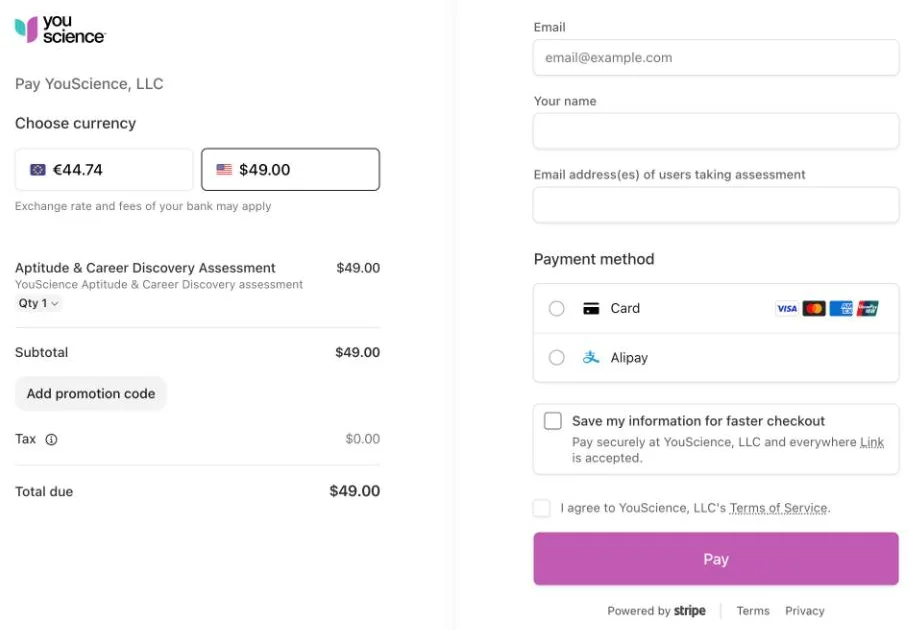
How much does YouScience cost? $49.00, once. No trial, no renewal, no upsell on the checkout. Tax showed as $0.00 on a US-dollar checkout, and a euro price of €44.74 is offered.
Is the YouScience aptitude test free? Only through school. If your school or district licenses YouScience Brightpath, students take it free; ask the counselor. Individuals get no free version and no preview, which is the main difference from most consumer career quizzes, where the test is free and the result is sold.
Is there a YouScience promo code? The checkout has a promotion code field. YouScience does not publish codes on its site; schools and counselors are the usual route to free access.
Can you get a refund? The Terms of Use (last updated 15 February 2023) contain no refund clause. If you buy and the test does not work for you, email support@youscience.com; there is no written guarantee to point to.
What YouScience reviews say
The public review record for YouScience is thin, and it is almost entirely about school.
Trustpilot shows 29 reviews and a 1.8 TrustScore. Split by how they were collected, the 12 YouScience invited average 4.58 stars and the 17 written without an invitation average 2.65. Read the text and the split matters less than the setting: 8 of the 11 low ratings and 11 of the 18 high ones come from school use. Students assigned the test in class call it long and boring; teachers and counselors praise the certifications and the support. Almost nobody reviewing it bought it for themselves at $49, which is worth knowing if that is what you are about to do.
What aptitude testing gets right
This section is genuine, because YouScience does several things that put it ahead of most consumer career quizzes.
1. It measures performance, not self-report. Most career quizzes ask you to describe yourself, and self-description is biased by mood, by how you want to be seen, and by what you happen to believe about yourself that day. YouScience asks you to do timed tasks and scores what you did. That is a structurally stronger signal than a Myers-Briggs-style type, and harder to game.
2. The interest-versus-aptitude distinction is a useful correction. YouScience's central insight is that you cannot be interested in something you were never exposed to, so an interest-only quiz quietly penalises anyone with a narrow background. The company reports that female high-school students show more than four times the aptitude as interest for careers in architecture and engineering. Whatever you think of any single statistic, the underlying point is sound: interest alone is a thin basis for a career decision.
3. It compressed a serious instrument into an affordable one. Rigorous aptitude testing used to mean an eight-hour Johnson O'Connor session. YouScience brought a structured aptitude battery down to about 90 minutes and $49, grounded in O*NET rather than in a proprietary career list with no public basis. For a 17-year-old with no idea what they are wired for, that is a meaningful upgrade over guessing.
If your question is strictly "what am I naturally good at," YouScience answers it well. The rest of this review is about the question it does not answer.
Where aptitude stops short for a career decision
Aptitude is one input to a career decision. Treating it as the decision creates three specific gaps.
Gap 1: aptitude is not direction. By YouScience's own framing, aptitudes are innate and stable. A stable trait is, by definition, the thing about you that did not change. But career-direction decisions are made by people whose situation changed: a graduation, a layoff, a burnout, a move, a child. The variable that moved is not your aptitude, it is your context. An instrument that holds still by design cannot tell you what to do about the part of your life that moved. When that move was a layoff, start with the numbers: the severance pay calculator shows what the package is worth after tax and how many months it buys you.
Gap 2: good at it is not the same as sustained by it. Aptitude predicts performance. It does not predict engagement. You can have high aptitude for work that drains you, and high aptitude is frequently the exact mechanism by which people get trapped: they were good at it, so they kept going, so they accumulated a decade of experience in it, so leaving felt irrational. Csíkszentmihályi's research on flow and Deci and Ryan's Self-Determination Theory point at the same missing piece: sustainable work depends on intrinsic motivation and flow, not on capability alone.
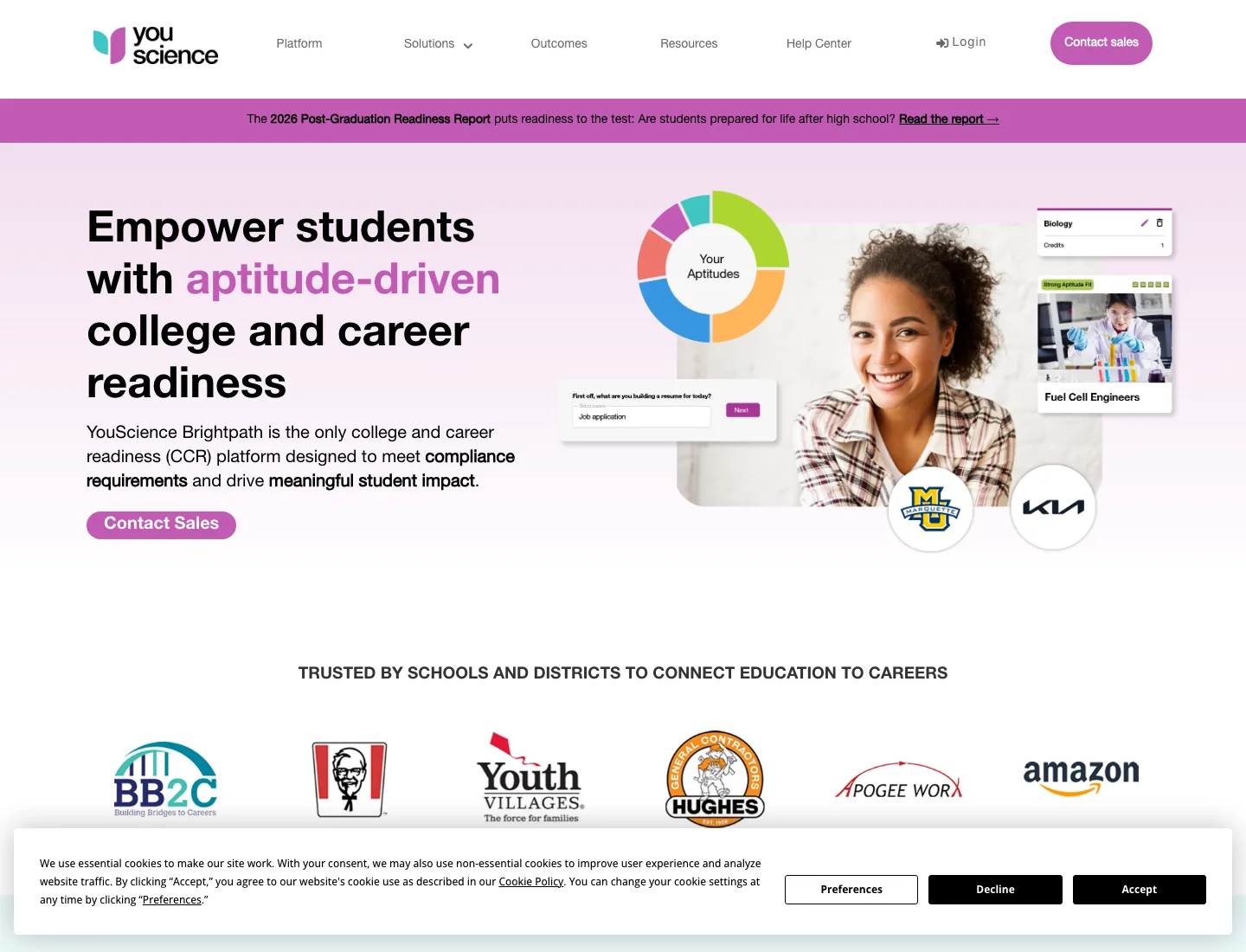
Gap 3: it is built for the school funnel. YouScience's design center is the K-12 classroom, and it shows in the product. The 90-minute battery, the desktop-and-keyboard requirement, the long report, and the professional debrief that third-party reviewers say improves interpretation all make sense inside a supervised classroom with a counselor attached. The Odyssey College Prep review of YouScience notes the tool "cannot reliably assess student-career matching without specialist guidance." For an adult deciding alone on a laptop at 11pm, that supervision is not there, and the format is friction rather than support. (If you are the student the tool was designed for and the bigger question is what comes next after graduation, the what to do after high school guide covers the decision aptitude scores feed into.)
You do not have to take my word for the school-funnel read; it is the company's own homepage:
The two-reader version, made concrete
The gaps above can sound abstract, so here is the version that matters in an actual decision.
Imagine two people who take YouScience and receive a near-identical aptitude profile: high spatial visualization, high inductive reasoning, strong numerical reasoning.
| Reader A | Reader B | |
|---|---|---|
| Age | 19 | 38 |
| Current state | First-year student, no work history | 10 years as a mechanical engineer |
| What is hard right now | Undecided, broad curiosity, no anchor | Burnt out, wants out of engineering |
| Financial constraint | None major | Mortgage, dependents |
| YouScience aptitude profile | High spatial visualization and inductive reasoning | High spatial visualization and inductive reasoning |
| YouScience career matches | Engineering, architecture, industrial design, skilled trades | Engineering, architecture, industrial design, skilled trades |
| What that answer is worth | A useful starting nudge toward a field | The field she is trying to leave |
For Reader A, the YouScience output is helpful. She has no anchor, and a credible signal that says "you are wired for spatially demanding, analytical work" narrows a wide field.
For Reader B, the same output is the problem restated back to her. She already knows she is good at engineering. Ten years of performance reviews told her so. Aptitude was never her question. Her question is whether to stay in a field she is capable of and drained by, and if not, where her capability could go that her current role does not. A stable aptitude score cannot reach that question, because the thing that changed for Reader B, her exhaustion and her priorities, is exactly the thing the instrument does not measure.
What MyPassionAI is, and how it differs structurally
A disclosure before this section: I founded MyPassionAI, so the operator detail here comes from owning the code, and the bias that comes with that is unavoidable. The honest counter is to publish the comparison with verifiable claims and the unflattering parts of my own product included.
I launched MyPassionAI in 2025 after a decade of optimising a career for the wrong target. The thesis is state-dependent: career fit is not a stable function of capability alone, it is a function of where you are right now (your current struggle), what you want to optimise for next (your priority), and how stable signals like flow and values interact with both.
The instrument. 26 questions, branching from the first question. The opening question asks which of four situations describes you: a student or graduate with no direction, someone in a paying career who wants change, someone with too many interests, or someone stuck or unemployed. Your answer reshapes the questions that follow, so the quiz reads your situation before it reads anything else.
The framework. The output is one of 20 named archetypes from a 2D matrix: five struggle types (Career Switcher, Grad Explorer, Multi-Passionate, Purpose Seeker, Explorer) crossed with four priority types (Income-Focused, Lifestyle Seeker, Stability First, Experimenter). Both axes are designed to move when your life moves, which is the attribute an aptitude score cannot have.
What it measures. Beyond the situational read, the quiz looks for flow markers (when you lose track of time) and values (what you would do if money were no object). Those two signals target Gap 2 above directly: not whether you can do the work, but whether the work holds you.
The honest scope. MyPassionAI does not measure aptitude. It will not tell Reader A whether she is wired for spatial reasoning. It tells her, and Reader B, what kind of move fits the situation each is in, in under 10 minutes. If you want both readings, taking YouScience for capability and MyPassionAI for direction is a coherent pair, not a contradiction.
What MyPassionAI gets wrong, honestly
1. No performance measurement. MyPassionAI is self-report. YouScience's timed brain games are harder to game and are a structurally better way to measure what you can do. On capability, YouScience wins, and it is not close.
2. No aptitude data at all. If your question is "what am I naturally good at," MyPassionAI does not answer it. YouScience does. We measure situation, flow, and values, and those are different inputs entirely.
3. Newer, smaller, less validated. YouScience has school distribution across all 50 states, a 10-year results archive, and an aptitude battery with a long research lineage. MyPassionAI is months old, its matrix is informed by Self-Determination Theory and flow research but has not been peer-reviewed, and it has none of that institutional footprint yet.
4. We do not get you the job. The free result reads your situation, flow and values; the full report adds detailed career matches and fit scores; and the one-off Career Switch Kit does the switching work: your experience translated for the new field, your CV rewritten for the matched path, your LinkedIn written, 10 outreach messages, a four-week plan and an unlimited AI coach. There is no job board and no interview prep, and applying stays yours. YouScience will not make the decision for you either.
Who should take which
Take the YouScience assessment if any of these apply:
- You are a student, or the parent of one, and the core question is "what am I wired to be good at"
- Your school or college already provides it, so it costs you nothing
- You want a performance-based result rather than a self-description, and you have 90 minutes for it
- You specifically want aptitude data to weigh against your interests
Take the MyPassionAI career quiz if any of these apply:
- You are making a direction decision, not a capability audit: which career fits the version of you that exists today
- Your situation recently changed (graduation, burnout, a layoff, a move) and you need an answer that accounts for that
- You want a result that updates when your life updates, rather than a stable trait score
- You have under 10 minutes and want a starting point optimised for "what should I do next"
If neither fits
Other Quiz Comparisons in this silo are worth a look:
- The Sokanu / CareerExplorer review if you want a RIASEC-plus-trait instrument with a large career database and an hour to spend
- The Truity career test comparison if you want a peer-reviewed methodology pairing Big Five with Holland Code
- The Apt AI career test review if you want an AI-driven assessment bundled with resume and job-search tools
- The 16Personalities career test review if you are weighing a personality-type product and want the science behind it first
- The JobTest.org review if you want another paid instrument assessed before you spend, including what sits behind its paywall
- The CareerFitter test, walked to the paywall if you want a cheap work-personality inventory and a long career list instead of an aptitude battery
- The Sparketype review if the aptitude framing appeals but you want the work-you-are-wired-for version of it
If the deeper question is not which test to take but how to think about passion and direction at all, how to find your passion is the conceptual foundation underneath every quiz in this silo.
The bottom line
YouScience is a methodologically respectable aptitude assessment, more rigorous than the personality quizzes it competes with, fairly priced at $49 for individuals, and genuinely useful for the question "what am I wired to be good at." Its scientific approach, performance-based scoring, and O*NET grounding are genuine strengths, and a student with no anchor will get value from it.
The limit is scope, not quality. Aptitude is one input to a career decision, and YouScience treats it as close to the whole decision. It cannot see the variable that moved in your life, it does not measure whether a high-aptitude field sustains you or drains you, and it is built first for a supervised classroom rather than for an adult deciding alone.
If your question is capability, take YouScience. If your question is direction, the version of "what should I do next" that depends on where you are in your life right now, take the MyPassionAI career quiz: under 10 minutes, 26 branching questions, one of 20 situational archetypes, and career matches built around the part of you that changed rather than the part that held still. The quiz also flags which archetypes are most prone to staying too long in work they are good at, which is the exact trap a high aptitude score can quietly set. For the school-side versions of both, our educator resources page collects what counsellors can hand out, and teenagers deciding before graduation are better served by the career quiz for teens or, once enrolled, the career quiz for students.
YouScience is the strongest genuine aptitude instrument in the consumer market, which makes the comparisons worth naming: Pymetrics applies the same performance-based logic to hiring, Jobtest.org claims the aptitude label without naming its instruments, and the best career aptitude test roundup ranks what actually qualifies. On the free side, Google Career Dreamer is the closest thing to a no-cost equivalent, ranked alongside the rest in best AI career assessment tools. For the readers YouScience is actually sold to, what to do after high school covers the decision it is meant to inform, how to choose a college major the one that follows it, and childhood interests and career the signal it is trying to measure. On the older-versus-newer question underneath all of this, the evidence behind AI and traditional tests is where the validation records get compared directly.
Frequently Asked Questions
Ready to find your passion career?
The free under-10-minute quiz maps your childhood patterns and flow triggers to one of 20 archetypes, then gives you matched careers and a 7-day first-step plan.
Take the Free Career QuizRelated Articles
Trusted by 12,900+ career-quiz takers across 166+ countries · Methods covered in