
Career Change at 40: How to Switch Without Starting Over
How to change careers at 40 without starting over: the runway math around a mortgage and kids, the 24-month sequence, the first age screen, and the fields that pay.


Contents · 9 sections
A career change at 40 is common, it usually works, and the obstacles that make it harder than at 30 are specific and plannable. The American Institute for Economic Research surveyed workers aged 47 and over and found that 82% of those who attempted a career change after 45 succeeded, and half of the successful changers ended up earning more than before. At 40 you start five years earlier than that group, with roughly 25 working years ahead of you. What follows is the plan for this decade: the runway math around a mortgage and children, the 24-month sequence, the first age screen, and the fields where 15 years of experience counts as a qualification.
What changes at 40 is the stake. This is the decade when a mortgage, children at home and ageing parents most often arrive at the same time, when you step down from the highest salary your field has paid you so far, and when US law first classifies you as an older worker. Every section below is written around those three facts.
I am Marco Kohns, founder of MyPassionAI. If you want to know first which kind of change you are facing, a new employer, a new function or a new profession, the career change at 40 quiz reads that from your answers in under ten minutes. The rest of this page is the plan it feeds into.
What makes a career change at 40 different from 30 or 50?
Four things are true at 40 that are not true, or not as sharply true, a decade either side.
You are most likely to be caring for two generations at once. Pew Research Center's September 2025 survey of 8,750 US adults found that 54% of people in their 40s have a living parent aged 65 or older and are raising a minor child or supporting an adult child. That is the highest share of any decade.
| Answer | Share |
|---|---|
| 18 to 29 | 8% |
| 30 to 39 | 25% |
| 40 to 49 | 54% |
| 50 to 59 | 45% |
| 60 and older | 10% |
That chart is from Pew's August 2026 update on the sandwich generation. At 30 most people have not reached this stage. At 50, the minor children have usually become adult children, which changes what the money is for.
Your mortgage is probably new. The median first-time US home buyer is now 40, a record high in the National Association of Realtors' 2025 Profile of Home Buyers and Sellers. If you bought in the last few years, the loan was sized to the salary you now want to step away from.
You are stepping down from a peak. At 30 the salary you leave behind is still climbing. At 40 it is usually the highest your current field has paid you, and the first role in a new field is often a level or two below it. The cut is steeper in cash terms even when it is the same in job-title terms.
The law now treats you as an older worker. The Age Discrimination in Employment Act forbids age discrimination against people aged 40 or older, at employers with 20 or more employees. What that means for a job search is covered below.
Is 40 too old to change careers?
No. At 40 you have about 25 working years left if you stop in your mid-60s, and a two-year transition uses about 8% of them.
Job changes at this age are normal. People born between 1957 and 1964 held an average of 12.9 jobs from ages 18 to 58, according to the US Bureau of Labor Statistics' National Longitudinal Survey, and 2.9 of those jobs came between 35 and 44. A career change is a bigger move than a job change, and the best outcome data for it comes from workers slightly older than 40.
That data is AIER's New Careers for Older Workers report. Of 2,009 panel members aged 47 and over, 405 had attempted a career change after 45. Of those, 82% succeeded, and of the successful changers, 90% called the move a success and 87% said they were happy or very happy with it. The same table shows the cost: three in ten saw their income fall.
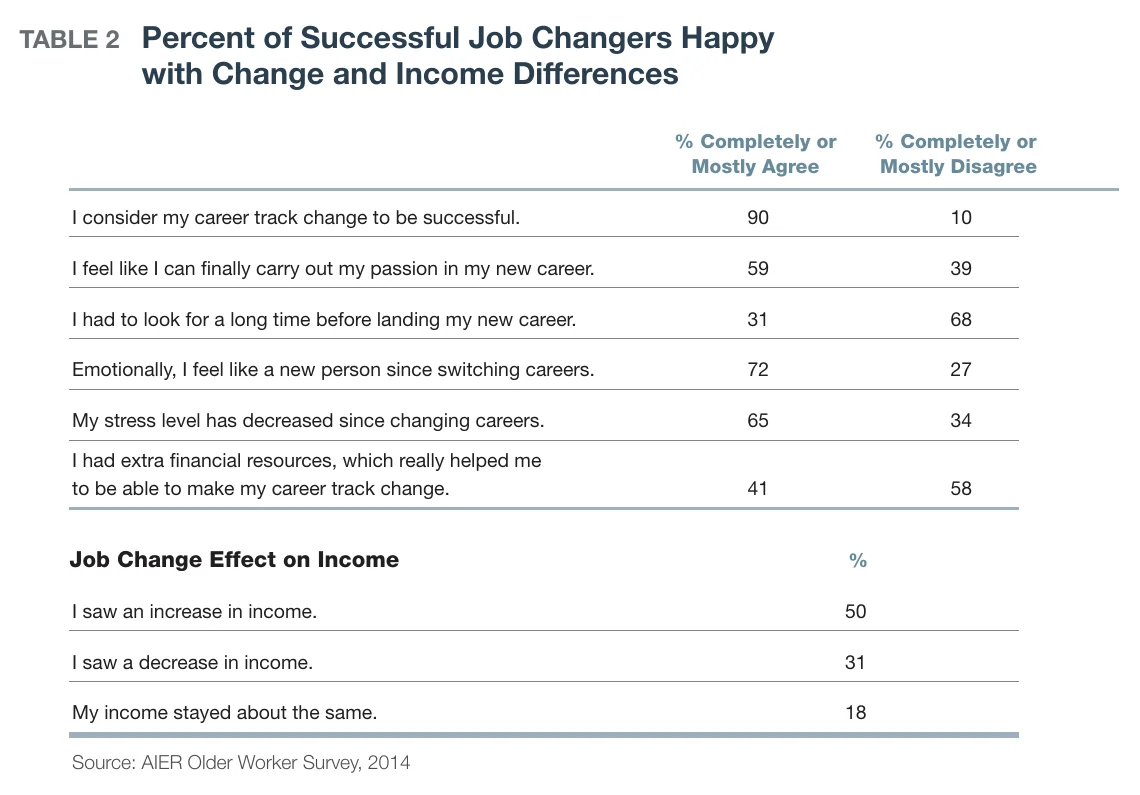
Two findings from the same report matter more for a 40-year-old than the headline rate. Successful changers used an average of 7 of the survey's 14 skills in both their old and new jobs, against 2 for the people whose change failed. And successful changers applied to 8 jobs on average and searched for 11 months, where unsuccessful changers applied to 20 and searched for 22. The people who succeeded moved toward work that reused what they already did, and applied narrowly.
Our own data adds the view from the people asking the question. In the Career Changer Index, which keeps only quiz takers with four or more years of experience, about one in five of those aged 35 to 44 name being stuck or bored as their core struggle, and the share keeps rising in each older band.
| Answer | Share |
|---|---|
| 25-34 (n = 1,121) | 16.3% |
| 35-44 (n = 1,279) | 20.2% |
| 45-54 (n = 766) | 21.4% |
| 55+ (n = 254) | 25.2% |

How do you make a career change at 40?
Plan it as 24 months in four phases. The sequence matters more at 40 than at 30 because a failed jump costs more when the mortgage payment is fixed and two generations depend on the income.
Months 0 to 3: the number and the audit
Write down two things before you look at a single job listing. The first is your runway number (next section). The second is a skills audit: the five or six things you do in your current role that other people come to you for. Negotiating with suppliers, explaining a regulation to a sales team, running a quarter-end close, calming a client. The AIER finding on shared skills says the right target field is the one where most of that list still applies.
Months 3 to 9: experiments inside your current job
Test two or three candidate fields while the salary is still arriving. At 40 you usually have the seniority to ask for this inside your current employer: volunteer for the cross-functional project, shadow the team you are curious about, take one freelance project in the evenings, or complete one short certificate. Harvard Extension School reports that more than 80% of its certificate students worked full time while studying, and in a survey of 1,000 recent completers, 42% took on more responsibility, were promoted or changed careers while still in the programme.
By month 9, one field should be clearly ahead. If none is, run another round of experiments before you resign from anything.
Months 9 to 15: the bridge role
Your first job in the new field is a bridge. Choose the bridge that keeps as much of your current work as possible, either the same function in a new industry or the same industry in a new function, because that is where your existing skills carry the most weight and the pay step down is smallest. A finance manager who moves into financial planning and analysis at a software company has changed industry and kept function. A finance manager who retrains as a UX designer has changed everything at once.
Clinicians face the same choice. A doctor who moves into utilization management keeps the medicine and changes the setting, which is how the guide to where physicians go after clinical practice sorts the exits. The guides for nurse practitioners who want to keep the NP earning and physical therapists moving beyond the clinic draw the same line between leaving the setting and leaving the profession.
Months 15 to 24: the role that fits
The second role is where the fit improves. By now you have a year of results in the new field, a network inside it, and a clear sense of which part of the work you want more of. This is the step where AIER's finding applies: half of successful changers eventually earned more than before.
How much runway does a career change at 40 need?
More than at 30, because the floor under your spending is higher and less flexible. A useful starting target is 9 to 12 months of essential costs, and the way to get a precise number is to price each obligation that is specific to this decade.
| Cost at 40 | Why it is larger at 40 | How to size it |
|---|---|---|
| Income gap in the bridge role | You are stepping down from your field's peak salary | (Current take-home minus likely bridge take-home) x 12 to 18 months |
| Mortgage | Often a recent loan sized to your current salary | Keep the full payment in the floor; do not assume a refinance |
| Children at home | Most sandwiched 40-somethings have a child under 18 | School, childcare and activity costs for the full 24 months |
| Support for a parent | 54% of people in their 40s are sandwiched | A buffer line, even if you pay nothing today |
| Paused retirement contributions | Pausing for two years still leaves 25 years of compounding lost | Decide in advance whether you pause, and for how long |
On the last row, some arithmetic: at an assumed 5% annual return after inflation, a contribution you skip at 40 would have grown about 3.4 times by 65. Pausing is often the right call during a transition, and it is cheaper to decide the length of the pause now than to discover it at month 18.
The full method for turning those lines into one number, including five ways to shrink the gap, is in how much savings you need before a career change.
Will age screening hurt you at 40?
It can, and 40 is where it starts. In an AARP survey of 2,914 US adults who were working or looking for work, 70% of job seekers said they had been asked for age-related information, such as a birth date or graduation year, during applications or interviews. Workers in their 40s mostly see the problem coming, and mostly do not know their rights.
| Answer | Share |
|---|---|
| Believe it is very or somewhat common | 69% |
| Have heard others' stories of it | 48% |
| Have witnessed it | 20% |
| Know protection starts at 40 | 9% |
| Have experienced it themselves | 7% |
The figures come from AARP's report on workers in their 40s. For a career changer, the screen usually happens on paper, before anyone meets you. Four adjustments help:
- Cap the CV at the last 15 years and summarise anything earlier in one line. Recruiters need your recent results, and a 1990s start date invites the age calculation.
- Leave graduation years off unless an application form requires them.
- Lead with the transferable result, stated in the new field's language. "Cut month-end close from nine days to five" reads as operations capability to a hiring manager outside finance.
- Apply through people more than portals. AIER's successful changers applied to 8 jobs where the unsuccessful ones applied to 20. A referral from someone inside the target field gets you past the stage where age screening happens.
If the screen goes the other way and you suspect you were rejected for your age, the EEOC page linked above explains the filing deadlines.
What are the best careers to switch to at 40?
The fields that pay for the experience you already have. Each of the nine below takes 15 years of domain knowledge as a qualification, so a 40-year-old usually enters a level or so below their current seniority rather than at the bottom. Pay is the US median from the Bureau of Labor Statistics and updates when the BLS data does.
| Role | 25th percentile | Median | 75th percentile | Why it suits a 40-year-old switcher |
|---|---|---|---|---|
| Project management specialist | $78,440 | $102,320 | $133,100 | Rewards the people who have been running projects without the title |
| General and operations manager | $72,320 | $105,770 | $167,280 | Running the function you already know, for an employer that needs it run |
| Management analyst | $77,950 | $101,860 | $133,370 | Consulting on the industry you know from the inside |
| Compliance officer | $61,280 | $80,730 | $109,010 | Regulated-industry experience is the qualification |
| Training and development specialist | $50,110 | $69,280 | $95,050 | For people who have trained every new hire on their team |
| Logistician | $64,440 | $82,320 | $106,190 | Fifteen years of watching a supply chain is the entry ticket |
| Instructional coordinator | $60,780 | $77,440 | $98,820 | Turning what you know into something others can be taught |
| Technical writer | $70,880 | $90,390 | $115,510 | Explaining a complex domain you already understand |
| Human resources specialist | $58,610 | $75,940 | $99,380 | Management experience and judgement count directly |
Annual wages from the U.S. Bureau of Labor Statistics Occupational Employment and Wage Statistics program, May 2025 release. Half of workers in a role earn more than the median; the 25th to 75th percentile span shows how wide the role pays. To see where your current salary sits in your own occupation, use the free salary benchmark.
None of these is right for everyone. The better test for your shortlist is the skills audit from month 0: pick the field where most of your five or six skills still apply, then check the pay against your runway number. If the shortlist is still empty, a career test for adults measures the interests and strengths underneath it, which is a faster first filter than a job board.
Can you change careers at 40 with no degree?
Yes, by the same route that works with one: move toward work that reuses what you already do, and prove it with results. Most of the roles in the table above hire on a track record once you are past the first job, which is why "15 years running the warehouse floor" gets a logistics interview that a new graduate would not. The exceptions are the licensed professions, such as nursing, public-school teaching and accounting, where the entry route is defined and takes one to three years that most people complete while still employed.
What changes without a degree is the screening stage, not the work. Application portals that filter on a bachelor's degree never see your results, so the fourth adjustment above, applying through people rather than portals, matters twice as much. The evidence on which fields hire without a degree, and how to build proof instead of credentials, is in career change with no degree.
Is a second career at 40 worth the pay cut?
For most people who plan it, the numbers say yes over the full horizon, with a cost up front. Pew Research Center found that from April 2021 to March 2022, 60% of workers who switched employers saw an inflation-adjusted pay rise, against 47% of those who stayed. That is job switching rather than career changing, so treat it as the upper end. AIER's career changers are the harder case, and even there half ended up earning more.
The trade-off at 40 is time. A pay cut taken at 40 has 25 years to recover, where one taken at 55 has ten.
The cases where it is not worth it are specific: when the only field that interests you requires starting again at entry level with a multi-year degree, and your runway covers less than a year. In that case, the better move is a bridge role that gets you closer while the pay holds, and a second step later.
What changes if you are 45 rather than 40?
The plan above holds, with three adjustments. First, tenure: workers aged 45 to 54 had a median 7.0 years with their current employer in January 2026, against 4.7 years for those aged 35 to 44, according to the BLS tenure release, so the move at 45 usually gives up more seniority, more accrued leave and more vested benefits than the same move at 40. Price that into the runway. Second, the runway may also have to cover the start of university costs for older children. Third, the gap between you and the hiring managers in the new field widens, which makes referrals matter more than applications.
The healthcare and retirement-access questions that dominate a move at 50 are still a decade away at 45, so they belong in the plan as a line item rather than a constraint.
If you are under 40, career change at 30 covers the version with fewer fixed costs and a longer runway. If you are closer to 50, career change at 50 covers the healthcare bridge and the catch-up years. The whole second half of a working life, rather than one decade, is the subject of midlife career change, and the stage-by-stage overview is in the career change guide.
Frequently Asked Questions
Ready to find your passion career?
The free under-10-minute quiz maps your childhood patterns and flow triggers to one of 20 archetypes, then gives you matched careers and a 7-day first-step plan.
Take the Free Career QuizRelated Articles
Trusted by 15,300+ career-quiz takers across 168+ countries · Methods covered in