
Informational Interviews When You Already Have a Career
The informational interview script was written for students. Here is the version for someone fifteen years in, and the step that has to come before it.


Contents · 9 sections
An informational interview is a 20 to 30 minute conversation with someone doing work you are considering, arranged by you, with no job on the table. Every page ranking for the term gives that definition and every page is right about it. What they assume is that you already know which work you are considering, so the article can get straight to finding a name and drafting an email.
For someone fifteen years into a career they want out of, that assumption is the whole problem. MyPassion's Career Changer Index is a frozen snapshot of 4,288 quiz takers with four or more years of experience, or returning from a career break, who answered between 29 January and 24 September 2026. Among the 3,655 of them who named their core struggle, the two most common answers are not about any particular job: 24.0% chose "I have no idea which direction to pick" and 22.6% chose "I can't tell what I'm good at".
So here is the frame this article runs on: a conversation can test a direction and it cannot hand you one. Get the sequence wrong and you spend six weeks collecting warm, generic encouragement from people who could not have told you anything else, because you never gave them a question sharp enough to answer.
What an informational interview can do for you, and what it cannot
It does four things well, and none of them is telling you what you want.
| What you want to find out | Can a 25-minute conversation establish it? |
|---|---|
| Whether the day-to-day work suits you | Partly. You get one person's account, filtered through their own fit. |
| What a hiring manager screens on at your level | Yes, and this is the strongest reason to ask. |
| Which credential on the posting is load-bearing | Yes. Insiders know which box is a formality. |
| Who else is worth speaking to | Yes, and the second name is usually better than the first. |
| Which field you should move into | No. Nobody on the other side of this conversation can answer that for you. |
The fourth row is the one that compounds. A single conversation gives you one perspective on a field, which is thin evidence. Five conversations reached through four introductions give you a pattern, and the pattern is what you came for.
The fifth row is where most career changers lose the month. Asking someone "do you think I would be good at this?" hands them a question they have no information to answer, and politeness guarantees you get a yes.
Which problem are you bringing to the conversation?
Three different blockers send people into these conversations, and only one of them is the sort a stranger can move. Across the experienced quiz takers in the index, direction and self-assessment dominate, while being stuck or bored in current work sits third, running about three times as common as it does among early-career takers.
| Answer | Share |
|---|---|
| No idea which direction to pick | 24% |
| Can't tell what they're good at | 22.6% |
| Stuck or bored in current work | 19.1% |
| Too many interests to commit to one | 18.1% |
| Nothing they try feels like a passion | 16.1% |

Read down that list against what a conversation can supply.
"I have no idea which direction to pick." A conversation cannot fix this, and more conversations make it worse, because every field sounds plausible when described by someone who likes it. This is a shortlist problem, and it gets solved before you send a message.
"I can't tell what I'm good at." Partly fixable, from the outside in. You cannot name your own capability reliably, which is why the transferable-skills exercise works better as a translation job than as a list. Asking an insider which parts of your background map onto their field is a genuine use of the meeting.
"I'm stuck or bored in what I do now." This one is fixable in a conversation, because the question is narrow: does the work you are looking at contain more of the thing your current role stopped giving you? That is checkable in 20 minutes.
Is this conversation worth asking for yet?
Three tests, in order. A yes at any step means the meeting will produce something. Three no answers mean you are asking a person to do work you have not done.
Question 1
Can you name the specific role and level you would be moving into, not just the field?
Yes: You have a hypothesis. The conversation can test it, so go ahead and ask.
No: Go to the next question.
Question 2
Do you have a question only an insider could answer, that a job posting and an hour of reading could not?
Yes: Ask it. That question is your entire agenda and it is what makes the meeting worth their time.
No: Go to the next question.
Question 3
Are you trying to decide between two fields you can both describe concretely?
Yes: Ask two people, one in each, and put the same three questions to both so the answers are comparable.
No: You are still choosing a direction. Narrow the shortlist first, then come back.
The tests get easier to pass as the hypothesis gets narrower. Nobody fails all three because they are unprepared; they fail because the shortlist does not exist yet.
Why the guides that rank do not fit your situation
The canonical guides for this term come from university career centres, and they are built for a reader with no working history to account for. Cornell's version is a good example of the template: a definition, a five-step sequence, and a pointer to a module holding more than 100 questions you can pick from.
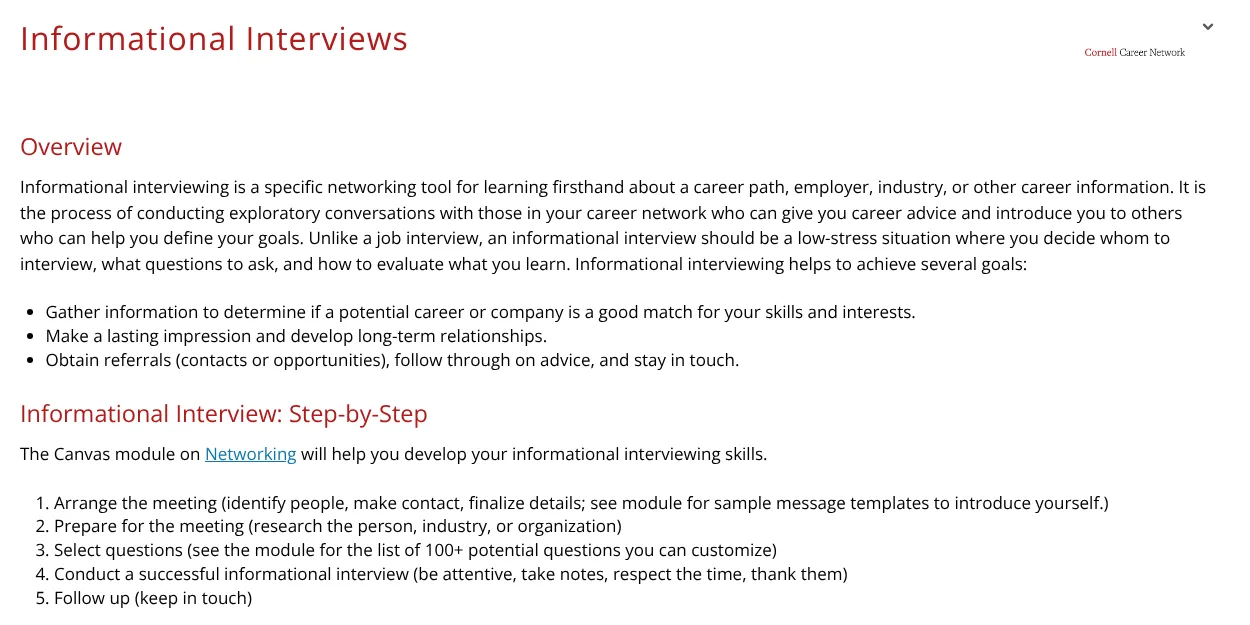
Coursera's guide, the other durable result for this query, runs the same seven-step arc: decide what to ask, find the person, request the meeting, build a question list, get to know them, send a thank-you note, keep in touch. For a 22-year-old with no evidence about any job, that arc is correct.
It breaks in three places once you have a career behind you.
The seniority runs the wrong way. The person who can tell you most about entering a field at mid-level is often five to ten years younger than you and two rungs below where you sit now. The student script has you as the junior party asking for guidance, and performing that role when it is visibly untrue makes the conversation awkward for both of you.
"I'm exploring" reads differently at 42. From a student it is literally true. From someone with a title and a mortgage it sounds like a euphemism for job hunting, and the other person spends the call deciding whether they are being recruited.
Breadth is the wrong resource. A list of 100 questions helps a reader who does not know which answers matter. You already know. Three precise questions beat twelve general ones, and they leave room for the follow-ups that produce the useful part.
Who to approach when you are the senior one
Not your closest colleagues, and not strangers. The band in the middle.
This is the one piece of networking advice with a large causal experiment behind it. In 2022, Karthik Rajkumar, Guillaume Saint-Jacques, Iavor Bojinov, Erik Brynjolfsson and Sinan Aral published a causal test of the strength of weak ties in Science, using randomised variation in LinkedIn's People You May Know algorithm across more than 20 million people over five years, a window covering roughly 2 billion new connections and 600,000 new jobs. The relationship between tie strength and job mobility turned out to be an inverted U: weaker ties helped more, but only up to a point, and moderately weak ties produced the most job mobility. The effect was stronger in more digital industries, while strong ties did more of the work in less digital ones.
In practice that points at four groups, roughly in order of usefulness.
- People you worked with two jobs ago. Enough shared history that they will reply, enough distance that their network barely overlaps yours.
- People who made the move you are considering, within the last three years. They remember the entry criteria because they were screened on them recently.
- People one level below where you would enter. They do the work daily and they are not deciding whether to hire you, so they answer plainly.
- Second-degree introductions from the first three. The introduction carries the credibility, which is why the second name usually beats the first.
The group to skip is the one most people start with: current close colleagues. They know the same companies and the same openings you do, so the information they hold is information you already have.
The request that gets a reply
Four sentences. The job of each one is different, and the message fails when any of them goes missing.
| Sentence | Its job | What kills it |
|---|---|---|
| The connection | Explains why you, specifically, are writing to them, specifically | A template opener that would fit 200 recipients |
| The question | Shows the meeting has a bounded agenda | "I'd love to pick your brain about the industry" |
| The ask | Names the exact length and the format | Leaving the time open, which reads as an hour |
| The exit | Makes no an easy answer | Pressure, or a follow-up threat |
A template with the four jobs marked, filled in here by an operations manager in logistics who is looking at clinical operations roles in medtech:
Hi [name], I run warehouse and fulfilment operations for a 300-person logistics firm and I am working out whether that background transfers into clinical operations. Your move from supply chain into trial logistics at [their employer] is the closest example I have found to the move I am weighing, and the part I cannot work out from the outside is how much of the regulatory knowledge you were expected to bring on day one versus learn in post. Would you have 20 minutes in the next couple of weeks for me to ask you about that? If this is not a good month, no problem at all and thank you for reading.
Note what is absent. No CV, because a CV converts the message into an application and most people will not answer an application they never advertised. No flattery. No mention of looking for opportunities. The regulatory question is the whole reason the message is worth answering: it is specific, it is answerable in two minutes, and only someone who has done it knows the answer.
Questions that work when you outrank the person answering
The standard list assumes you cannot picture the job. Your gap is different. You can picture the job and you cannot picture anyone hiring you into it, which is the gap that the overqualified objection lives in. Trade each general question for the version that targets that.
| The standard question | The version that earns the meeting | What it tells you |
|---|---|---|
| What does a typical day look like? | Which part of the week do people in this role quietly dread? | Where the attrition comes from, which the posting never says |
| What skills do I need to succeed? | What had the last three people hired at this level done immediately before? | The entry profile, as applied in practice rather than as advertised |
| How did you get into this field? | What was the first thing you had to unlearn from your previous field? | Which of your habits will read as competence and which as noise |
| What advice would you give someone starting out? | Looking at a background like mine, where would a hiring manager hesitate? | Your objection, in advance, from someone with no reason to soften it |
| Is a certification worth it? | Which qualification on these postings is load-bearing and which is decoration? | Whether to spend a year and several thousand euros, or not |
| What is the culture like? | How does this team decide who gets the interesting work? | How seniority is granted here, which decides whether the move stalls |
Three of those, not six. Ask the hesitation question last, after the conversation has warmed up, and resist the urge to defend yourself when the answer comes. The answer is the product. If a gap in your history is what they name, that is useful early rather than after four rejections, and there are better and worse ways to account for it.
How a conversation becomes a referral
Never by asking for one.
Two requests do the work instead, and both are easy to say yes to. The first is the criteria question above, because a person who has told you what they would screen on has started evaluating you against it without being asked. The second is the closing line: "Who else should I be talking to about this?" People who enjoyed the conversation almost always have a name, and the introduction they make carries their credibility rather than your cold email.
Then the follow-up, which is where most of these go quiet. Send the thank-you within 24 hours and put one specific thing you changed because of what they said inside it. Not gratitude in general, a sentence like "I had been treating the regulatory gap as the blocker and you have convinced me the stakeholder-management piece matters more, so I am rewriting how I describe the last four years." That sentence proves you listened, and it gives them something to mention if your name comes up.
Then go quiet for six to eight weeks and come back once with an outcome, not a request. The person who hears "I took your advice and here is what happened" is the person who forwards a job posting three months later.
What to do in the first two weeks
Days 1 to 3. Write down the specific role and level, not the field. "Clinical operations manager at a mid-size medtech firm" is a hypothesis. "Something in healthcare" is not. If you cannot write that sentence yet, the shortlist is the work, and everything below waits.
Days 4 to 5. Build a list of twelve names across the four groups above. Expect four replies from twelve messages, which is a normal rate and not a verdict on you.
Days 6 to 10. Send the messages, spaced out, each one written for its recipient. Three precise questions per conversation, the hesitation question last.
Days 11 to 14. After the third conversation, look for what repeats. One person's view is an anecdote and three people naming the same entry criterion is a specification. Write the specification down, because it is the thing you were trying to buy with the month.
If you get through this and the honest answer is that you still cannot name the role, that is information rather than failure. The shortlist comes first, and a structured read of your own pattern is a faster way to get one than another round of coffee. The free career quiz takes 26 questions and gives you directions worth testing, which is the input every conversation above assumes you already have.
Frequently Asked Questions
Ready to find your passion career?
The free under-10-minute quiz maps your childhood patterns and flow triggers to one of 20 archetypes, then gives you matched careers and a 7-day first-step plan.
Take the Free Career QuizRelated Articles
Trusted by 13,400+ career-quiz takers across 166+ countries · Methods covered in