
Is the Official MBTI Test Worth It? $79.95, Tested
The official MBTI costs $59.95 to $99.95. Its own publisher says it does not predict job performance. What the $79.95 career version buys, priced out.

Contents · 11 sections
The official Myers-Briggs assessment costs $59.95 for the personal version and $79.95 for MBTIonline Careers, the one that adds job matches. Both are one-off payments, nothing renews, and the price is on the product page before you answer anything. That is a cleaner commercial setup than most paid career tests. The problem is what you get for the $79.95: the publisher itself states that the MBTI does not predict job performance and is not intended for selecting candidates, so the career product is built on an instrument whose own maker declines the career-prediction claim. If you want your verified Myers-Briggs type, it is a fair price. If you are paying it to find out what to do next, you are buying the wrong tool.
I walked the purchase flow to the registration and payment page on 29 September 2026, read the Terms of Use, and checked every claim on the product pages against what The Myers-Briggs Company publishes elsewhere on its own sites. I did not buy, so nothing behind the payment screen is described here as though I had seen it.
A note on framing. I run MyPassionAI, which is a career quiz, so I compete with the career half of this product and not with the instrument. I have kept every claim below to something you can open and check yourself.
What does the official MBTI test cost?
Three products, three one-off prices, all shown on the product pages before you begin.
| Product | Price | What it adds |
|---|---|---|
| MBTIonline | $59.95 USD | The assessment, your type, an individual report, type-based action guides, a comparison tool, short courses |
| MBTIonline Careers | $79.95 USD | The above plus occupational matches with predicted satisfaction scores, and more than 1,000 occupations to browse |
| MBTIonline Teams | $99.95 USD per participant | Individual and team reports, a shared portal, for groups of three or more. Also listed at £79.95 GBP, €89.95 EUR, $169.95 AUD, with volume discounts above 50 seats |
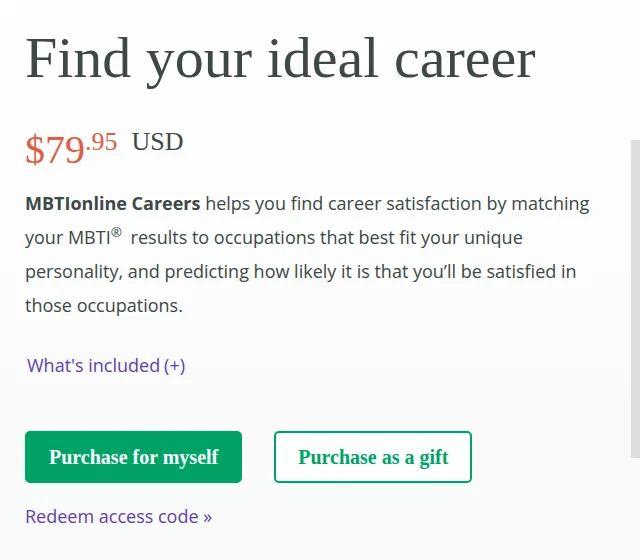
The structure is the inverse of the subscription tests in this category. You pay, then you answer. There is no free preview to argue with, no partial result, and no teaser type. That means the purchase decision rests entirely on whether you trust the instrument, which is why the next two sections matter more than the price.
What does $79.95 buy that a free four-letter test does not?
Administration, not a different theory. The publisher's own comparison block is the clearest statement of what you are paying for, and it is worth reading closely because it does not claim what buyers assume it claims.
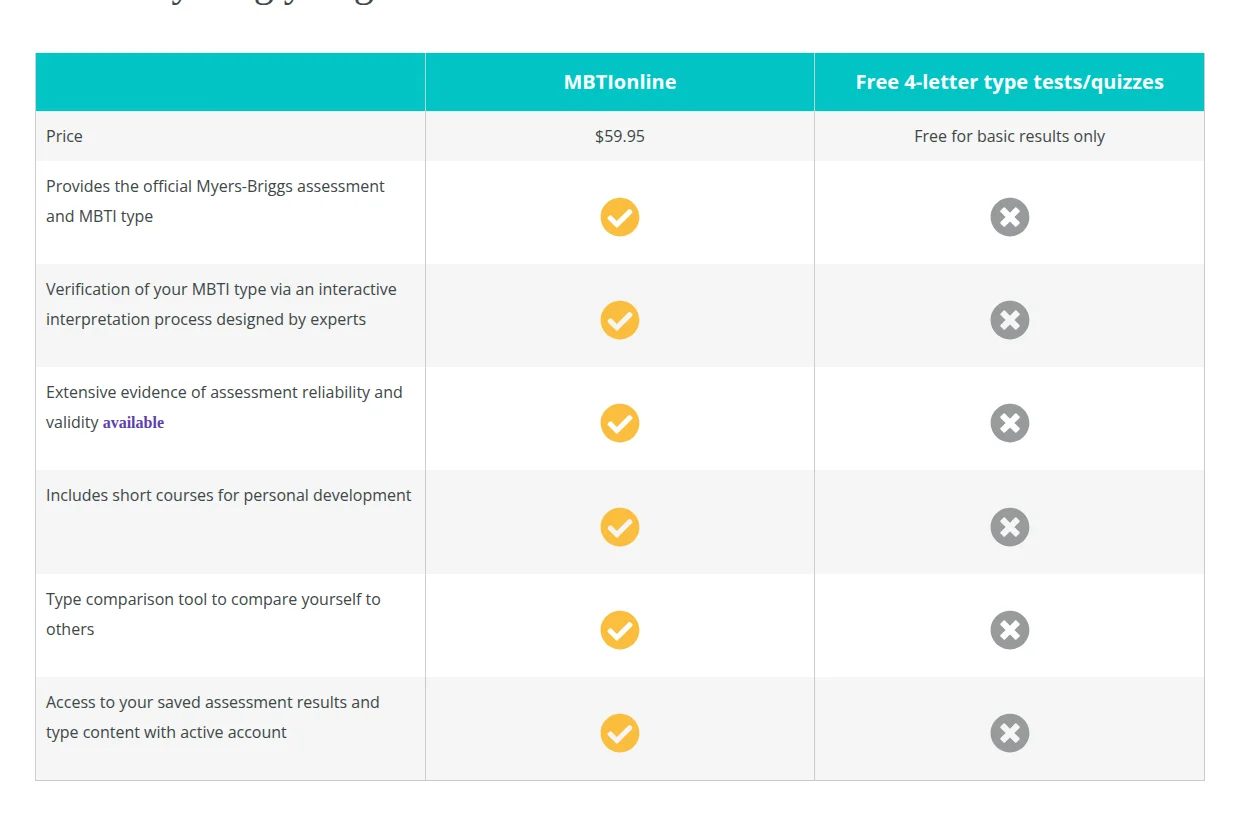
The row that carries most of the value is the second one: verification of your type through an interpretation process. Free tests hand you four letters and stop. The official flow walks you through the framework, shows how it read your answers, and asks you to confirm the fit against your own judgement. If you have taken three free tests and got three answers, that step is the thing you are short of, and $59.95 buys it.
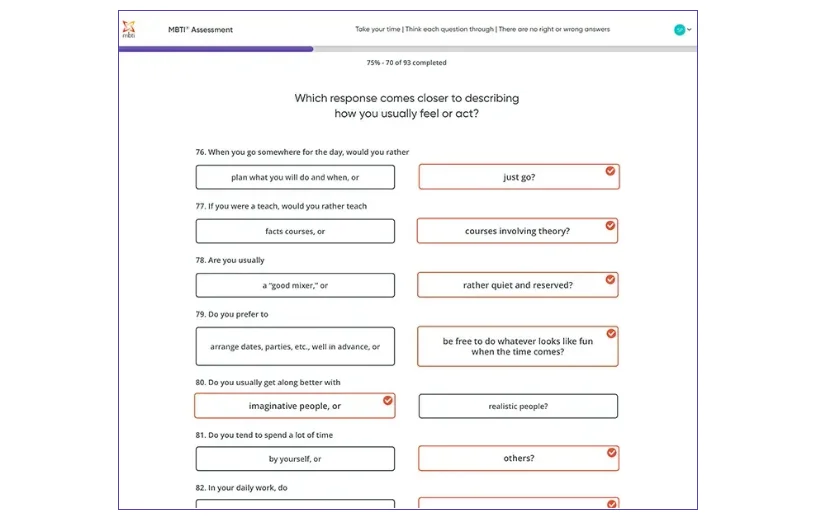
The assessment itself is 93 forced-choice items. Each one gives two options and asks which comes closer to describing how you usually feel or act.
What does the Myers-Briggs Company say the assessment cannot do?
This is the section that decides the purchase, and the source is the publisher, not a critic.
On its MBTI Facts page, The Myers-Briggs Company writes that the assessment "is not intended for use in selection of job candidates, nor for making internal decisions regarding job placement", and that "Preferences do not indicate skill or ability". In its article on whether the instrument can be trusted, it puts it more directly still: "It doesn't predict job performance, because that's not what it was designed for."
Read that against the Careers product, whose headline is "Find your ideal career" and whose pitch is predicting how satisfied you would be in matched occupations. The publisher is not contradicting itself, because satisfaction and performance are different outcomes. But a buyer typing "is the official MBTI test worth it" into a search box is almost never separating the two. They want to know whether the $79.95 answers the question they came with, and on the publisher's own account it answers a narrower one.
The reliability figures point the same way. The same MBTI Facts page reports 1-month test-retest reliabilities for the preference scales of .94 to .97, which is strong, and 4-year test-retest of .57 to .81. A career decision you are making at 42 and living with at 46 sits in the second window, not the first.
If an employer asks you to take the MBTI as part of hiring or placement, the publisher's own position is that the instrument is not built for it. That is a useful sentence to have to hand.
Will the official version settle a type you got from a free test?
Partly, and the part that does the work is the confirmation step rather than the scoring.
Start with the publisher's numbers, because they are better than the internet's reputation for them. The Myers-Briggs Company reports 1-month test-retest reliabilities for the preference scales of .94 to .97, and says test-retest correlations up to 15 weeks on the current form average .87. Those are respectable figures for a self-report instrument, and they describe the underlying preference scores.
The four letters are a different object. Each letter is a dichotomy cut out of a continuous score, so a preference that sits near the midpoint can report as I on one sitting and E on the next while the score behind it barely moves. The instrument is more stable than the label it prints. That mismatch is the whole reason people take three free tests and get what looks like three answers, and it is why arguing about which free test is most accurate misses the mechanism.
This is where the official product earns its price. After scoring, MBTIonline walks you through the framework, shows you how your answers were read, and asks you to confirm your best-fit type yourself. A borderline preference is surfaced rather than hidden behind a letter. That is a process designed for exactly the person who has three conflicting results and wants one of them settled, and no free four-letter test offers it.
Two caveats before you buy for that reason. First, the 4-year test-retest figure is .57 to .81 on the same preference scales, so a type confirmed today is a weaker guide to the person you will be at the end of a career move than the 1-month figure suggests. Second, confirming a type resolves the contradiction between your free results; it does not add information about occupations. If settling the label is what you want, $59.95 does it. If you expected settling the label to settle the career question, the section above is the one to reread.
Where do the career matches come from?
O*NET, the US Department of Labor's occupational database, which is free.
The Careers product page states that it integrates occupational information from ONET and gives you more than 1,000 occupations to research, with salary expectations, job trends and education requirements. Every one of those figures is public. You can search the same database at no cost through ONET OnLine and through My Next Move, which the Department of Labor also publishes, and which includes a free interest inventory built on Holland's RIASEC model. The same distinction runs through the 16Personalities career test, which repackages the same four dichotomies without the confirmation step.
What MBTIonline adds on top is the predicted satisfaction score: a 0 to 100 likelihood for each of your top 300 matches, described on the page as drawn from a sample of more than half a million working adults. That is the proprietary part, and it is the part with no published method. The page links no validation study, no error rate and no explanation of how a type maps onto a satisfaction probability. For $79.95 against free public data, the satisfaction model is what you are paying the premium for, and it is the only component you cannot inspect.
What do independent reviewers say about MBTIonline?
Almost nothing, and that absence is itself the finding.
Every other paid career test I have reviewed this year has a review corpus to read against its marketing. Apt AI has 213 Trustpilot reviews with a sharp split between invited and uninvited. Personality.co has more than 24,000. MBTIonline has no reachable profile on Trustpilot, a SmartCustomer page carrying zero reviews, and no app listing. The company does not solicit reviews, so there is no invited-review inflation to correct for, and there is also nothing to check the claims against.
That cuts both ways. There is no pattern of refund complaints or cancellation traps here, which is what those corpora usually surface. There is also no independent consumer signal at all, so the assessment has to be judged on the published psychometrics and on the publisher's own statements, which is what the two sections above do.
What people buying a career test are stuck on
Here is the part the four letters do not reach. In the Career Change Report 2026, roughly half of the people who came to a career quiz name either a direction problem or a self-assessment problem as the thing that is wrong. Of the 6,467 who answered the core-struggle question between January and September 2026, this is how that splits.
| Answer | Share |
|---|---|
| No idea which direction to pick | 28.3% |
| Can't tell what they're good at | 25.2% |
| Too many interests to commit to one | 20.2% |
| Nothing they try feels like a passion | 14.5% |
| Stuck or bored in current work | 11.8% |
The top two answers, together more than half the group, are a direction problem and a self-assessment problem. A confirmed Myers-Briggs type is a partial answer to the second: it gives you vocabulary for how you prefer to take in information and make decisions. It is not an answer to the first, and the publisher does not claim it is. The full distribution and its method are published with the report's sample notes.
This is also why people who already own a type keep searching. If four letters had closed the question, the searches that bring people to a page like this one would not exist.
Can you get a refund on MBTIonline?
There is no stated refund window and no money-back guarantee, on the product pages or in the Terms of Use.
The Terms of Use, effective 14 April 2026, say fees must be paid in advance by credit card, and that if you ask the company to delete your account "you will not receive any refunds, and you will need to create a new account and pay the fees specified on the Site" to get a new report. No satisfaction guarantee appears anywhere in the flow.
Set against the market, this is strict. It is also consistent: you are buying a psychometric instrument, not a subscription, and instruments are not usually returnable once administered. The practical consequence is that the decision has to be made before you pay, because there is no preview and no way back.
How the $79.95 compares with the rest of the paid market
Against the tools this site has walked to checkout, MBTIonline is the expensive one per sitting and the cheap one over a year.
| Tool | What you pay | Free before paying | Trustpilot | Checked |
|---|---|---|---|---|
| MBTIonline (The Myers-Briggs Company) | MBTIonline: $59.95 USDMBTIonline Careers: $79.95 USDMBTIonline Teams: $99.95 USD per participant | The price, on the product page, before you start | No listing | 29 September 2026 |
| Apt AI (tryapt.ai) | Annual: $9.99/moQuarterly: $19.99/moMonthly: $29.99/mo | Big Five percentages for all five traits | 3.6 TrustScore, 213 reviewsinvited by apt 4.67 · written without an invitation 1.60 | 25 September 2026 |
| JobTest.org | Monthly: $29.99/monthQuarterly: $19.99/monthAnnually: $9.99/month | After the email step: a projected salary ("$173,000... a 419% increase from your current salary") and a sales page. No careers, no profile | 4.5 TrustScore, 759 reviewsinvited by jobtest.org 4.94 · written without an invitation 4.52 | 26 September 2026 |
| YouScience | Aptitude & Career Discovery: $49.00 (or €44.74) | Nothing for individuals: no free test, no preview | 1.8 TrustScore, 29 reviewsinvited by youscience 4.58 · written without an invitation 2.65 | 25 September 2026 |
The subscription products look cheaper on the shelf and are not. Apt AI's paywall shows $9.99 a month on the annual plan, which its Stripe checkout charges as $119.88 up front, so the headline monthly figure is 50% more than MBTIonline Careers by the time it clears. A one-off $79.95 with nothing renewing is the more predictable spend, and for a buyer who wants an assessment rather than a job-hunting workflow, it is also the one that stops costing money when they stop using it.
What the subscriptions buy that MBTIonline does not is the work after the result: a CV rewrite, outreach help, interview preparation, a job board. MBTIonline finishes at the report. Whether that is a gap or a mercy depends on whether you are mid-application or still deciding what to apply for.
The honest comparison for the deciding case is against free. the free O*NET Interest Profiler costs nothing, are published by the US Department of Labor, and give you a RIASEC profile plus the same occupational database MBTIonline Careers licenses. If your reason for paying is the occupational data, you are paying for the wrapper.
Should you buy it? Four questions
Question 1
Do you want your Myers-Briggs type specifically, from the publisher, with the confirmation step?
Yes: Buy MBTIonline at $59.95. That is exactly the product, and the price is fair for what the free tests skip.
No: Keep going. Paying for the official administration of a model you do not need is the most common way to waste this money.
Question 2
Is a team or a facilitator asking you for an official result?
Yes: Buy the version they name. A team programme runs on MBTIonline Teams at $99.95 per seat, and a self-bought individual result may not slot into it.
No: Go to the next question.
Question 3
Do you mainly want salary, outlook and day-to-day detail on occupations?
Yes: That is O*NET, and it is free. Use O*NET OnLine or My Next Move before paying for a wrapper around the same database.
No: Go to the next question.
Question 4
Are you trying to decide which career to move into?
Yes: The instrument's own publisher says it does not predict job performance. Use something built for the direction question instead.
No: If none of the four fits, you do not have a use for the result yet, and the purchase can wait.
Only the first two questions describe a purchase that earns its price. The third and fourth describe the two ways this product gets bought for the wrong reason.
The bottom line
MBTIonline is the most commercially honest paid career test I have reviewed this year. The price is visible before the questions, you pay once, nothing renews, there is no countdown timer and no scripted order counter, and the company does not farm its own reviews. In a category where the default is a $9.99 monthly figure revealed after a 34-question chat, that deserves saying first.
The problem is the fit between the product and the search that brings people to it. The $79.95 Careers version attaches occupational matching to an instrument whose publisher says it does not predict job performance and is not for job placement, using an occupational database anyone can search free, plus a satisfaction model with no published method. Someone who wants their verified type is getting what they paid for. Someone who wants to know what to do next is paying a premium for a narrower answer than they think.
If it is the direction you are short of rather than the label, the free career quiz asks 26 branching questions, places you in one of 20 archetypes, and returns career directions matched to it with a first step for each. Trusted by 12,600+ quiz takers.
Frequently Asked Questions
Ready to find your passion career?
The free under-10-minute quiz maps your childhood patterns and flow triggers to one of 20 archetypes, then gives you matched careers and a 7-day first-step plan.
Take the Free Career QuizRelated Articles
Trusted by 12,600+ career-quiz takers across 166+ countries · Methods covered in