
Strong Interest Inventory Review: There's No Public Price
The Strong Interest Inventory has no public checkout: the official shop closed in 2025. What it actually costs through a college or coach, verified.

Contents · 7 sections
The Strong Interest Inventory has no price on its own product page. Not a hidden one, not one you reach after answering questions: none. The Myers-Briggs Company's "Explore Solutions" page for the Strong ends in a lead form asking for your job title and company name, not a payment field, and the publisher's direct-purchase shop permanently closed on 16 September 2025. What you pay for the Strong depends entirely on which college, counselor or coach you go through, and I found four of them checked this review: $13 at one university, $80 at another once the mandatory coaching fee is added.
I spent this review trying to do what every other review of a paid career test on this site does: walk the purchase flow to the payment screen. For the Strong, that flow does not exist for an individual buyer. Below is what I found instead: why there is no public checkout, what four US institutions charge, what the test measures when someone does pay for it, and the two paths that cost nothing.
Can you actually buy the Strong Interest Inventory yourself?
No. It is restricted to practitioners who have completed the Strong Certification Program, a two-day course through which, in the publisher's own words, "you gain a certificate of qualification to purchase and use both the instrument and its reports." There is no individual checkout to skip to.
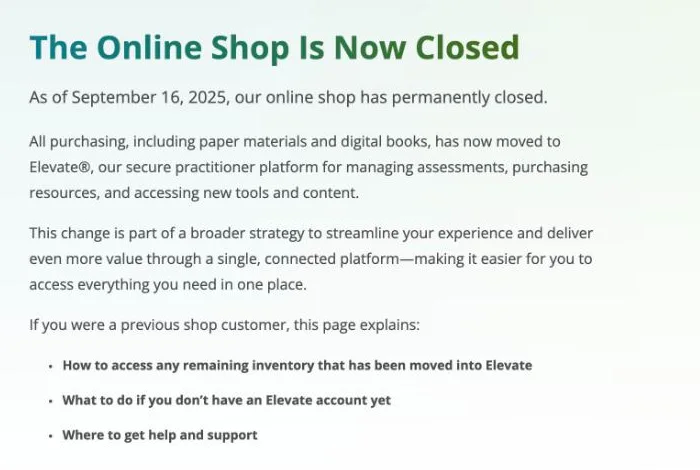
The clearest evidence is the publisher's own former shop. Until September 2025, counselors and institutions bought Strong materials through an online store at shop.themyersbriggs.com. That store is gone.
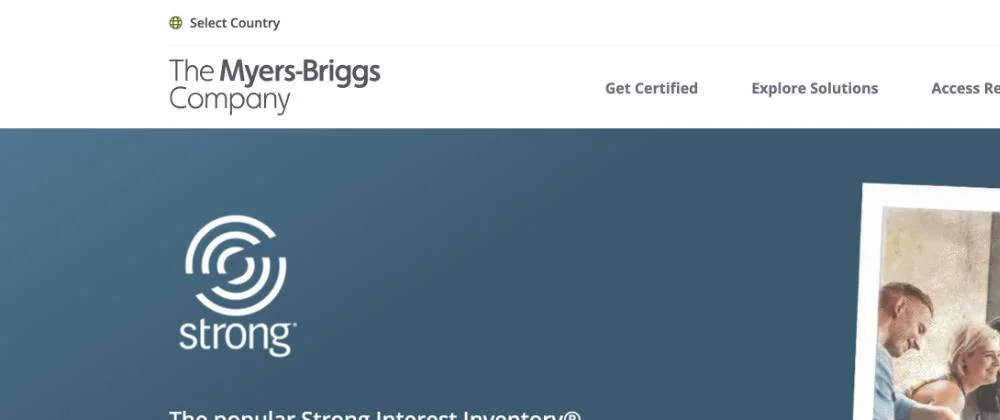
The current product page for the Strong carries the same structure as every other page on the publisher's site: a "Get Certified" link in the main navigation, a "Contact Us" link, and, at the bottom, a lead-generation form that asks for your job title, company name and organization type (the options are things like Corporate, Education, Government and Independent Consultant, not "individual"). No "Buy now." No price. No cart.
That is why this review does not include a paywall walkthrough the way the official MBTI or CareerFitter reviews on this site do. There is no payment screen to stop at. The only way to take the Strong is through whoever is certified to administer it near you, and that provider, not the publisher, is who answers "what does it cost."
Why gate it this way at all? Restricting a psychometric instrument to qualified administrators is a standard practice in the testing industry, not something unique to the Strong: publishers classify instruments by a required qualification level, and tools that generate occupational comparisons against clinical or validated criterion groups are routinely sold only to people trained to interpret them correctly. The MBTI runs the same certification model, which the official MBTI review on this site covers from the buyer's side rather than the access side. The practical effect for a career changer is the same either way: the instrument you most often hear recommended by a counselor is one you cannot simply go buy.
So what does it actually cost?
Whatever your provider charges, because the publisher sets no retail price. I checked four US university career centers directly for this review, all current as of 7 October 2026:
| Where | Current students | Everyone else | What's included |
|---|---|---|---|
| Clark College | $20 | $30 | Scoring, a printed career report, and a mandatory 1.5-hour small-group interpretation with a career advisor |
| Winthrop University | $13 | $13 | A mandatory individual 60-minute appointment with a coach to discuss results |
| Seton Hall University | $40 | $40 | A 75-minute session with a detailed report and interpretation by a qualified professional |
| University of South Carolina (alumni) | n/a | $30 assessment + $50 coaching ($80 total; $30 for Alumni Association members) | The coaching fee is waived only for association members, not for the assessment itself |
Four patterns hold across the institutions I checked. First, the price is set locally, not by the publisher, so it varies by more than 6x for the identical instrument. Second, nearly every provider bundles a mandatory interpretation session into the price: you are not buying a test result, you are buying a conversation about a test result, and you generally cannot decline the conversation to pay less. Third, none of the four quotes a price for taking the assessment without some form of guided follow-up, which tracks with the instrument's own design: the Strong is meant to be interpreted, not read on your own. Fourth, "who can even book it" varies as much as the price does. Clark College's own page explicitly welcomes "prospective students, alumni, and community members" at the $30 rate, so a member of the public can walk in there. The University of South Carolina figure, by contrast, is specifically its alumni program, not a general-public offer. Winthrop's and Seton Hall's pages do not state a public-access policy either way, so whether a non-affiliated adult can book a session through them is a question for their career center, not something printed on the fee page.
None of the four providers above publishes a refund policy for the assessment fee, which is consistent with the product rather than an oversight: once a career advisor has walked you through your results in a 60-to-90-minute session, there is no version of "returning" the service. If getting your money back matters to you, that is a reason to ask before you pay rather than after, since it is not a question any of the four pages answers on its own.
One third-party estimate puts private career-coach sessions as high as $300 once the coach's own time is the thing being billed rather than a subsidized student rate. I did not verify a specific coach's pricing for this review, so treat that figure as the upper end of a range rather than a quote.
What does the Strong Interest Inventory actually measure?
Six broad interest themes, scored against people who are satisfied in their occupations, not against a general population.
The publisher's own sample report, which I pulled directly for this review, confirms the structure: 291 items, roughly 30 to 40 minutes to complete, producing a report across five levels. General Occupational Themes score you on Holland's six-type model: Realistic, Investigative, Artistic, Social, Enterprising and Conventional.
| Letter | Type | Core interests |
|---|---|---|
| R | Realistic | Hands-on work: tools, machines, the physical world |
| I | Investigative | Research, analysis, working with ideas |
| A | Artistic | Design, writing, performance, open ends |
| S | Social | Teaching, care, service to people |
| E | Enterprising | Leading, selling, starting things |
| C | Conventional | Systems, data, order, getting details right |
The hexagonal model comes from John Holland’s theory of vocational choice (1959), the framework underneath the U.S. Department of Labor’s O*NET database.
Below that sit Basic Interest Scales (narrower sub-areas within each theme), Occupational Scales (how closely your pattern of likes and dislikes matches people who report being satisfied in roughly 260 specific occupations), Personal Style Scales (work style preferences such as how you like to learn or take risks) and Administrative Indices (quality checks on how you answered). A separate, shorter product called the Strong 244 uses 244 items instead of 291 and is marketed at students, but it runs through the identical certified-practitioner channel and the identical lack of a public price.
The mechanism worth understanding before you pay for it: the Occupational Scales do not ask whether you are skilled at an occupation. They compare your pattern of likes and dislikes to the pattern reported by people already working and satisfied in that occupation. That is a genuinely useful signal, built on documented criterion groups rather than a guess, and it is also a narrower claim than most buyers assume. A strong match tells you your interests resemble those of people who are happy doing the work. It does not tell you whether you would be good at it, whether the income fits your life, or whether you could tolerate the path to get there.
Is there a free version?
Two, and they measure different things. The publisher's own shortened alternative is SuperStrong, a 5-to-10-minute digital version delivered through the VitaNavis platform. It is "data-optimized" from the full Strong rather than a separate instrument, and it is nearly always provided through a school rather than sold to an individual directly, so it solves the certification problem but not the direct-access one.
The genuinely open options are the US Department of Labor's O*NET Interest Profiler and CareerOneStop's Interest Assessment, both free, both online, both built on the same six RIASEC themes the Strong uses, and both reachable without an institution or a practitioner standing between you and the result. Neither gives you the Strong's Occupational Scales comparison against satisfied-worker criterion groups, which is the part the paid versions above are charging for. If that comparison is specifically what you want, there is no free substitute for it; if six interest-theme scores are enough, the free versions get you there today.
Which path makes sense depends on who is asking. A current student already has a school route to the full instrument at $13 to $20, so the free alternatives mostly save them a scheduling step, not money. An alumnus or working adult with no institutional tie is choosing between paying a stranger (a coach, at a rate the four examples above suggest could run well past $80) or taking the free RIASEC tools and accepting the narrower, uninterpreted version. A high school counselor recommending a tool to a whole cohort is choosing between a per-student fee that multiplies fast and a free tool with no bundled conversation, which is exactly the tradeoff the career interest inventory comparison on this site works through for that specific reader.
The Strong Interest Inventory and Career Key both sit behind the same kind of institutional gate as each other, which is worth knowing if a school or counselor is weighing which paid instrument to recommend rather than which free one.
What the Strong doesn't measure, and why that's the actual gap
The Strong Interest Inventory answers one question well: which broad areas of work match your current stated interests, compared against people already satisfied doing that work. It was never built to answer a second one: what to actually do next, this year, with the specific constraints of your situation.
That gap shows up directly in what people ask for when they come looking for a career direction. The quiz behind this site works from a different starting signal: not current stated interests, but the activities someone pursued without anyone asking them to, as a signal for the kind of work that produces flow rather than just satisfaction. The two instruments are not measuring the same thing, and neither makes the other redundant. Interests tell you what you say you like now. Childhood patterns and flow triggers are a harder signal to fake, because nobody was grading them.
What MyPassionAI offers if you want more than an interest label
The free MyPassionAI quiz returns one of 20 archetypes from a 5x4 matrix of struggle type and priority type, with matched careers, a fitScore, and first steps, all from a free, 26-question, branching quiz that takes under 10 minutes for most people.
For anyone who wants more than the free result, the one-off Career Switch Kit is not a bigger report. It is a set of things done for you from your own results: your experience rewritten in the language of your matched path, your CV rewritten for it, your LinkedIn headline and About section written, ten outreach messages already drafted plus where that kind of work is concentrated, your first four weeks planned, and an AI coach that has read your results available on an ongoing basis. It does not include a job board, interview prep, or per-application tailoring, and it does not place you in a role; it is the start of the move, not someone doing the move for you. Full pricing is on the pricing page.
Bottom line
There is nothing dishonest about the Strong Interest Inventory's distribution model: the publisher never claims to sell direct to consumers, and the certification requirement is published plainly. But "what does the Strong Interest Inventory cost" does not have a single answer the way "what does CareerFitter cost" does, and a search for that answer deserves that fact up front rather than a made-up number. Go through a college or counselor you already have access to and expect something in the $13 to $80 range with an interpretation session attached, or start with the free RIASEC tools if the Occupational Scales comparison isn't the specific thing you need. Either way, go in knowing there is no page where you can just check the price yourself.
If what you actually want is a specific next step rather than another interest score, the career quiz is free and finishes in one sitting.
Frequently Asked Questions
Ready to find your passion career?
The free under-10-minute quiz maps your childhood patterns and flow triggers to one of 20 archetypes, then gives you matched careers and a 7-day first-step plan.
Take the Free Career QuizRelated Articles
Trusted by 13,600+ career-quiz takers across 166+ countries · Methods covered in