
Career Interest Inventory for Students: How to Choose One
Four interest inventories appear on nearly every college resource page. Two are the same instrument, one publishes its coefficients, and two disclose no price.


Contents · 7 sections
A career interest inventory asks a student which activities they would enjoy, scores the answers against Holland's six interest types, and returns a three-letter code plus occupations whose profile matches it. If you advise students, the useful question is not what an inventory is. It is which one to hand over. Four show up on nearly every college resource page: the O*NET Interest Profiler, CareerOneStop's Interest Assessment, the Strong Interest Inventory, and Career Key. All four rest on the same framework, two of the four are the same instrument, one publishes its coefficients along with the sample they came from, and two disclose neither an item count nor a price on the page where you make the decision. Below is what each gives you, what the evidence supports, and which student each suits.
The four inventories on almost every college resource page
Pull up a dozen career-centre resource pages or library guides and roughly the same shortlist appears. It is worth knowing what sits behind each name before you decide which belongs on yours.
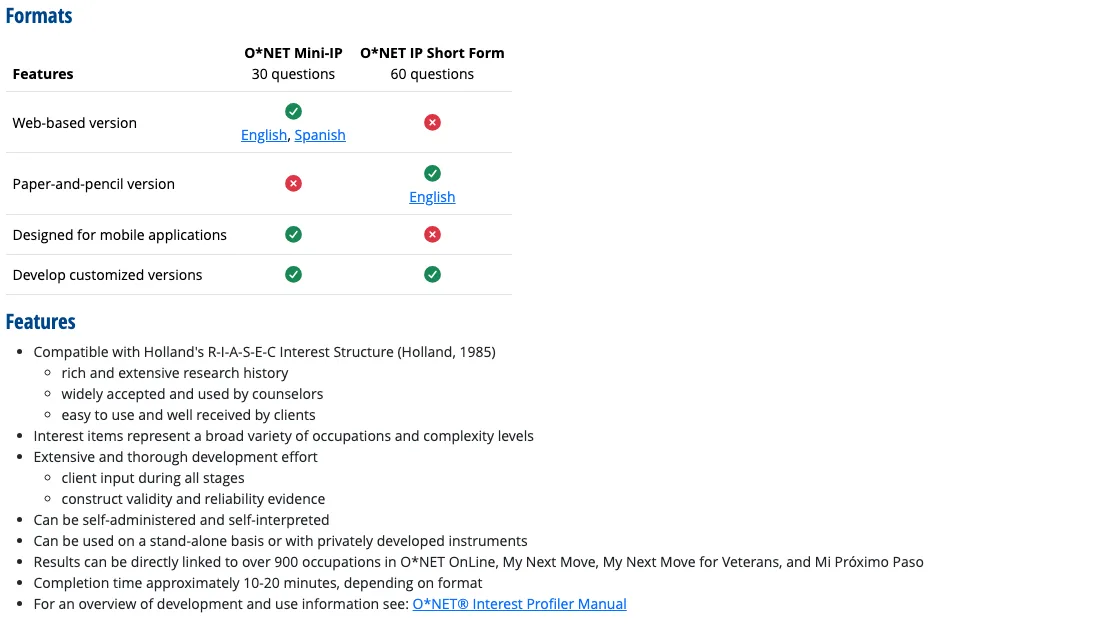
The O*NET Interest Profiler is published by the National Center for ONET Development for the U.S. Department of Labor. Its resource centre page documents two formats: a 30-question web version, available in English and Spanish, and a 60-question paper-and-pencil short form in English only. It states that the tool can be self-administered and self-interpreted, that completion runs roughly 10 to 20 minutes depending on format, and that results link to over 900 occupations across ONET OnLine, My Next Move, and Mi Próximo Paso.
CareerOneStop's Interest Assessment is also a Department of Labor property, presented as its own tool inside the CareerOneStop toolkit.
The Strong Interest Inventory is a commercial instrument sold by The Myers-Briggs Company. Its product page describes the assessment as grounded in the RIASEC model and points to a certification programme through which you learn to administer it and interpret results.
Career Key is a commercial product with a strong counsellor-education pedigree. Its interest-inventory page was originally written by Lawrence K. Jones, Ph.D., NCC, Professor Emeritus of Counselor Education at North Carolina State University, and is maintained by Career Key's current chief executive, with a June 2026 review date on the page.
All four measure the same construct, and two are the same instrument
The framework is not a differentiator. O*NET lists its instrument as compatible with Holland's RIASEC interest structure. Strong is described on its own page as grounded in the same model. Career Key measures a person's resemblance to Holland's six types. Our own test does the same thing on the same public framework. So an adviser choosing between them is not choosing between competing theories of vocational interest, which is how the shortlists tend to read. The choice is about delivery, disclosure, and cost.
Two of the four go further than sharing a framework. CareerOneStop's Interest Assessment reports 30 questions and about five minutes, and the page credits the ONET Interest Profiler in its footer. That item count matches the ONET Mini-IP exactly.
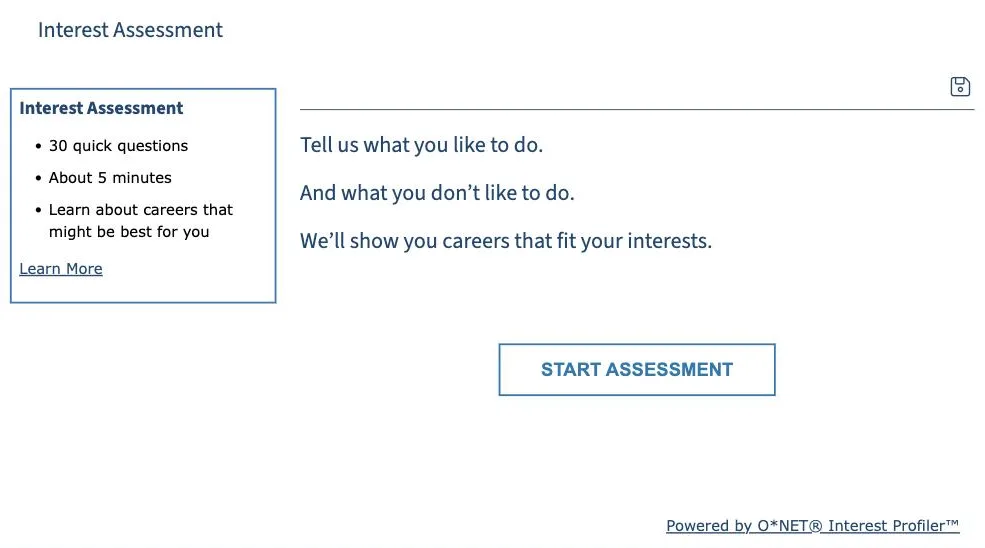
This matters in a specific, practical way. Advisers often list several tools so a student who bounces off one can try another. If two entries on the list are the same 30 items with different styling, a student who found the first one unhelpful gets the same result from the second and concludes that career assessment does not work for them. Offering genuine variety means varying the construct being measured, not the logo above it.
What each publisher discloses at the point you decide
The question a career centre needs answered is narrow: what is this, how long does it take, what does it cost, and is there evidence it measures consistently. Here is what each publisher put on the page as of 7 September 2026.
| Instrument | Items disclosed | Cost disclosed | Psychometric evidence on or from the page |
|---|---|---|---|
| O*NET Interest Profiler | Yes: 30 (web), 60 (paper) | Yes: free | Yes: downloadable technical report with coefficients and samples |
| CareerOneStop Interest Assessment | Yes: 30 | Yes: free | Inherited from O*NET, credited on the page |
| Strong Interest Inventory | No | No | Described as regularly updated for validity and reliability, without figures or a manual link on that page |
| Career Key | No | No, institutional enquiry | Yes: cites peer-reviewed studies of its own instrument |
Two things in that table are worth separating carefully. A commercial publisher not printing coefficients on a marketing page is not evidence that no technical manual exists, and the Strong has a long research record. The finding is narrower and still useful: at the moment an adviser is deciding what to put in front of a student, two of these four publishers show their work and two ask you to take it on trust.
The O*NET formats table is the model for what disclosure looks like, and it also settles a question that trips up resource pages: which version a student will get online.
Reading a reliability coefficient without overreading it
The Interest Profiler's evidence is published in O*NET Interest Profiler: Reliability, Validity, and Self-Scoring, a 1999 report by Rounds, Walker, Day and Hubert at the University of Illinois with Lewis and Rivkin at the National Center for O*NET Development. Three numbers in it are worth knowing, and so is the sample behind each.
Internal consistency across the six RIASEC scales runs from .93 to .96, on a main sample of 1,061 participants. Stability across roughly one month runs from .81 to .92, and that estimate comes from 132 participants split between junior-college or vocational students and college students. The report is candid about that second sample's limits: the eastern United States was not represented, and most participants were unemployed or working part time.
That student-based retest sample is the part worth carrying into an advising conversation, because it answers the question a sceptical student asks. If they take these 30 items twice a month apart, they will get close to the same code, and that has been measured on people at their stage rather than inferred from adults.
What the numbers do not license is the inference students most want to draw. A coefficient of .93 says the instrument measures something consistently. It says nothing about whether that something predicts which job will suit them, how long they will stay, or whether they will be any good at it. Interest reliability and career-outcome prediction are separate claims, and only the first one is supported here. Our longer treatment of that distinction sits in the O*NET Interest Profiler review, and the framework itself is unpacked in our RIASEC test guide.
Interest is one of three questions students bring you
Here is where our own data says something the shortlists do not. Among the people who arrive at our career quiz, the largest single group describes themselves as a student or recent graduate with no clear direction. When we ask what specifically has them stuck, the answers do not cluster where an interest inventory is strongest.
| What they name as the core struggle | Share |
|---|---|
| No idea which direction to pick | 28.3% |
| Cannot tell what they are good at | 25.2% |
| Too many interests to commit to one | 20.2% |
| Nothing they try feels like a passion | 14.5% |
| Stuck or bored in current work | 11.8% |
Base: 6,467 MyPassion.ai career-quiz respondents, snapshot of 1 September 2026. These are self-selected people who came to a career quiz already questioning their direction, so they are not a sample of students in general. Full figures, bases and methodology are in the Career Change Report 2026.
Read the top two rows against what an interest inventory does. An interest inventory is precise about preference, which is closest to the third row, roughly a fifth of this group. The largest share cannot pick a direction, and the second largest cannot tell what they are good at, which is an ability question an interest inventory explicitly does not answer. That is not an argument against inventories. It is an argument for knowing which of the three questions your student is asking before you choose the instrument, because handing a preference measure to someone with an ability question produces a polite dead end.
One more pattern in the same respondents cuts against what students assume, and it belongs in an adviser's pocket. The share naming boredom as their core struggle climbs at every step up the formal-education ladder, and the highest rate sits with those who already hold a master's degree or above.
| Answer | Share |
|---|---|
| High school | 6% |
| Bachelor's degree | 15.4% |
| Master's degree or higher | 19% |

Further study did not settle the direction question for this group, and for some it deferred the question to a point where changing course cost more to do. So when a student floats another degree mainly as a way to buy time on the decision, that gradient is a more useful thing to put in front of them than reassurance that clarity arrives with the credential. The full breakdown, including the two non-degree routes that interrupt the line, is on the education and career boredom page.
Which inventory suits which student
The choice gets easier once you match the instrument to the situation rather than ranking them absolutely.
| Situation | What to reach for | Why |
|---|---|---|
| First-year or undeclared, needs a starting vocabulary | O*NET Interest Profiler, 30-question web version | Free, five to ten minutes, Spanish available, and it maps straight into occupational data |
| Group session, workshop, or no reliable devices | O*NET 60-question paper form, or a printable RIASEC worksheet | Self-scoring on paper, no logins to manage, works when the room's wifi does not |
| Student who already knows their interests and is still stuck | Something other than an interest inventory | Their question is direction or ability, and more preference data will not move it |
| Sustained one-to-one work with a trained practitioner | Strong Interest Inventory | The certification and interpretive structure are what the price buys, and that has genuine value in extended counselling |
| Institution needing a documented, citable instrument | O*NET, or Career Key where the budget exists | Both publish evidence you can point at in a programme review |
Our own free Holland Code career test belongs in the first two rows for disclosure's sake, since we build it: 30 original items on the public RIASEC framework, scored in the browser, with a printable worksheet for group sessions. It is not affiliated with O*NET and says so on the test itself. Permission to link it, plus a copy-ready title and description for a resource page or library guide, is on our educators page.
Using the code in the session
An interest inventory earns its place in the ten minutes after the student sees the result, not in the five minutes they spend answering. Three moves get more out of it than a longer instrument would.
Ask what surprised them. The code itself is rarely news to a 20-year-old; the occupations attached to it usually are, and their reaction to a specific job title carries more information than the scores.
Ask where the code and their own read on their strengths disagree. A quarter of the people in our data cannot say what they are good at, and an interest result does not settle that question, so the disagreement is usually where the useful part of the conversation starts.
Then convert the code into one concrete next action, because a three-letter code with no appointment attached decays within a week. One informational conversation, one shadowing request, one course to audit.
The instrument you choose matters less than whether the result gets used. On that measure the free 30-item version a student finishes attentively, discussed properly, beats the expensive one that arrives as a PDF nobody opens.
Frequently Asked Questions
Ready to find your passion career?
The free under-10-minute quiz maps your childhood patterns and flow triggers to one of 20 archetypes, then gives you matched careers and a 7-day first-step plan.
Take the Free Career QuizRelated Articles
Trusted by 15,100+ career-quiz takers across 168+ countries · Methods covered in