
Tech Careers Without Coding: Pay, Growth, and Which One Suits You
Tech careers that need no code, with current BLS pay and growth figures, the four roles wrongly sold as code-free, and a way to match roles to how you work.


Contents · 7 sections
You can work in technology without writing code, and a lot of people do. What the popular lists on this topic will not tell you is which of those roles is growing, which is quietly shrinking, and which ones are being sold as code-free when they are not. That is most of the useful information, so it is what this piece covers.
Two things worth setting out first. The pay and growth figures below come from the US Bureau of Labor Statistics Occupational Outlook Handbook, current as of May 2025 for wages and the 2025 to 2035 window for projections. The three pages ranking above this one all cite May 2024 wages or a private salary aggregator, so if you have been comparing numbers across articles, some of them are a year stale. Second, the framing question in most of these guides is "what jobs exist", when the question people are actually stuck on is "which of them would suit me". The roles below differ far less in subject matter than in how the work feels day to day, so that is the axis I have used to sort them.
The specialist assumption, checked against our own data
The reason "tech" became a synonym for "coding" is partly an assumption about what technical work is: deep, solitary mastery of one difficult subject. That is a fair description of a programming job. It is a poor description of most people.
We ask everyone who takes our career quiz how they prefer to work, and the answers are consistently lopsided in a way that matters here. The breakdown below comes from the Career Change Report 2026, and only about 1 in 6 of these quiz takers identify with mastering a single subject.
- Connecting ideas or people29.3%
- Improving what already exists29.1%
- Starting new projects25.8%
- Mastering one subject15.8%
| Answer | Share |
|---|---|
| Connecting ideas or people | 29.3% |
| Improving what already exists | 29.1% |
| Starting new projects | 25.8% |
| Mastering one subject | 15.8% |

Improving something that already exists, connecting ideas or people, and starting new things each account for a bit over a quarter. Read that as a statement about self-reported preference among people already questioning their career, not about the general workforce, because that is what the sample is.
A separate question in the same quiz points the same way. Of roughly 4,000 quiz takers who told us what puts them in a state where they stop watching the clock, about 1 in 7 named solving hard technical problems. Learning, being around people, and making things each came in higher.
So the coding-shaped job fits a minority of the people who consider it, and it is also the only technology job most of them can name. That gap is the whole opportunity here, and it is why the sensible order is to work out your own pattern first and match roles to it second.
What these roles pay, and which two are shrinking
Here is the current picture for the roles inside the BLS computer and information technology group that can be done with little or no programming, plus project management and technical writing, which sit in other groups but are staffed heavily by technology companies.
| Role | Median pay, May 2025 | Projected change, 2025 to 2035 | Typical entry education |
|---|---|---|---|
| Information security analyst | $129,180 | +21% | Bachelor's degree |
| Computer systems analyst | $105,850 | +8% | Bachelor's degree |
| Project management specialist | $102,320 | +7% | Bachelor's degree |
| Network and computer systems administrator | $99,130 | -4% | Bachelor's degree |
| Technical writer | $90,390 | +1% | Bachelor's degree |
| Computer network support specialist | $76,220 | -3% (support group) | Associate's degree |
| Computer user support specialist | $61,860 | -3% (support group) | Some college courses |
For context, the median across all computer and information technology occupations was $109,470 in May 2025, with about 280,000 openings projected a year.
The line worth stopping on is the fourth one. Every guide on this topic recommends support and systems administration as the accessible way in, because the education requirements are genuinely lower. Both are also the only two occupations in that table that BLS projects to lose jobs over the decade.
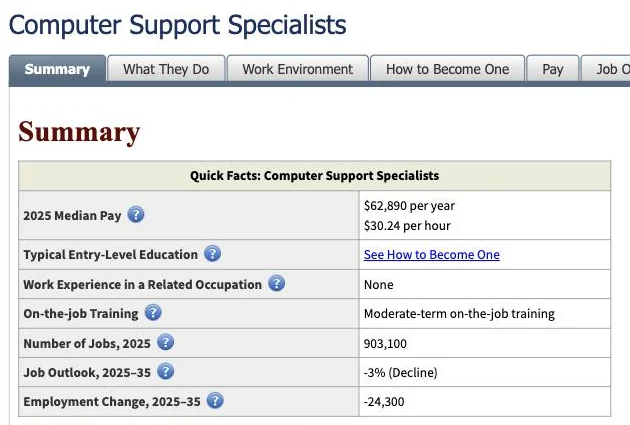
A declining occupation is not a closed one, and it would be misleading to present it that way. BLS still projects about 48,700 openings a year for computer support specialists and 13,400 for systems administrators, because both are large occupations where most hiring replaces people who move on. The practical read is that support is a viable door and a poor destination, so treat it as a first job with an exit plan attached rather than the career itself.
What the work actually involves
Job titles in this field are unusually poor at describing the job, so here is what each of the roles above does on an ordinary Tuesday, and the route people typically take in.
Information security analyst. You monitor systems for intrusions, run vulnerability checks, write the policies that decide who can access what, and lead the response when something goes wrong. BLS lists no programming among the core duties. The common routes in are a support or systems role plus a security certification, or an audit and compliance background moved sideways.
Computer systems analyst. You sit between the people who need software and the people who build it, working out what a business process requires and specifying how systems should change to serve it. This is the classic translator job, and the one place where some programming is genuinely part of the work.
Project management specialist. You own the plan, the dependencies and the deadline for work other people execute. In technology companies this covers programme and delivery management, and it is the most portable role on the list because the skill transfers from any industry that ships complex things on schedule.
Network and computer systems administrator. You keep the infrastructure running: accounts, permissions, networks, backups, upgrades. Much of the routine work here is what automation has been steadily absorbing, which is visible in the projection.
Technical writer. You turn how something works into instructions someone can follow, which means interviewing engineers, reading interfaces and testing your own steps. Near-flat projected growth makes this a role to enter for the work rather than the market.
Computer support specialist. You diagnose and resolve problems for users or across a network, usually against a queue and a response target. It teaches you how systems break, how organisations actually operate, and how to keep a frustrated person calm, which is why so many security and operations people started here.
Four roles sold as code-free that are not quite
This is where the ranking guides are least reliable, because the roles they list as requiring no coding are drawn from job titles rather than from what the work involves.
Computer systems analyst. BLS states plainly that most analysts do some programming in the course of their work, and that analysts who lean into it are often retitled programmer analysts. Fine as a role, misdescribed as code-free.
Data analyst. SQL is code. It is a gentler language than most, and you can be productive within weeks, but a job spent querying databases is a job spent writing instructions a machine executes. Several guides list this as their headline no-coding option.
Quality assurance. Manual testing needs no code. Automated testing is code, and it is where the field has moved. BLS makes the point structurally by grouping QA analysts and testers together with software developers in a single occupation at a $134,040 median, which tells you what that pay reflects.
Information security. The highest-paying role in the table above is reachable without a development background, and plenty of security work is policy, audit, incident response and architecture. Scripting still shows up quickly in the monitoring and automation parts of the job.
None of this makes those roles wrong choices. It makes "no coding, ever" the wrong filter. A more useful filter is how much code, of what kind, and whether it is the point of the job or a tool inside it.
Match the role to how you work
This is the part every ranking guide leaves out, and it is the reason their lists are hard to act on. Once you know your own working pattern, the shortlist gets short quickly.
| If you work by | The pull is | Roles built around it | What most days look like |
|---|---|---|---|
| Improving what exists | Making a working thing better, measurably | Quality assurance, security analysis, systems and reliability operations, process and tooling roles | Finding what is wrong, ranking it, fixing the ranked list |
| Connecting ideas or people | Sitting between groups who need translating | Support and customer success, product management, technical enablement and training, sales engineering, technical recruiting | Meetings, written summaries, unblocking other people's decisions |
| Starting new things | An empty page and a live problem | Early product, growth and marketing operations, internal tooling, founding or first-hire roles | Scoping something undefined, shipping a rough version, deciding what to do next |
| Mastering one subject | Depth, and being the person who actually knows | Security specialisms, data engineering, developer relations, deep technical writing | Long stretches on one hard thing with few interruptions |
Two cautions on using this. Preference is not aptitude, so a pattern tells you where you are likely to stay engaged rather than where you will be immediately good. And the fourth row is the one that most often leads back toward programming, which is worth knowing if that is where you place yourself.
The cheapest way to test a role before you commit
Retraining is expensive and slow, and most people commit before they have any evidence. Every role above produces a specific artefact, and you can usually produce a rough version of it in a weekend without permission from anyone.
Support produces resolved tickets, so answer questions in a busy product community for two weeks and see whether the tenth repeat of the same question irritates you or interests you. Project management produces a plan that survives contact with people, so volunteer to coordinate something small with a firm deadline. Technical writing produces documentation, so pick an open-source tool with poor setup instructions and rewrite them. Security produces findings, so work through a capture-the-flag exercise and notice whether the puzzle or the paperwork holds you. Product produces decisions with reasons attached, so write the argument for a change you would make to a product you use daily.
Your existing work counts for more than most guides suggest, too, and it maps fairly predictably. Teaching transfers to technical enablement and training. Retail and hospitality transfer to support and customer success, where the scarce skill is staying precise with a frustrated person. Administration and operations transfer to project coordination, and project managers already inside technology companies often move toward product, a route the guide to where project managers go next sets out. Marketing transfers to growth and marketing operations, with product marketing as the usual bridge toward product, as the career change guide for marketers explains. Journalism and research transfer to technical writing and user research. Mechanical, civil and electrical engineers have one of the shortest steps, and the engineering career change guide covers the technical pivots that credit nearly all of that background. In each case the technical vocabulary is the part you are missing, and vocabulary is the fastest thing on the list to acquire.
If you want the shortlist rather than the survey, the tech career quiz above reads your working pattern and flow triggers across 26 branching questions and returns matched roles with a first step for each. For the wider question of what a role pays when you skip the traditional credential, the highest-paying careers without a degree breakdown covers the ceilings honestly, and if you are moving across industries rather than into one, the best jobs for career changers is the better starting point.
If you take one thing from this
The question is not whether tech jobs without coding exist, because plenty do and several pay above six figures. It is which ones are growing, which are being described inaccurately, and which one matches how you actually like to spend a working day. On current BLS projections, security and analysis work is expanding while support and systems administration are contracting, and the accessible entry point is the shrinking one. Plan the second job at the same time as the first, and sort the options by working pattern before you sort them by salary. If you want that pattern measured rather than guessed, the career quiz is free and returns an archetype plus matched roles.
Frequently Asked Questions
Ready to find your passion career?
The free under-10-minute quiz maps your childhood patterns and flow triggers to one of 20 archetypes, then gives you matched careers and a 7-day first-step plan.
Take the Free Career QuizRelated Articles
Trusted by 14,600+ career-quiz takers across 168+ countries · Methods covered in