
Career Change from Project Management: Where PMs Go Next
Where project managers go next: operations, product, consulting, IT management, L&D. BLS pay, O*NET data on decision authority and a fit test for your move.


Contents · 7 sections
Project managers most often move into operations management, product management, management consulting, IT or program leadership, and learning and development. O*NET, the US Labor Department's occupational database, links project management specialists to the same families through shared tasks. Pick by what you want more of: authority (operations), shaping what gets built (product), diagnosis (consulting), a bigger delivery remit (program or IT management), or the people (training). Here are 12 destinations worth weighing, with what carries over from project work:
- General and operations manager: the coordination you already do, with the budget and the decisions attached.
- Product manager: scope and trade-off calls, now measured on whether the thing shipped moved a metric.
- Management analyst (consultant): the lessons-learned habit, sold as diagnosis to clients.
- Program manager or PMO lead: several projects at once, for PMs who still like delivery and want a wider remit.
- Computer and information systems manager: IT leadership, strongest if your projects were technical.
- Training and development manager: for PMs whose best days were onboarding and coaching the team.
- Administrative services manager: facilities, vendors and support services, heavy on the contracts you already manage.
- Operations research analyst: quantitative optimisation of schedules and resources; usually needs a graduate degree.
- IT project manager: a related O*NET occupation, a sideways step that changes the tools more than the job.
- Construction manager: a related O*NET occupation, open mainly to PMs who came up through a trade or site work.
- Logistician: a related O*NET occupation that applies schedule and supplier coordination to a supply chain.
- Logistics analyst: the analytical side of the same supply chain, for PMs who liked the planning more than the meetings.
This page covers those moves with BLS pay, O*NET data on what each job is like to do, a translation of your project vocabulary into the words other functions hire on, and an honest list of which moves need a new credential. If you have been delivering for years and suspect the next move is further out than any of these, the career change quiz is a quicker place to start.
Where project managers usually go next
The moves split into two groups. Some keep the delivery engine and change what it serves: program management, IT management, construction management if you came up through a trade. Architects make the reverse trip into project and construction management, and the guide for architects changing careers shows how they reframe a design record for it. Others keep the skills and drop the delivery role: operations, product, consulting, training.
O*NET's related-occupations list for project management specialists names administrative services managers, computer and information systems managers, construction managers, general and operations managers, IT project managers, logisticians, management analysts, operations research analysts and training and development managers. That list is built from overlap in tasks and skills, which is why it reads like a map of where your existing work already reaches.
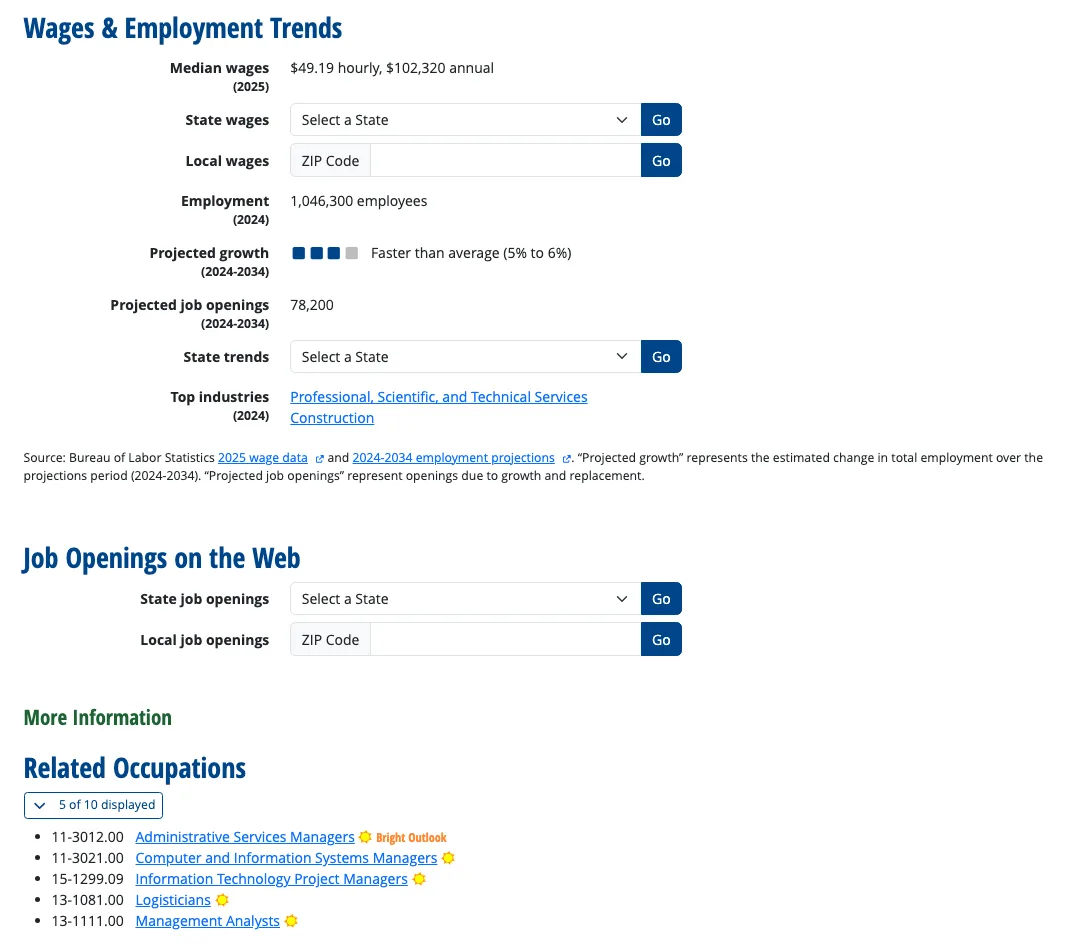
What the list does not tell you is which of these solves your problem. That depends on what you are leaving. Changing careers works best when the destination fixes the specific thing that wore you down, so the next section starts there.
Accountability without authority, in numbers
Most project managers can describe the core frustration in one sentence: you are responsible for the result, and you do not control the people or the budget that produce it. O*NET's work-context survey puts a number on it.
Among project management specialists, 73% report high or very high responsibility for the work outcomes of other workers. Only 27% report having a lot of freedom to make decisions. That combination is unusual. The chart below compares the second figure across the occupations O*NET lists as related, and the spread is wide.
| Answer | Share |
|---|---|
| General and operations managers | 86% |
| Administrative services managers | 54.3% |
| Computer and information systems managers | 53.5% |
| Training and development managers | 42.9% |
| Management analysts | 38.1% |
| Logisticians | 29.2% |
| IT project managers | 28.6% |
| Project management specialists | 27.3% |
Use the chart to sort your options. If the missing authority is your problem, the top of the chart is where you are heading, and general and operations management is the clearest case: it keeps the coordination you are good at and hands you the decisions. If authority is fine and the problem is that you are tired of the delivery treadmill, the middle of the chart (analysis, training) changes the work itself.
A sideways step into an IT project manager title barely changes the number (29%), so it is unlikely to fix this particular problem, however different the tool stack looks from outside.
Being stuck is a common complaint at this stage. In the Career Changer Index, quiz takers with four or more years of experience name being stuck or bored about three times as often as early-career takers.
| Answer | Share |
|---|---|
| No idea which direction to pick | 24% |
| Can't tell what they're good at | 22.6% |
| Stuck or bored in current work | 19.1% |
| Too many interests to commit to one | 18.1% |
| Nothing they try feels like a passion | 16.1% |

Your project vocabulary, translated
Project managers undersell themselves outside delivery because their résumé is written in delivery language. A hiring manager in operations or product reads "managed RAID log" and sees administration. The same work described in their language reads as judgment. This is the translation that matters most for the moves on this page:
| What you did as a PM | How the destination function says it | Where it counts most |
|---|---|---|
| Held scope, schedule and budget on a program | Owned delivery against a cost and time target | Operations, administrative services |
| Ran the RAID log and escalations | Identified risk early and decided when to escalate | Operations, consulting |
| Negotiated change requests | Made prioritisation and trade-off calls | Product management |
| Wrote the weekly status for sponsors | Communicated to executives in their terms | Consulting, IT management |
| Ran lessons-learned sessions | Diagnosed process failures and fixed them | Management analysis |
| Managed vendors and contractors | Negotiated and managed supplier contracts | Administrative services, operations |
| Onboarded people onto a project mid-flight | Designed ramp-up and training | Training and development |
The second column describes the same activity at the level of the decision, which is the level other functions pay for. Rewrite your last two roles in that column before you apply anywhere, and the question of fit will get easier because you will see which rows you are proudest of.
For a wider version of this exercise that covers any profession, the guide to transferable skills at mid-career walks through how to audit what you have.
Seven moves, with verified pay
The table below prices the moves against your current role. The pay figures are read from the Bureau of Labor Statistics wage survey at build time. Product management appears without them because it is spread across several BLS occupations.
| Role | 25th percentile | Median | 75th percentile | What it changes for a PM |
|---|---|---|---|---|
| Project management specialist (your baseline) | $78,440 | $102,320 | $133,100 | Responsibility for outcomes, limited authority over them |
| General and operations manager | $72,320 | $105,770 | $167,280 | The authority move: you run the operation instead of the project |
| Computer and information systems manager | $138,060 | $175,140 | $220,730 | IT leadership; strongest if your projects were technical |
| Training and development manager | $101,850 | $133,000 | $176,870 | For PMs whose best days were onboarding and coaching the team |
| Administrative services manager | $86,460 | $114,130 | $157,420 | Facilities, vendors and support services; heavy on contracts |
| Management analyst (consultant) | $77,950 | $101,860 | $133,370 | Trades delivery for diagnosis at about the same pay |
| Operations research analyst | $68,360 | $88,940 | $125,990 | Quantitative optimisation; usually needs a graduate degree |
| Product manager | No single BLS occupation; pay varies widely by company | Owns what gets built and why; no clean BLS occupation | ||
Annual wages from the U.S. Bureau of Labor Statistics Occupational Employment and Wage Statistics program, May 2025 release. Half of workers in a role earn more than the median; the 25th to 75th percentile span shows how wide the role pays. To see where your current salary sits in your own occupation, use the free salary benchmark.
Two things stand out. First, most of these moves do not cost money. Management analysis sits almost exactly at the project management median, and operations and administrative services sit at or above it. Second, the two moves with the biggest pay upside, IT management and training and development management, are both management roles, so they reward the people you have led more than the projects you have shipped.
If a PM is asking whether to go into consulting, the pay line says the decision is about the work. Consulting keeps the travel and client pressure and adds a sales component at senior levels, so it suits people who liked the diagnosis part of projects and do not mind being judged on recommendations someone else implements. Bankers weigh the same trade, and the page on where bankers go when they leave sets consulting against their other exits.
What needs a credential, and what your delivery record already covers
Most of these moves hire on evidence of judgment, which you already have. The ones that need more:
No new credential, just a reframed record. Operations management, administrative services management and product management. O*NET reports that 72% of general and operations manager incumbents say the job requires less than a bachelor's degree, which tells you employers hire this role on track record. It is also why veterans moving into civilian work so often start in operations. Product management has no licensing body; what gets you hired is proof that you have made product decisions, so the internal route (owning a small area of a product you already deliver) beats any course.
Helpful, rarely required. For management analysis, O*NET finds 57% of incumbents say a bachelor's is the requirement and a third say post-graduate education is, which is where the MBA shows up. It helps with the large consulting firms and matters much less in internal consulting or boutique firms. For training and development management, 71% say a bachelor's is enough.
Needs retraining. Operations research analysis. Two thirds of O*NET respondents say the job requires education beyond a bachelor's degree, 43% a master's specifically. If you are drawn to the modelling side, a part-time quantitative master's is the honest price of entry. Computer and information systems management also expects technical depth; if your projects were in IT, you likely have it, and if they were in construction or marketing, you probably do not.
A note on the PMP: it is worth keeping current if the next role is still delivery (program management, PMO leadership), and it is close to irrelevant for operations, product or consulting hiring. Do not spend money renewing a credential for a job you are trying to leave.
A fit filter: which part of the project did you enjoy?
Every project has three phases that feel different from the inside, and the one you miss on a Monday morning is a good predictor of your exit.
O*NET gives project management specialists a Holland interest code of Enterprising then Conventional: persuading and organising people, with systems and order as the second pull. The exits differ mainly on which neighbour of that pair they add. Management analysts are coded Conventional, Investigative, Enterprising; training and development managers Enterprising, Social, Conventional; operations research analysts Investigative, Conventional. On the hexagon below, a move toward an adjacent corner is a smaller change of daily work than a move across it.
| Letter | Type | Core interests |
|---|---|---|
| R | Realistic | Hands-on work: tools, machines, the physical world |
| I | Investigative | Research, analysis, working with ideas |
| A | Artistic | Design, writing, performance, open ends |
| S | Social | Teaching, care, service to people |
| E | Enterprising | Leading, selling, starting things |
| C | Conventional | Systems, data, order, getting details right |
The hexagonal model comes from John Holland’s theory of vocational choice (1959), the framework underneath the U.S. Department of Labor’s O*NET database.
The front end. The problem was still open, the scope was not set, and you were in the room deciding what the project was for. If this was your favourite part, product management or consulting fits, because both live in the undefined phase.
The middle. Twenty people, four vendors and a budget, all moving because you kept them moving. If this was the part you were good at and enjoyed, operations management is the natural move, because it is the middle phase with no end date and more authority.
The retrospective. You liked working out why things went wrong and fixing the process for next time. That is management analysis, process improvement or, with the numeric bent, operations research.
The people. You liked the onboarding, the coaching, the moment someone new became useful. That points to training and development.
Question 1
Is carrying outcomes you have no authority over what wears you down?
Yes: General and operations management. It keeps the coordination and hands you the decisions.
No: Go to the next question.
Question 2
Was the open front end, deciding what the project was for, your favourite part?
Yes: Product management, or consulting if you prefer advising to owning.
No: Go to the next question.
Question 3
Did you enjoy working out why projects went wrong?
Yes: Management analysis, or operations research if you want the modelling.
No: Go to the next question.
Question 4
Were onboarding and coaching the best days?
Yes: Training and development.
No: The neighbouring jobs on this page may not fix it. Start a wider search from what absorbs you.
Run the questions in order and stop at the first yes. The order follows the chart above: the authority problem first, because a sideways move does not solve it.
Most people recognise themselves in one or two of these. If you recognise none of them, and project work never gave you energy in any phase, then you need a wider search than the neighbouring jobs on this page. The quiz linked above maps that wider question, using signals such as the kind of work that makes hours disappear for you and the choice you would make with pay off the table, to one of 20 archetypes with matched careers.
Related guides: career change from marketing and career change from HR.
Test the move inside one delivery cycle
Project managers have an advantage most career changers do not: your job already contains small versions of every destination on this page. Use the next project as the test.
If you are considering operations, ask to own an operational metric alongside the project, such as the run cost of the system after go-live. If product, volunteer for the discovery interviews and write the prioritisation memo. If consulting, run a proper post-mortem on a failed project and present the findings to a sponsor. If training, design the onboarding for the next person who joins mid-project.
Each of these takes a few weeks, costs nothing, and tells you two things: whether you enjoy the work when it is yours, and whether you are good at it in someone else's eyes. That second part becomes the first line of your application. A test that fails is also useful, because it removes an option before you pay for it.
The timing question comes next. Most of these moves are possible inside the same employer, which is the lowest-risk version, and internal moves also tend to keep your salary intact. An external move makes sense once the internal test has told you which direction holds.
For the neighbouring move, see career change from sales.
Frequently Asked Questions
Ready to find your passion career?
The free under-10-minute quiz maps your childhood patterns and flow triggers to one of 20 archetypes, then gives you matched careers and a 7-day first-step plan.
Take the Free Career QuizRelated Articles
Trusted by 12,200+ career-quiz takers across 165+ countries · Methods covered in