
Career Change from Marketing: Where Marketers Go, and AI's Role
Where marketers go next: product, fundraising, PR leadership, analytics, UX, consulting. BLS pay, Microsoft AI usage data by job and a filter to pick your move.

Contents · 8 sections
The most frequent moves out of marketing are product management, fundraising, communications or PR leadership, management consulting, analytics, UX design, sales management and training, and O*NET's related-occupations data for marketing specialists covers most of them. Your best option depends on the part of marketing you want to keep: product and consulting keep the strategy, fundraising and PR keep the persuasion, analytics keeps the measurement, UX keeps the craft. Fourteen destinations, with what each keeps:
- Product manager: customer insight and positioning, with ownership of what gets built.
- Marketing manager: the inside promotion to strategy, budget and team.
- Advertising and promotions manager: a related O*NET occupation that runs paid campaigns at the leadership level.
- Public relations manager: message and reputation, owned at the top of the function.
- Fundraising manager: persuasion and storytelling aimed at donors instead of buyers.
- Sales manager: the commercial side of the same customer, with a team's number.
- Management analyst (consultant): strategy and research, sold as advice.
- Business intelligence analyst: a related O*NET occupation for marketers whose best work was the reporting.
- Data scientist: the measurement craft taken much deeper, with coding and statistics.
- Web and digital interface designer (UX): the craft of the page instead of the campaign.
- Search marketing strategist: a related O*NET occupation that specialises in search, for marketers who want depth in one channel.
- Financial and investment analyst: a related O*NET occupation where market research skills meet company valuation.
- Training and development specialist: content and teaching for an internal audience.
- Technical writer: writing for users, a common suggestion that the AI data below treats with caution.
There is a question in this decision that the other guides on this topic leave out, which is AI. Microsoft's analysis of 200,000 AI conversations placed marketing specialist work 26th of 785 occupations for AI applicability, and some of the most recommended exits score even higher. This page puts that data next to the BLS pay for each move, so you can see which exits change your exposure and which only change your title. If you are mid-career and unsure whether to stay in the function at all, the career change quiz is the faster first step.
What marketers most often move into
O*NET's related-occupations list for market research analysts and marketing specialists reads like a map of the moves marketers make: advertising and promotions managers, business intelligence analysts, data scientists, financial analysts, management analysts, marketing managers, public relations managers, sales managers and search marketing strategists. Add product management, which has no clean occupation code but appears on most of the published lists, plus fundraising and training, and you have the realistic set. The financial analyst route is also a common exit for bankers, so the page on where former bankers move shows who you would be competing with there.
They fall into three groups by what they keep:
- Keep the strategy: product management, management consulting, marketing leadership.
- Keep the persuasion: fundraising and development, PR and communications leadership, sales management.
- Keep one craft and go deep: analytics or data science, UX and digital design, training.
The first group is the easiest to enter from a mid-level marketing role. The third takes the most retraining, and, as the next section shows, it is also where the AI picture is least reassuring.
What the AI usage data says about marketing work
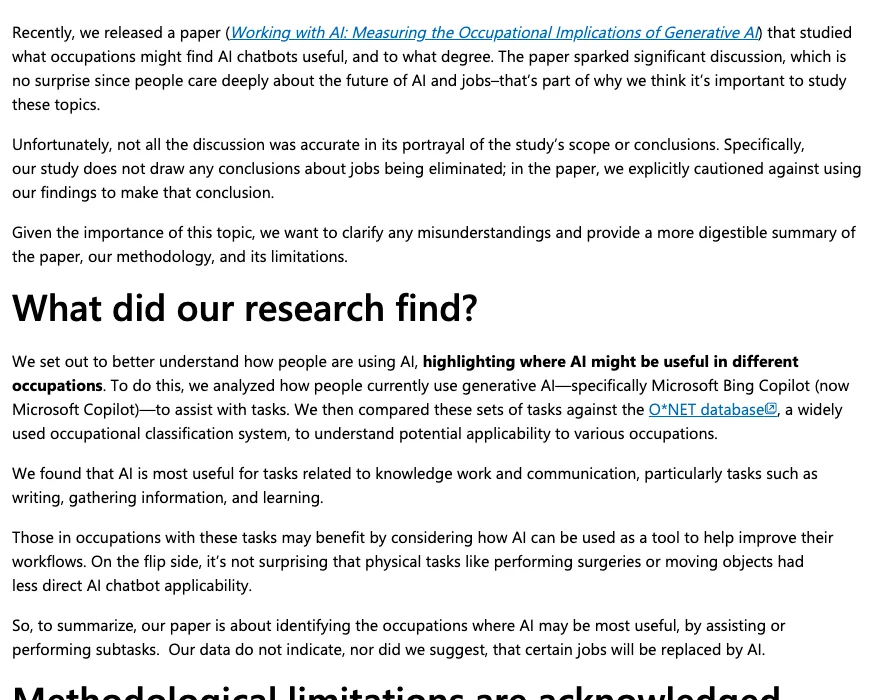
One of the largest public datasets on where generative AI is used at work comes from a Microsoft Research study, Working with AI by Kiran Tomlinson and colleagues. They analysed 200,000 anonymised conversations with Bing Copilot, mapped each one to the work activities in O*NET, and scored every occupation on how much of its work AI was being used for, and how successfully.
Market research analysts and marketing specialists ranked 26th of 785 occupations. Marketing managers ranked 266th. The difference is in the work: the specialist role is heavy on research, drafting, reporting and summarising, which are the activities people bring to AI most often, while the management role is heavy on decisions, budgets and people.
The authors are careful about what this means. In a follow-up note they wrote that their data "do not indicate, nor did we suggest, that certain jobs will be replaced by AI." Applicability measures where AI is useful. It does not measure where jobs disappear, and a marketer whose research and first drafts get faster may end up with more strategic work in the same role.
So the useful question for your career change is narrower: how much of your current week sits in the layer AI is already doing, and does the move you are considering change that?
Exits compared by how much of the work AI already touches
The chart uses the study's coverage measure: the weighted share of each occupation's work activities that appeared in Copilot conversations often enough to count. Higher means more of the job overlaps with what people already use AI for.
| Answer | Share |
|---|---|
| Web and digital interface designers | 88.7% |
| Technical writers | 85.9% |
| Data scientists | 77.2% |
| Marketing specialists and market research analysts | 73.8% |
| Management analysts | 70.5% |
| Public relations managers | 46.2% |
| Training and development specialists | 45.4% |
| Marketing managers | 42.9% |
| Sales managers | 33.9% |
| Fundraising managers | 27.3% |
The pattern is consistent: roles built around relationships, budgets and people decisions sit low, and roles built around producing content or analysis sit high. That makes three of the most recommended exits for marketers (UX, technical writing, data science) poor choices if your reason for leaving is AI. They may be excellent choices for other reasons, such as liking the craft, but they do not move you out of the layer AI is changing.
If the driver is a restructuring that already happened, rather than a worry about the next one, the guide to a career change after redundancy covers the first weeks and the money questions.
The promotion route, and what it costs in hours
For many marketers the lowest-exposure move on the chart is the one inside their own function: from specialist to marketing manager. It cuts AI coverage by about 40% and roughly doubles the median wage in the BLS data below. It also changes the week.
| Answer | Share |
|---|---|
| Marketing specialist | 31.6% |
| Marketing manager | 83.6% |
The same survey finds that 80% of marketing managers describe their work as highly or extremely competitive. So the promotion answers the AI question and the pay question and asks more of your evenings. If the pace is part of why you want to leave, the persuasion exits (fundraising in particular) are worth a closer look, because they keep the manager-level pay with a different kind of pressure.
Eight destinations, priced
The table compares marketing specialist pay with each move. The wage columns are drawn from the latest BLS occupational wage release. Product management is listed without them because the BLS does not classify it as one occupation.
| Role | 25th percentile | Median | 75th percentile | What it keeps from marketing |
|---|---|---|---|---|
| Marketing specialist / market research analyst (baseline) | $58,350 | $78,760 | $108,310 | Research, content and campaign execution |
| Marketing manager | $123,020 | $166,790 | $216,410 | The inside promotion: strategy, budget and team |
| Fundraising manager | $95,970 | $125,470 | $169,990 | Persuasion and storytelling aimed at donors |
| Public relations manager | $106,580 | $146,910 | $204,520 | Message and reputation at the leadership level |
| Sales manager | $100,360 | $148,270 | $207,340 | The commercial side of the same customer |
| Management analyst (consultant) | $77,950 | $101,860 | $133,370 | Strategy and research sold as advice |
| Data scientist | $85,660 | $120,230 | $158,880 | The measurement craft, taken much deeper |
| Web and digital interface designer (UX) | $73,290 | $104,000 | $158,820 | The craft of the page instead of the campaign |
| Training and development specialist | $50,110 | $69,280 | $95,050 | Teaching and content for an internal audience |
| Product manager | No single BLS occupation; pay varies widely by company | Owns what gets built; product marketing is the bridge | ||
Annual wages from the U.S. Bureau of Labor Statistics Occupational Employment and Wage Statistics program, May 2025 release. Half of workers in a role earn more than the median; the 25th to 75th percentile span shows how wide the role pays. To see where your current salary sits in your own occupation, use the free salary benchmark.
Almost every move pays more than the specialist baseline, which says less about the destinations than about where marketing specialist pay sits. The management moves (marketing, PR, sales, fundraising) pay the most and score lowest on AI coverage. The craft moves pay well and score high. Training is the only move here that tends to pay less than the baseline.
Campaign skills, in other departments' words
Marketing résumés are full of channel names and tools that mean little outside the function. The same work, described as the capability underneath it, reads well to a product lead, a development director or a consulting partner.
| What you did in marketing | How the destination says it | Where it counts |
|---|---|---|
| Built personas and ran customer interviews | Customer discovery and research | Product management, UX |
| Owned a campaign budget and reported ROI | Managed a budget against measurable outcomes | Marketing leadership, consulting |
| Wrote positioning and messaging | Framed a value proposition for a specific audience | Product, fundraising |
| Ran A/B tests and attribution reports | Designed experiments and analysed results | Analytics, data science |
| Managed agencies and freelancers | Managed external suppliers to a brief and budget | PR leadership, operations |
| Grew an email list or community | Built and retained an audience over time | Fundraising, development |
| Presented results to leadership | Communicated findings to executives | Consulting |
The row that does the most work in fundraising interviews is the audience one. Development directors hire people who can keep donors engaged over years, and a marketer who has grown and retained a list has done a version of that already.
Related guides: career change from project management.
Where you need to retrain, and where a portfolio is enough
A portfolio is enough. Product management, fundraising, PR leadership, sales management and marketing management hire on what you have run. O*NET reports that 66% of fundraising managers say a bachelor's degree is the required level, with no licence, and 91% of public relations specialists say the same. Your campaigns, launches and results are the evidence, so collect them into a short document before you apply.
Helpful but optional. Management consulting. O*NET finds that about one management analyst in three reports a post-graduate requirement, which reflects the MBA pipeline into the large firms. Boutique and internal consulting hire on sector expertise more often.
Retraining required. Data science asks for coding and statistical depth well past what marketing analytics usually builds, which takes sustained study if your analytics work so far has lived in spreadsheets and dashboards. UX design needs a design portfolio of your own work. Both are full crafts that score high on the AI chart above, so they make sense when the craft itself is what you want to spend your days on.
Training and development sits in between: 78% of O*NET respondents say a bachelor's is the required level, and the skill you need to show is designing learning, which is close to designing a content journey. Most corporate training sits inside HR, and the guide to career change from human resources shows what that function is like from the inside.
For the neighbouring move, see career change from sales.
Three questions to sort the list
Which part of your job did you look forward to? The strategy meeting, the creative brief, the data review or the stakeholder presentation. Each maps to one group above: strategy to product and consulting, creative to UX or content, data to analytics, presentation to PR, fundraising and sales leadership. Content teams also hire many journalists leaving the news business, which tells you who else will apply.
Is AI a reason or a worry? If your role has already changed because research and first drafts are faster, the chart above is your filter and the management and relationship exits are the direction. If it is a general worry and you enjoy the work, a move up inside marketing may answer it without a career change.
What are you willing to trade for it? The lowest-exposure moves come with more hours and pressure (marketing and sales management) or a sector change (fundraising). The quieter moves (training) pay less. There is no option on this page that improves every variable at once, so decide which one matters most before you apply.
Question 1
Has AI already changed your week, with research and first drafts done much faster?
Yes: Look at the management and relationship exits: fundraising, PR leadership, sales management.
No: Go to the next question.
Question 2
Is the pace part of why you want out?
Yes: Fundraising or training. The promotion to marketing manager adds long weeks.
No: Go to the next question.
Question 3
Do you want to go deep on one craft?
Yes: Analytics, data science or UX, with the retraining and the high AI coverage priced in.
No: Product management or consulting, which keep the strategy and the customer insight.
Based on the Microsoft coverage chart and the O*NET hours data on this page. Stop at the first yes.
If none of the groups fits, and the answer to the first question was "none of it, for a while now", the move is probably bigger than marketing-adjacent. That is where a look at how to change careers from first principles helps, starting with what absorbs you rather than what your résumé qualifies you for.
Frequently Asked Questions
Ready to find your passion career?
The free under-10-minute quiz maps your childhood patterns and flow triggers to one of 20 archetypes, then gives you matched careers and a 7-day first-step plan.
Take the Free Career QuizRelated Articles
Trusted by 12,200+ career-quiz takers across 165+ countries · Methods covered in