
Alternative Careers for Occupational Therapists: A Fit Guide
Alternative careers for occupational therapists: ergonomics, UX research, assistive tech, rehab leadership, L&D. BLS pay, burnout evidence and a fit filter.


Contents · 8 sections
Occupational therapists who leave direct care move most often into ergonomics and injury prevention, UX and accessibility research, assistive technology and home modification, rehab or program leadership, and training or sales roles at equipment and software companies. All of them sell activity analysis, the OT habit of breaking a task into its physical, cognitive and environmental demands and redesigning the fit. These are the 14 alternative careers OTs take most, with who each one suits:
| Alternative career | Who it suits, or what carries over |
|---|---|
| Ergonomist or injury prevention specialist | OTs who preferred work hardening and return-to-work cases |
| UX or accessibility researcher | OTs who kept redesigning apps and forms for clients |
| Assistive technology professional (ATP) | OTs who loved seating, switch access and equipment trials |
| Home modification specialist | Home safety evaluations, run as the whole job |
| Rehab director or program manager | The informal lead who already fixed the schedule |
| DME, seating or adaptive equipment sales | You have fitted the product and know why trials fail |
| Clinical or corporate trainer | Caregiver training is adult education under pressure |
| Rehabilitation counselor | O*NET's closest related occupation; usually a pay cut and a counselling master's |
| Low vision or vision rehabilitation therapist | Listed by O*NET as a related occupation with its own specialist training |
| Driving rehabilitation specialist | Community work with its own certification track |
| Functional capacity and job demands evaluator | FCE skills for insurers and return-to-work programs |
| Certified hand therapist | Clients who mostly get better, after years of hand therapy practice |
| School-based or early intervention OT | Stays in OT with a team-set pace and the school calendar |
| Research, compliance or documentation roles | Progress reports are structured research write-ups |
Which of the five main doors suits you?
The right door for you depends on which part of the work you want to keep. An OT who still loves the one-to-one client relationship belongs in assistive technology or home modification. One who is more interested in the environment than the person belongs in ergonomics or UX. One who wants authority over how the work is done belongs in leadership.
The career change quiz makes that call from your own answers, resolving them to one of 20 archetypes with matched careers. The rest of this guide gives you the evidence and the pay data to check its answer.
The list below starts from O*NET's task profile for occupational therapists: testing physical and mental abilities, planning programs that teach work and life-management skills, training caregivers, and writing detailed progress reports. Each door keeps a different subset of those tasks.
- Ergonomics and workplace injury prevention. Keeps the task analysis and the environmental redesign, drops the treatment. Suits OTs who preferred the work-hardening and return-to-work cases.
- UX and accessibility research. Keeps observation of people struggling with tools, drops the licence entirely. Suits OTs who found themselves redesigning apps and forms for clients because the defaults did not work. Psychologists apply for the same research roles on the strength of their methods training, and how psychologists move into UX research shows what that competition brings.
- Assistive technology and home modification. Keeps the client relationship and the equipment trials, often with more autonomy and fewer productivity rules. Suits OTs who loved seating, switch access or home safety evaluations.
- Rehab and program leadership. Keeps clinical judgment, adds budget and staffing authority. Suits OTs who were already the informal lead.
- Training and sales at equipment or software companies. Keeps caregiver training and patient education, aims them at clinicians and buyers. Suits OTs who enjoyed the teaching part of every session.
Activity analysis is the skill to sell
OT programs teach activity analysis as a clinical method. Outside healthcare it is the core competence of several job families, and it needs translating before a recruiter will see it.
| OT work | What it is called outside healthcare | Where it gets you hired |
|---|---|---|
| Activity analysis of a daily task | Task analysis, workflow mapping | UX research, ergonomics, process improvement |
| Environmental modification | Human factors and accessibility design | Accessibility teams, home modification, facilities |
| Adaptive equipment trial with outcome measures | Usability testing with success criteria | UX research, product teams at equipment makers |
| Caregiver and family training | Adult learning and enablement | Corporate L&D, clinical education, customer training |
| Functional capacity evaluation | Job demands analysis | Workplace safety, return-to-work programs, insurers |
| SOAP notes and progress reports | Structured research write-ups | Research, compliance, documentation roles |
The right column is the language to put on your LinkedIn headline. "OT, MOT" invites the explaining problem; "Accessibility and task-analysis specialist, OT background" does not. If you want the general method for reframing clinical work, transferable skills mid-career walks through it step by step.
The explaining problem, and why it follows you into interviews
Most OTs know the conversation: no, not physical therapy, and no, not job-finding either. That confusion is more than an irritation. A 2025 study of 400 US occupational therapy professionals in the American Journal of Occupational Therapy used relative weight analysis to rank what drives burnout. Workload came first, and professional identity strain, including being misidentified by others, came second, ahead of role conflict.
| Answer | Share |
|---|---|
| Workload (personal burnout) | 21% |
| Workload (work-related burnout) | 19% |
| Identity strain and misidentification (personal) | 11% |
| Identity strain and misidentification (work-related) | 8% |
| Role conflict (personal) | 7% |
| Role conflict (work-related) | 7% |
The explaining problem carries into a job search outside healthcare. A hiring manager in product or safety reads "occupational therapist" and pictures something vague. The fix is to stop leading with the title and lead with the outputs the title produced: a workstation redesign, a caregiver training program, an adaptive equipment trial with measured results. The same study found that OTs who reshaped their own jobs (job crafting, in the paper's terms) reported less burnout, which suggests a useful first experiment before you leave: pull more of the work you want into the job you have, then see whether that is enough.
What PDPM did to skilled nursing OT
A large share of OT burnout traces to one payment change. Medicare's Patient Driven Payment Model took effect in skilled nursing facilities on October 1, 2019, moving payment away from the volume of therapy delivered. The American Speech-Language-Hearing Association, tracking the fallout for its own members, reports that CMS data showed therapy services fell by roughly 30% in the first quarter after implementation, alongside member reports of layoffs, cut hours and mandated group treatment.
For the therapists who stayed, the pressure moved into productivity targets. A 2024 AJOT survey of 366 therapy practitioners in skilled nursing and assisted living found 20.5% met the full burnout profile across all three Maslach dimensions, and that productivity requirements were significantly related to five of six ethically questionable behaviours the researchers asked about. If your reason for leaving is the feeling that the building wants billable minutes more than it wants outcomes, that feeling has a documented cause, and it tells you what to avoid next: any employer paid per unit of therapy, whatever the setting is called.
The moves inside OT worth one test first
OT is unusually wide. The same licence covers neonatal intensive care, school-based practice, hand clinics, mental health units, driving rehabilitation and home health, and the daily experience of those settings has less in common than most career changes. Before you spend a year retraining, it is worth asking whether one of them would fix the thing you want to escape.
If the problem is productivity pressure, school-based practice and early intervention are the obvious tests. Caseloads are full and paperwork is heavy, but the payment model is built around education plans and service minutes set by a team, and the pace follows the school year. The shift is in who sets your pace, which is the variable the PDPM research points at. Dental hygienists run the same setting-first test against a practice's production targets, and the hygienist exits beyond the chair show which settings change it.
If the problem is the emotional load of long-term decline, hand therapy and outpatient orthopedics put you with clients who mostly get better. The Hand Therapy Certification Commission's CHT credential requires years of direct hand therapy practice before you can sit the exam, so this is a multi-year specialisation rather than a quick exit, and it is one of the few OT paths with its own professional market. Counsellors carrying compassion fatigue face a close version of this question, set out in career options for therapists and counsellors.
If the problem is being inside a building all day, driving rehabilitation, home modification and home health put you in the community. Driving rehab has its own certification track, and community work generally gives you more say over your schedule than facility work does.
If the problem is the work itself, none of these will hold, and the five doors above are where to look. The test is simple: if you picture yourself doing OT in the best version of your favourite setting and feel relief, stay in the profession and change the setting. If you picture it and still feel the pull away, that is the answer the rest of this page is built for.
Running that test honestly matters because OT is a master's-level credential with the student debt to match, and walking away from the licence is harder to reverse than switching from skilled nursing to schools. A setting change can be tried with a PRN shift or a summer contract. A career change usually cannot.
Question 1
Is productivity pressure the main thing you want gone?
Yes: Test school-based practice or early intervention, where a team sets service minutes and the pace follows the school year.
No: Go to the next question.
Question 2
Is it the emotional load of clients in long-term decline?
Yes: Look at hand therapy or outpatient orthopedics, a multi-year specialisation with clients who mostly get better.
No: Go to the next question.
Question 3
Is it being inside one building all day?
Yes: Driving rehabilitation, home modification and home health put you in the community with more say over your schedule.
No: Go to the next question.
Question 4
Picture the best version of your favourite OT setting. Do you feel relief?
Yes: Stay in the profession and change the setting, starting with a PRN shift or a summer contract.
No: The work itself is the problem, so the doors in the table at the top of this page are where to look.
The four setting tests from this section in the order worth running them. The first yes is your next experiment.
Pay across the five doors
These are national Bureau of Labor Statistics wage percentiles for the closest standard occupation to each door, with occupational therapist as the baseline. Several OT exits do not have a clean BLS series, so the label says which occupation the figure comes from.
| Role | 25th percentile | Median | 75th percentile | Why OTs get hired there |
|---|---|---|---|---|
| Occupational therapist (baseline) | $82,510 | $100,330 | $116,670 | Your starting point for every comparison |
| Rehab director or program manager | $94,700 | $123,860 | $166,100 | Clinical credibility plus the scheduling and compliance work you already do |
| Ergonomist or injury prevention specialist | $69,560 | $90,150 | $111,690 | Work hardening, job site analysis and workstation redesign carry over directly |
| UX or accessibility researcher (BLS groups with market research analysts) | $58,350 | $78,760 | $108,310 | Task analysis and observation of users under constraint |
| DME, seating or adaptive equipment sales | $75,030 | $104,920 | $158,160 | You have fitted the product and know why trials fail |
| Clinical or corporate trainer | $50,110 | $69,280 | $95,050 | Caregiver training is adult education under pressure |
| Rehabilitation counselor | $38,770 | $46,850 | $59,260 | O*NET's closest related occupation; usually a pay cut and a counselling master's |
| Assistive technology professional | no separate BLS series | Often an OT role with ATP certification; pay follows the employing occupation | ||
Annual wages from the U.S. Bureau of Labor Statistics Occupational Employment and Wage Statistics program, May 2025 release. Half of workers in a role earn more than the median; the 25th to 75th percentile span shows how wide the role pays. To see where your current salary sits in your own occupation, use the free salary benchmark.
Read the rows against your own pay, and against where you would start. A first UX research role pays like an early-career analyst, which can mean a step down before the curve bends up. Leadership and sales carry the widest upper range, while rehabilitation counselling is the one move on the list that almost always pays less, which is why it suits OTs driven by the vocational work itself.
Degrees, certificates, and the moves that need neither
Needs nothing new. Rehab leadership, training roles, DME and equipment sales, and entry ergonomics work hire on your degree, licence and clinical years. Keep the licence active if you can: several of these roles are easier to get as a working clinician, and PRN work keeps a fallback.
A certificate helps. Assistive technology roles value the RESNA Assistive Technology Professional credential, home modification work values a dedicated home modification certificate program, and some ergonomics consultancies list professional ergonomics certification as preferred. UX research values a portfolio more than any certificate: two or three case studies written as usability studies will do more than a course badge.
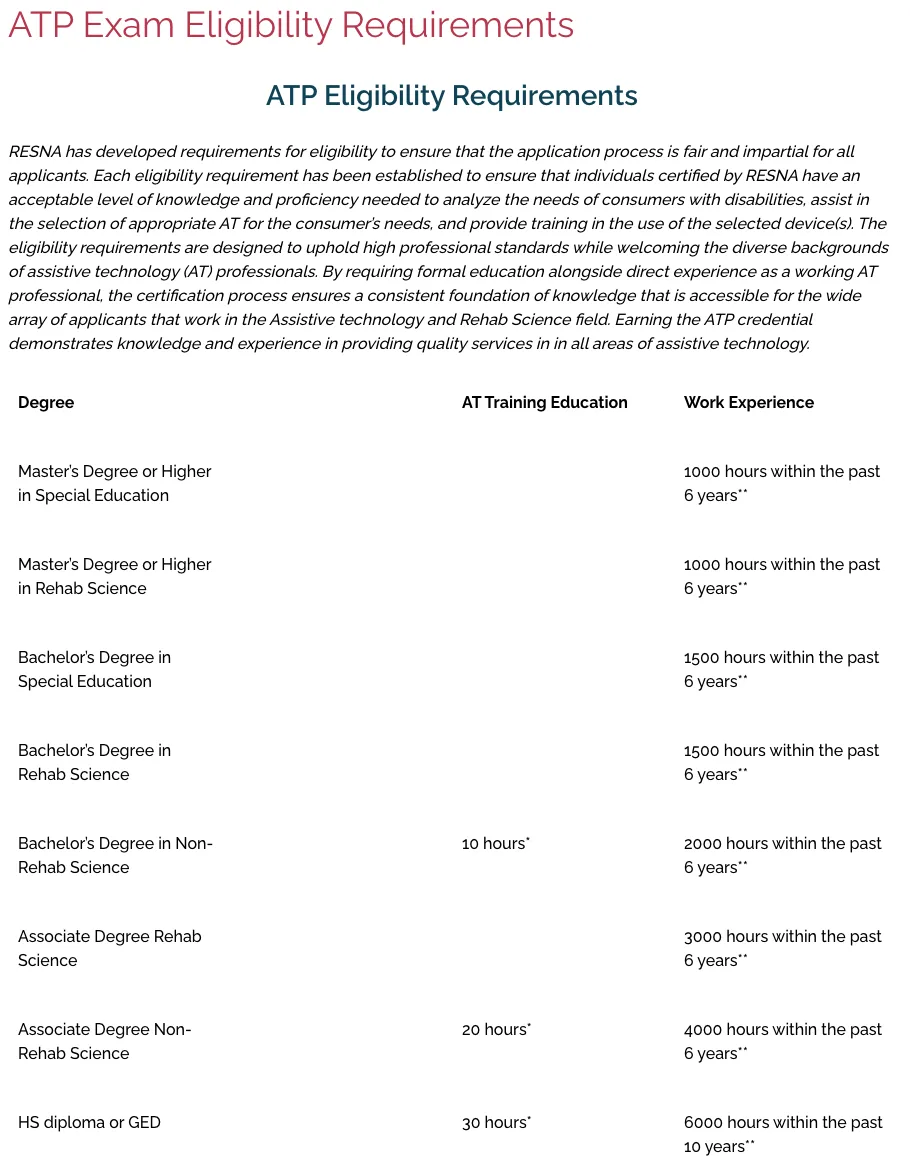
RESNA's own eligibility table shows why the ATP suits a working OT. Occupational therapy counts as a rehab science degree, so an OT with a master's needs 1,000 hours of assistive technology work within the past six years and no extra AT training hours before sitting the exam.
A new degree. Rehabilitation counselling expects a counselling master's in most states. Physician assistant or nursing mean full retraining and a new licence. Physical therapy is sometimes suggested as an escape and is the weakest of these, since O*NET lists it as a close neighbour and it runs on the same productivity model you may be leaving.
Sort the doors by what drained you
MyPassion sorts career changers on two axes: the struggle that brought them to the question and the priority they bring to the next move. The combination resolves to one cell of the matrix below. For OTs, the column usually decides the door.
What you need next →
| Income-Focused | Lifestyle Seeker | Stability First | Experimenter | |
|---|---|---|---|---|
| Career Switcher | Ambitious Pivoter | Freedom Seeker | Strategic Shifter | Curious Transformer |
| Grad Explorer | Rising Achiever | Modern Explorer | Foundation Builder | Open-Minded Starter |
| Multi-Passionate | Renaissance Earner | Creative Polymath | Focused Generalist | Passion Collector |
| Purpose Seeker | Impact Driver | Meaningful Creator | Mission Seeker | Values Explorer |
| Explorer | Emerging Achiever | Authentic Seeker | Grounded Explorer | Curious Adventurer |
↓ What is hardest right now
Highlighted: Career Switcher crossed with Lifestyle Seeker resolves to The Freedom Seeker. Source: the live MyPassion.ai archetype matrix.
- Income first. Leadership or equipment sales. Both reward clinical credibility with a higher ceiling.
- Sustainable week first. Ergonomics, UX research, assistive technology. Salaried work judged on outcomes.
- Stability first. Program leadership inside a hospital system, or clinical training at a large employer, where your licence stays relevant.
- Experimenting first. Keep a PRN caseload and test two doors at once for a quarter: a UX case study on nights, a job site analysis for a local employer.
The quiz reaches that sort through a values question most assessments skip: what you would wake up wanting to do if you never needed another paycheck. An answer with a person in the picture points toward door three; an answer about a system or a space points toward doors one and two. The changing careers covers the sequence from that answer to a tested direction.
For the closest parallel exit, the logic for nurses leaving the bedside is in career change from nursing.
Related guides: career change for physical therapists.
Before you rewrite a single résumé line, spend a few minutes on the free quiz. It hands back an archetype with a written reading and a short list of careers ranked by fit, and 12,200+ people have taken it so far. Read the result for one thing: which part of your current work it says to carry forward.
Frequently Asked Questions
Ready to find your passion career?
The free under-10-minute quiz maps your childhood patterns and flow triggers to one of 20 archetypes, then gives you matched careers and a 7-day first-step plan.
Take the Free Career QuizRelated Articles
Trusted by 12,200+ career-quiz takers across 165+ countries · Methods covered in