
Career Change for Physical Therapists: Where PTs Go Next
Where physical therapists go after the clinic: rehab leadership, device sales, informatics, ergonomics, teaching. BLS pay, setting burnout data and a fit test.


Contents · 8 sections
Most physical therapists who leave patient care move into one of five directions: rehab or clinic leadership, medical device and orthopedic sales, clinical informatics or EMR work, utilization review for insurers, or teaching and clinical education. A smaller group retrains as physician assistants. Here are the 13 roles PTs move into most, with what carries over to each:
- Rehab director or clinic operations manager. Suits the PT who was already the informal lead; caseload and scheduling experience is the qualification.
- Orthopedic or medical device sales. Surgeons and clinics trust a rep who has rehabbed the implant, and pay leans on commission.
- Clinical informatics or EMR analyst. For the PT who fought the rehab documentation template daily and wanted to rebuild it.
- Utilization review or claims examiner at an insurer. Judging medical necessity for therapy visits, often remote, with no visit quota.
- Ergonomics and injury prevention specialist. Biomechanics and movement analysis applied to industrial and office work.
- DPT faculty or clinical education. For PTs whose best hour was the new-grad in-service; tenure-track posts often expect board certification or a further doctorate.
- Clinical education specialist at an EMR or device company. Trains other clinicians on the product and hires on the DPT and clinical years.
- Quality and compliance roles. Notes written to survive a Medicare audit are compliance-grade writing.
- Patient engagement and training roles. Getting a sceptical patient to do a home program is behaviour change work.
- Product and wearables teams. Movement and posture analysis fed into design decisions.
- School-based physical therapist. Stays in PT under a different payment model; school PTs reported the lowest burnout of any setting in the survey below.
- Occupational therapist. O*NET's closest listed neighbour, and a second degree on the same productivity model.
- Physician assistant. The one move here with a genuine pay and scope change, at the price of a new degree and licence.
Which PT exit fits, and what does each pay?
Which one fits you depends less on pay than on the part of the job that wore you down. A PT exhausted by visit quotas needs a role without a quota. A PT who hit the pay ceiling at eight years needs a role with commission or a management track. A PT who still loves treating and dreads their skilled nursing building may need a different setting, and the data below suggests that is a bigger lever than most people expect.
The career change quiz sorts that distinction for you: your answers resolve to one of 20 archetypes, and the career matches that follow are weighted by what you are optimising for next. This guide gives you the destination map and the evidence to use it.
ONET's profile of physical therapists lists related occupations that are almost all clinical neighbours: occupational therapists, PT assistants, recreational therapists, rehabilitation physicians. That list tells you where the skills sit, and it is a poor guide to where PTs go, because most of those neighbours pay less or need another degree. The destinations below come from the same ONET task profile (evaluation, treatment planning, patient education, documentation, conferring with physicians) matched to roles outside direct care that reuse those tasks.
| Role | 25th percentile | Median | 75th percentile | What the DPT buys you there |
|---|---|---|---|---|
| Physical therapist (where you start) | $86,160 | $102,760 | $121,160 | The baseline: compare every row below against this one |
| Rehab director or clinic operations manager | $94,700 | $123,860 | $166,100 | Your caseload and scheduling experience is the qualification; the usual route is senior PT, then clinic lead |
| Orthopedic or medical device sales | $75,030 | $104,920 | $158,160 | Surgeons and clinics trust a rep who has rehabbed the implant; pay leans on commission |
| Clinical informatics or EMR analyst | $82,860 | $105,850 | $134,110 | You know what breaks in a rehab documentation template because you fought it daily |
| Utilization review or claims examiner (insurer) | $61,160 | $78,000 | $98,030 | Judging medical necessity for therapy visits; remote-friendly, no visit quota |
| Ergonomics and injury prevention specialist | $69,560 | $90,150 | $111,690 | Industrial and office ergonomics reuse biomechanics and movement analysis |
| DPT faculty or clinical education | $75,690 | $107,310 | $210,370 | Programs look for clinical specialists; academic posts often ask for a PhD or board certification |
| Physician assistant (retraining route) | $120,670 | $135,880 | $163,980 | The one row here that requires a new degree and licence |
Annual wages from the U.S. Bureau of Labor Statistics Occupational Employment and Wage Statistics program, May 2025 release. Half of workers in a role earn more than the median; the 25th to 75th percentile span shows how wide the role pays. To see where your current salary sits in your own occupation, use the free salary benchmark.
Two patterns stand out in that table. The management and sales rows carry the widest upper range, and both hire PTs because clinical credibility shortens the trust-building every new rep or manager has to do. The informatics and utilization review rows sit close to a clinical salary and remove the part of the job most PTs name first when they want out: the stack of daily notes behind a full schedule.
Leave the profession, or leave the setting?
Before you pick a row from that table, check whether your problem is PT or your building. The largest national survey on this, published in the Journal of Educational Evaluation for Health Professions in 2023, collected responses from 2,813 practising US physical therapists across all 50 states. Almost half, 49.34%, reported burnout. The spread by practice setting is where the decision gets interesting.
| Answer | Share |
|---|---|
| Skilled nursing facility | 63.3% |
| Home health | 57% |
| Private outpatient office or group | 48.7% |
| Hospital-based outpatient | 45.5% |
| Acute care hospital | 42.6% |
| School system | 27.5% |
The same study found that PTs who gave or received formal mentorship scored lower on burnout, which matters if you are three years into a skilled nursing contract with nobody senior to learn from. A move from SNF to outpatient ortho with a mentor, or into school-based practice, is a legitimate first experiment. If you have already tried two settings and the pull is still away from treatment, you have your answer, and the rest of this page is for you. If the pattern looks familiar from the other direction, the checklist in 13 signs of career burnout helps separate a bad year from a finished chapter. Psychologists run the same test with a caseload change before a career change, and the psychologist guide to building on a doctorate shows how they decide between the two.
Question 1
Would the treatment hour still feel good with a lower caseload and a mentor?
Yes: Change setting first. School-based practice, outpatient ortho or PRN work sit well below the 63% burnout rate the survey found in skilled nursing.
No: Go to the next question.
Question 2
Is the visit quota or the documentation load what you most want gone?
Yes: Look at utilization review or clinical informatics: salaried work judged on decisions, with no visit count.
No: Go to the next question.
Question 3
Is the pay ceiling the main reason you are looking?
Yes: Device sales or rehab leadership, the two rows with the widest upper range in the BLS table above.
No: Teaching and clinical education, or PA school if you want a new scope and can carry a second round of graduate debt.
Built from the setting data in the 2023 national PT survey and the destination pay table on this page. Stop at the first yes.
The reimbursement math behind the treadmill
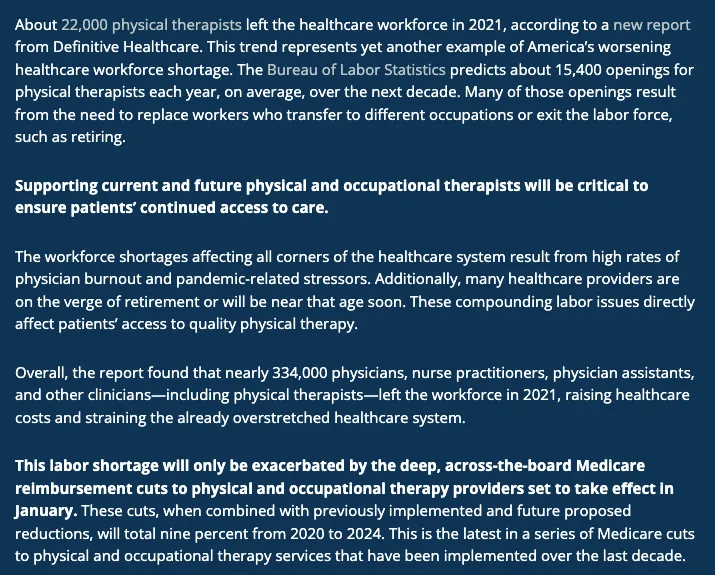
The part of PT burnout that outsiders miss is financial and structural. The Alliance for Physical Therapy Quality and Innovation, citing Definitive Healthcare data, reported that about 22,000 physical therapists left the healthcare workforce in 2021 and that Medicare reimbursement was cut by nine percent from 2020 to 2024. When the rate per visit falls, clinics make up the difference with volume, and volume is what you feel: more patients per hour, overlapping treatment, notes finished after the last patient leaves.
That mechanism tells you which destinations fix the problem. Any role still paid per visit, including a lateral move to another clinic, carries the same pressure. Roles paid by salary for judgment (utilization review, informatics, education) or by commission for results (sales) sit outside the per-visit economy. The question to ask of every job ad is how the employer gets paid for your hour, because that decides what your hour will feel like.
A quick test for any PT-adjacent job ad: find the unit the company bills. Visits and units mean productivity targets. Contracts, licences, devices or covered lives mean your performance is judged on outcomes over a quarter, which is a different kind of pressure from the one that follows a visit count.
What a DPT buys you outside the clinic
PTs undersell themselves on résumés by listing treatments. Hiring managers outside healthcare cannot read "manual therapy, neuromuscular re-education, gait training". They can read what those tasks prove about you. This table translates the O*NET task list into the language of the destination roles.
| What you did as a PT | What it proves to a new employer | Where it counts most |
|---|---|---|
| Initial evaluation and plan of care in 45 minutes | Structured problem diagnosis under time pressure | Utilization review, informatics, consulting |
| Getting a sceptical patient to do a home program | Behaviour change and persuasion | Device sales, patient engagement, training |
| Daily documentation that survives a Medicare audit | Compliance-grade writing | Utilization review, quality, informatics |
| Running a full day of overlapping treatment slots | Capacity planning and triage | Clinic operations, rehab management |
| Explaining a surgical protocol to a surgeon's office | Peer-level clinical communication | Orthopedic sales, clinical education |
| Movement and posture analysis | Biomechanics applied to design | Ergonomics, product and wearables teams |
Use the middle column as your résumé verbs and the left column as the proof. "Reduced documentation time across a 6-therapist team by redesigning the evaluation template" is an informatics bullet written by a PT; "performed evaluations" is not.
Moves that need no new licence, and the ones that do
The honest split looks like this.
No new credential needed. Rehab and clinic management, device and orthopedic sales, utilization review, clinical education roles at EMR and device companies, and most ergonomics consulting hire on the DPT, an active licence and your clinical years. Keeping the licence active through a PRN shift or two costs little and keeps a fallback.
A short credential helps. Informatics roles sometimes ask for a vendor certification in the EMR the employer runs, which an employer often sponsors after hire. Ergonomics consultancies often list a professional ergonomics certification as preferred, though entry roles hire on the clinical background. Teaching in a DPT program often expects a board-certified specialty or a doctorate beyond the DPT for tenure-track posts; adjunct and lab roles usually do not.
A new degree and licence. Physician assistant, nursing, or a switch to occupational therapy all mean school again. Occupational therapy is the closest neighbour on O*NET's list and the worst value as an escape, since the productivity model in skilled nursing and outpatient rehab is the same one you are leaving. PA school is the move with a genuine pay and scope change, and it also means a second round of graduate debt on top of your DPT loans.
What the first year looks like in the three common moves
Job titles hide the texture of the work, so here is what changes in your week in the three directions PTs take most.
Rehab or clinic leadership. You trade a caseload for a spreadsheet of other people's caseloads. The first year is mostly scheduling, hiring, payer mix and fielding the complaints you used to make. PTs who enjoy it tend to be the ones who were already the informal lead: the person the new grads asked, the one who rebuilt the intake flow. PTs who took it for the title often find the productivity pressure is still there, now aimed at them from the regional office, which is the pattern to watch for if the treadmill is your reason for leaving.
Device and orthopedic sales. You spend your days in operating rooms, surgeon offices and outpatient clinics, and your evenings on call for case coverage in some territories. The clinical knowledge gets you in the door quickly, because you can talk about a knee system from the rehab side, which most reps cannot. The adjustment is the scoreboard: a territory number replaces the visit count, and a bad quarter is visible to everyone. PTs who liked the persuasion part of patient care, getting a reluctant patient to commit to a plan, usually adapt faster than the ones who liked the quiet one-to-one treatment hour.
Informatics and utilization review. Both are desk roles, often remote, and both turn the documentation you tolerated into the core of the job. In informatics you build and fix the templates, order sets and reports that therapists use; in utilization review you read other clinicians' notes and decide whether the visits meet medical necessity. The pace is steadier and the physical demand drops to zero, which matters to PTs whose own backs and shoulders have been paying for a decade of transfers. Dental hygienists make the same calculation about their necks and shoulders, and where hygienists go when the body sets the deadline covers how they time it. What you give up is the face-to-face progress you watched every week, and some PTs miss that more than they expected, which is why a PRN shift on weekends is a common bridge.
None of the three requires you to decide in one step. Each has a trial version you can run while employed: cover for your clinic director during a leave, spend a day in the field with a rep your clinic already buys from, or volunteer for the next EMR upgrade committee. The one you keep volunteering for is the one to pursue.
Which way your interests point
The US Department of Labor's career site describes the people who do well in physical therapy as liking activities that include helping people, teaching, and talking. In Holland's RIASEC model that is the Social corner of the hexagon. The destinations above sit in different corners: sales and management lean Enterprising, informatics and utilization review lean Conventional, ergonomics and product work lean Realistic and Investigative.
| Letter | Type | Core interests |
|---|---|---|
| R | Realistic | Hands-on work: tools, machines, the physical world |
| I | Investigative | Research, analysis, working with ideas |
| A | Artistic | Design, writing, performance, open ends |
| S | Social | Teaching, care, service to people |
| E | Enterprising | Leading, selling, starting things |
| C | Conventional | Systems, data, order, getting details right |
The hexagonal model comes from John Holland’s theory of vocational choice (1959), the framework underneath the U.S. Department of Labor’s O*NET database.
Adjacent corners are the easier moves on paper, but your own profile decides. A PT whose favourite hour of the week is the new-grad in-service is squarely Social and should look hard at clinical education before sales. A PT who enjoys the scheduling puzzle and the audit prep more than the treatment already has a Conventional streak, and for that person informatics is a shorter step than the hexagon suggests. How the change fits into the wider sequence of how to change careers at any stage is covered in the hub guide.
This is also where MyPassion's quiz does something a job list cannot. One of its signal questions asks which activities make the hours disappear for you, another asks what you would do with your days if income were no longer the constraint, and the pair separates a PT who misses treating from one who misses the teaching moments inside treatment. For healthcare-specific directions, the healthcare career quiz narrows the field further.
A fit filter before you apply anywhere
Run your top two destinations through these four questions and keep the one that scores better.
- Where did your last good workday come from? If it was a patient's first pain-free step, protect patient contact (education, PRN, a better setting). If it was fixing a broken process, look at operations or informatics.
- What does the employer bill? Per-visit employers recreate the treadmill. Salaried-judgment or commission roles do not.
- How much school can you carry? With DPT loans still open, favour the no-new-credential rows first. Vets carrying DVM debt face the same sequencing, and where vets go after general practice shows how loan forgiveness shapes the order of moves.
- Can you test it in 90 days? Shadow a device rep for a day, ask your EMR team to let you join a template rebuild, cover a lab session at a local DPT program. A test that costs a weekend beats a guess that costs a degree.
For PTs weighing a move into a neighbouring allied-health field, the parallel logic for nurses is in career change from nursing.
Related guides: alternative careers for occupational therapists and career change for respiratory therapists.
When you are ready to narrow the list, take the quiz once before you apply anywhere. It resolves to one archetype and a handful of matched roles, each with a fit score and a first step, and 12,200+ people have taken it. Use the result to make the call this page is about: new setting or new field.
Frequently Asked Questions
Ready to find your passion career?
The free under-10-minute quiz maps your childhood patterns and flow triggers to one of 20 archetypes, then gives you matched careers and a 7-day first-step plan.
Take the Free Career QuizRelated Articles
Trusted by 12,200+ career-quiz takers across 165+ countries · Methods covered in