
Career Change for Architects: Finish the License or Leave Now?
A career change for architects: construction management, project management, planning, UX, interiors. BLS pay, O*NET hours data and NCARB numbers on the ARE.


Contents · 9 sections
Architects who change careers most often move into construction and project management, urban planning, interior and product design, building inspection and UX, with a smaller group going into development, visualisation, teaching or software for the building industry. Whether to finish the licence first depends on where you are on the licensing path, covered below. Here are 15 destinations and what each one keeps from architecture:
- Construction manager: the building, from the contractor's side, with more pay and similar hours.
- Project management specialist: coordination and delivery, inside or outside the built environment.
- Owner's representative: manages design and construction on the client side, where you set the brief.
- Urban and regional planner: the city instead of the building, with more predictable weeks.
- Interior designer: design at a smaller scale and a faster cycle.
- Commercial and industrial designer: the same design process at hand scale, for objects and products.
- Landscape architect: a related occupation in O*NET that keeps site design and moves it outdoors.
- Construction and building inspector: codes and compliance, with the shortest weeks on the O*NET chart below.
- Code consultant or permit expediter: sells the regulatory knowledge you picked up on every project.
- BIM or VDC coordinator: turns your modelling skills into coordination work for contractors.
- Facilities manager: in-house design and construction for a university, hospital or large company.
- Web and digital interface (UX) designer: the design process on screens, with weekly iteration.
- Product specialist at an AEC software company: you know the user, which is why these firms hire architects.
- Architectural visualisation artist: renderings and animation as the whole job, for firms and developers.
- Real estate developer: decides what gets built, but leans on finance and deal skills most architecture training skips.
Licensed, mid-exam or never started: three different decisions
Which of those fits depends first on the licensing path, because a licensed architect, a candidate halfway through the exams and a graduate who never started face three different decisions. It also depends on what you are leaving: the hours, the pay relative to the training, the slow cycle between design and building, or the lack of design authority in a large firm. Each destination fixes a different one of those. This page sets out the moves with BLS pay and O*NET data on working hours, and uses NCARB's own numbers to answer the question most architects in their thirties are asking: should you finish the licence before you go?
Licensed architects hold something scarce: in 2024 the average new architect took 12.9 years to reach the licence. NCARB's State of Licensure data counts about 116,000 architects in the U.S., down 4% in 2024, with close to 3,600 newly licensed that year. The question for you is whether the next role uses the licence (owner's representative, code and permitting consulting, firm leadership, expert witness work) or makes it a line on the résumé. Keeping it active costs little each year and keeps the way back into practice open.
Candidates partway through the Architect Registration Examination face the hardest call, because each passed division feels like sunk cost and each failed one feels like a verdict. The section on finishing the ARE below uses NCARB's pass rates and attrition data to make the choice less emotional.
Graduates who never started licensure are freest. Your degree and studio experience count on their own in most of the destinations below, and none of them asks whether you passed an exam.
The hours problem, measured against the alternatives
Long hours are the complaint most associated with architecture, and O*NET's work context data backs it up. When raters for architects were asked about the length of a typical work week, 85% said more than 40 hours. The same question for the most common destinations sorts them clearly:
| Answer | Share |
|---|---|
| Architects | 85% |
| Commercial and industrial designers | 75.3% |
| Construction managers | 73.7% |
| Architecture teachers, postsecondary | 54.3% |
| Interior designers | 52% |
| Urban and regional planners | 45.8% |
| Construction and building inspectors | 20% |
That chart overturns one common piece of advice. Construction management is often suggested as the natural exit because it pays well and keeps you in buildings, and it does both. It does not fix the hours. If the week is what you are escaping, planning, building inspection, public-sector project roles and teaching are the moves that change it, and they tend to pay less than construction at the median.
Hours are only one kind of pressure, and the same database shows the trade. Only about 10% of architect raters said they work under time pressure every day, while about half of building inspector raters and a third of construction manager raters did. Architecture's pressure comes as long weeks around deadlines; inspection and construction compress it into every day. Decide which of the two wears you down before you pick the exit that removes the other one.
Seven exits from practice and their BLS pay
O*NET's related occupations for architects include construction managers, project management specialists, interior designers, landscape architects, commercial and industrial designers, building inspectors and urban planners. National pay from the BLS wage survey:
| Role | 25th percentile | Median | 75th percentile | What it keeps from architecture |
|---|---|---|---|---|
| Architect (baseline) | $77,960 | $99,280 | $126,550 | Design authority, liability, long cycles |
| Construction manager | $88,550 | $114,990 | $151,640 | The building, from the contractor's side; similar hours, more pay |
| Project management specialist | $78,440 | $102,320 | $133,100 | Coordination and delivery, in or outside the built environment |
| Urban and regional planner | $72,020 | $89,320 | $110,030 | The city instead of the building; more predictable weeks |
| Interior designer | $51,840 | $67,190 | $85,740 | Design at a smaller scale and a faster cycle |
| Commercial and industrial designer | $66,450 | $83,910 | $109,050 | Objects and products; the same design process at hand scale |
| Construction and building inspector | $58,860 | $74,690 | $94,710 | Codes and compliance; the shortest weeks on the O*NET chart |
| Web and digital interface designer | $73,290 | $104,000 | $158,820 | The design process on screens, with weekly iteration |
Annual wages from the U.S. Bureau of Labor Statistics Occupational Employment and Wage Statistics program, May 2025 release. Half of workers in a role earn more than the median; the 25th to 75th percentile span shows how wide the role pays. To see where your current salary sits in your own occupation, use the free salary benchmark.
Construction management pays clearly more than architecture at the median; digital interface design and project management pay slightly more. Planning, industrial design, interior design and building inspection pay less at the median, which is the price of the calmer week or the faster cycle, and the 75th percentile column shows how far each can climb.
Leaving the firm without leaving the building industry
Some of the most workable moves never appear on alternative-careers lists because they keep you inside the building industry while changing your seat at the table. Owner's representatives and in-house facilities teams at universities, hospitals and large companies manage design and construction on the client side, so you hire architects instead of working as one. BIM and virtual design and construction roles at contractors turn your modelling skills into coordination work on site. Software companies that build design, estimating and project tools for the construction industry hire architects as product specialists, trainers and product managers because they know the user. Code consultants and permit expediters sell the regulatory knowledge you picked up on every project.
These seats share two features. They reuse your whole training, so there is almost no retraining cost, and they change the thing most architects say they want changed: who holds the budget and the decisions. On the client side you are the one setting the brief. They are also the moves where an active licence carries the most weight, which is worth knowing before you decide what to do about the exam.
Should you finish the ARE before you leave?
NCARB's examination data for 2024 gives the numbers behind the decision. The overall ARE pass rate was 55%, down from 58% in 2023. Candidates who completed the exam took 2.3 years on average, and the full path to licensure took 12.9 years. Pass rates vary by division:
| Answer | Share |
|---|---|
| Construction and Evaluation | 61% |
| Programming and Analysis | 61% |
| Project Management | 60% |
| Project Development and Documentation | 55% |
| Practice Management | 48% |
| Project Planning and Design | 47% |
And stopping is normal. NCARB's 2025 report says 36 to 38% of candidates stop pursuing licensure over a ten-year period. Of those who started in 2015, 38% had stopped and 27% were still working toward the licence ten years later.
With those numbers, three rules of thumb:
Question 1
Does any future you can picture involve stamping drawings, owning a practice or representing building owners?
Yes: Finish it, especially with two or fewer divisions left and your experience hours logged.
No: Go to the next question.
Question 2
Do your ten target job postings mention licensure at all?
Yes: Keep the exam alive at a slower pace. Passed divisions no longer expire after five years, so a pause costs little.
No: Go to the next question.
Question 3
Are you studying mostly because stopping feels like failing?
Yes: Stop without guilt. More than a third of candidates stop, and many work in the destinations above.
No: Pause it and put the study hours into the new field's skills; the divisions you passed stay on your record.
The rules of thumb below as a sequence, using NCARB's 2024 pass rates and attrition data from this section.
- Finish it if you have two or fewer divisions left, your experience hours are logged, and any future you can picture involves stamping drawings, owning a practice or representing building owners. NCARB has also retired the old five-year expiry on passed divisions, so a pause does not wipe your progress the way it once did.
- Pause it if you have three or more divisions left and your target is construction, planning, product or UX. Those employers hire on your portfolio and experience, and the study hours are better spent on the new field's skills.
- Stop without guilt if you are studying only because stopping feels like failing. More than a third of candidates stop, and many of them work in the destinations above.
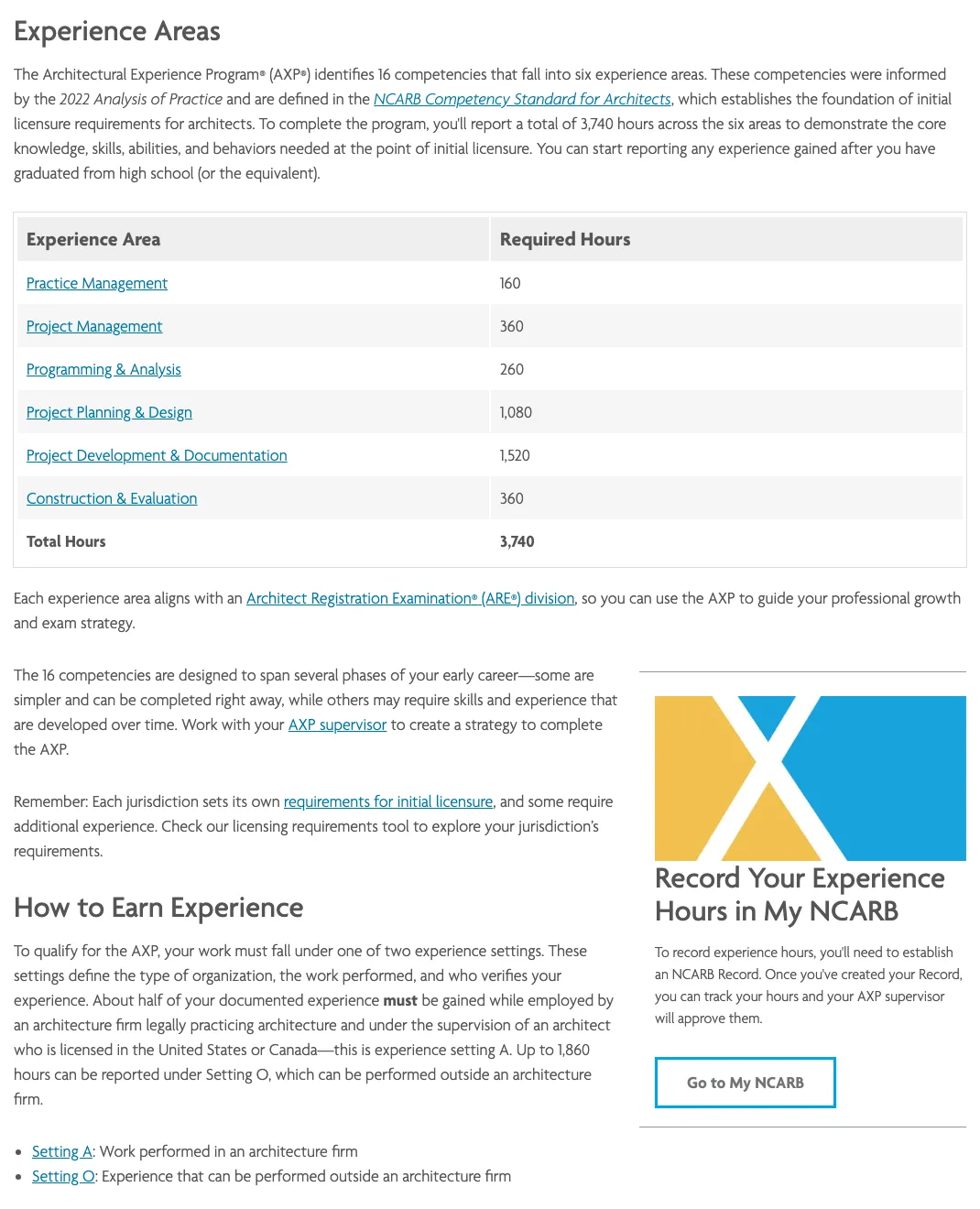
The experience requirement matters for the choice too. The Architectural Experience Program asks for 3,740 hours across six areas, and up to 1,860 of them can be earned in settings outside an architecture firm. If you move into construction or a public agency while still logging, some of that work may still count.
One more way to decide is to ask what the licence is worth in the specific seat you want. In an owner's-rep firm, a code consultancy or a small practice, it is often the credential clients pay for. In a contractor's project management team it is a respected extra. In UX, product design or software it is a curiosity that nobody screens for. Look at ten job postings for your target role and count how many mention licensure; if the answer is none, the remaining divisions are a hobby, and you can pick them up again later without losing the ones you passed.
Studio skills under the names other industries use
O*NET's top activities for architects include making decisions and solving problems, thinking creatively, and drafting and specifying technical details. The translation for the next employer:
| What you did as an architect | How the next employer reads it | Where it counts |
|---|---|---|
| Ran a project from schematic design through construction administration | End-to-end delivery of a multi-year project with budget, schedule and many stakeholders | Project and program management, construction management |
| Coordinated consultants (structural, MEP, civil) | Managed cross-functional technical teams and resolved conflicting requirements | Project management, product roles |
| Presented design options to clients and planning boards | Research-backed proposals presented to executives and regulators | UX, planning, business development |
| Produced construction documents and specifications | Precise technical documentation that others build from | Construction, inspection, technical roles |
| Worked zoning, codes and permitting approvals | Regulatory analysis and approvals management | Planning, code consulting, development |
| Iterated a design through dozens of options | Rapid prototyping and user-centred iteration | UX, industrial design |
A portfolio built for architecture firms will not work unchanged. For UX or product roles, rebuild two projects as case studies that show the problem, the research, the iterations and the outcome, with fewer renderings and more process. For construction and project management, lead with budget, schedule and team size. The guide on transferable skills mid-career covers the general method.
Trial runs inside the projects on your desk
Architects have an advantage most career changers do not: many destinations are already sitting in your current projects. Ask to shadow the owner's representative on one site meeting. Volunteer to run the BIM coordination for a phase. Sit in on a design review at the local planning department, which is often a public meeting. Take one weekend and rebuild a past project as a UX-style case study, with the problem, research and iterations, and see whether you enjoy that framing more than the renderings.
Keep notes on what you enjoyed, as well as what you were good at. After years of long weeks, the reason to leave is often clearer than the reason to go somewhere specific, and a few small trials turn a vague wish to get out into a concrete preference.
Retraining load, from none to months
No new credential, mostly experience. Construction management and project management roles in design-build firms, owner's-rep companies and developers hire architects on their project record. Certifications such as a project management credential or a construction management certification help later; they are rarely the entry ticket. For a view of where that ladder goes, the page on project managers changing careers shows what the role looks like after a few years in it.
A licence or certification in some states. Building inspection and code enforcement usually require certification to the codes your jurisdiction uses, so ask the hiring agency which certificate it expects and by when. Planning roles value a planning degree or the professional planning certification, and planning departments also run design review, where architectural training is directly relevant.
Skills and portfolio. UX, interface and product design need tools, a digital portfolio and familiarity with product development cycles. A structured course plus two case studies is a common route. Interior design is regulated in some states for certain commercial work, so check your state before offering it as a service.
Degree or credential required. Teaching architecture at a university usually needs a graduate degree and professional experience; real estate development leans on finance and deal skills that most architecture training does not cover.
Building, city, object or screen: a fit filter
O*NET codes every occupation on the Holland interest model, and the codes explain why some exits feel natural and others feel like a personality change. Architecture is coded Realistic-Artistic-Investigative: building things, designing them, and working out how they should work.
| Letter | Type | Core interests |
|---|---|---|
| R | Realistic | Hands-on work: tools, machines, the physical world |
| I | Investigative | Research, analysis, working with ideas |
| A | Artistic | Design, writing, performance, open ends |
| S | Social | Teaching, care, service to people |
| E | Enterprising | Leading, selling, starting things |
| C | Conventional | Systems, data, order, getting details right |
The hexagonal model comes from John Holland’s theory of vocational choice (1959), the framework underneath the U.S. Department of Labor’s O*NET database.
The design exits (interiors, industrial design) keep your top two letters, which is why they feel familiar. UX keeps Artistic and Investigative and drops the physical building. Construction and project management swap design for Enterprising work: running people, budgets and contracts. That is the right move for architects who liked running the job more than drawing it, and a hard one for those who became architects to design. If the doubt is whether a mid-career switch works out at all, the piece on how many career changers finish the move traces the one figure with a published base.
Four questions help most architects narrow the list to one or two moves:
- Which scale do you enjoy? The building points to construction, project management or owner's representation. The city points to planning. The object points to industrial and interior design. The screen points to UX.
- What is the one thing you must change? Hours: planning, inspection, public agencies. Pay: construction management, digital design. Cycle speed: interiors, product, UX. Authority: owner's rep, development, your own small practice.
- How close to the licence are you? Use the rules of thumb above.
- How much retraining will you accept? Construction and project management need almost none; UX needs months of focused learning, so work out how much savings to hold before a career change before you enrol in a course.
If you are asking these questions because your firm cut staff, the order changes: income first, the decision second. The guide to a career change after redundancy walks through that sequence. Architects who enjoyed writing design narratives and competition texts may also find the moves open to journalists relevant, such as PR and content roles in design and building-product companies. Related guides: alternative careers for journalists.
If the first two answers are unclear, the career change quiz asks what absorbs you when no deadline is attached and what you want the next five years to pay for. A Creative Polymath will probably resist leaving design and should look at product or interiors; a Strategic Shifter usually wants the steady ladder of construction or project management. For the method that applies to any career, see the guide to changing careers.
Frequently Asked Questions
Ready to find your passion career?
The free under-10-minute quiz maps your childhood patterns and flow triggers to one of 20 archetypes, then gives you matched careers and a 7-day first-step plan.
Take the Free Career QuizRelated Articles
Trusted by 12,200+ career-quiz takers across 165+ countries · Methods covered in