
Alternative Careers for Journalists: Where Reporters Go Next
Alternative careers for journalists: PR, content, technical writing, research, editing. BLS pay, Pew data on newsroom cuts, and the advocacy test before you switch.


Contents · 9 sections
Journalists who leave the news business most often move into public relations and communications, content and marketing, technical writing, editing, research and teaching. Each keeps one core part of reporting: the writing, the investigation, the craft of the story or the explaining. Here are 14 destinations, with the part of the job each one keeps:
- Public relations specialist: the writing and the media instinct, pointed at a client.
- Public relations manager: the same work a few years in, with a team and a budget.
- Public affairs specialist: your source network across government, business and community becomes the job.
- Content strategist: plans and edits what an organisation publishes, on a calmer cadence than a news desk.
- Market research analyst: the investigation, aimed at what customers think and why.
- User researcher: interviewing strangers and writing up what it means, for product teams.
- Technical writer: explaining complicated things accurately; an edge for anyone who covered tech, health or science.
- Editor: the craft of the story, inside publishing, content teams or agencies.
- Writer or author: long-form, books and ghostwriting, with the widest income spread on the list.
- Producer or director: storytelling for video and audio teams outside news; strongest for TV and radio people.
- Policy analyst: for reporters who covered courts or government and know the subject cold.
- High school teacher: keeps the explaining; needs a state teaching licence.
- Journalism instructor: university teaching, usually with a graduate degree or a strong professional record.
- Trade or nonprofit newsroom reporter: stays in reporting, in the corners of news that are more stable.
What the newsroom numbers say about why you are leaving
Which move fits you depends on which part of reporting you would miss most, and on one question most job lists never ask: whether you can write in the service of a client after years of writing for readers. Many journalists leave because the jobs disappeared while they still loved the work. That changes the choice, because the goal is often to keep doing the parts you love somewhere with more stability. The numbers first.
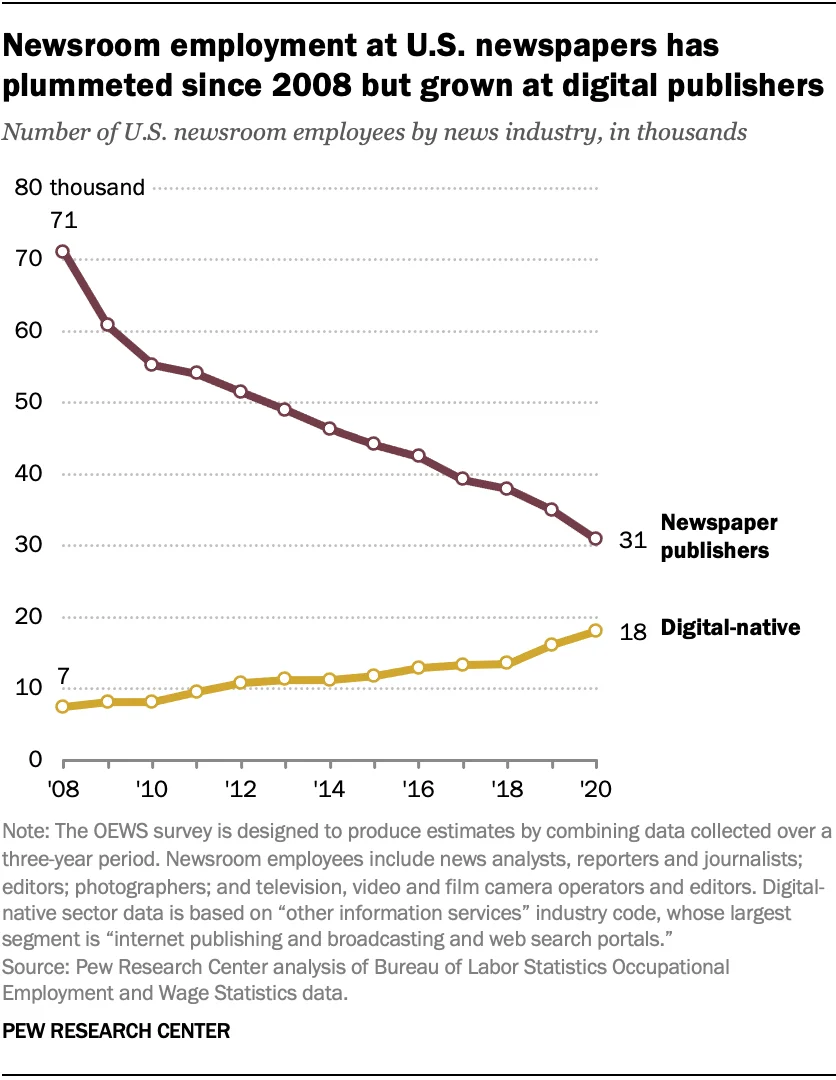
The decline of news employment is well documented. Pew Research Center's analysis of BLS data found that U.S. newsroom employment fell 26% between 2008 and 2020, from about 114,000 jobs to about 85,000. The loss was concentrated in one place:
| Newsroom sector | 2008 | 2020 | Change |
|---|---|---|---|
| Newspapers | about 71,000 | about 31,000 | down 57% |
| Digital-native outlets | about 7,400 | about 18,000 | up 144% |
| All five news sectors combined | about 114,000 | about 85,000 | down 26% |
Cuts have continued since. Challenger, Gray and Christmas, which tracks announced layoffs, counted 4,902 news job cuts in 2024 and 2,254 in 2025 across broadcast, digital and print.
What makes the journalism exit unusual is what journalists say about the work itself. In Pew's 2022 survey of 11,889 U.S. journalists, most still believed in the job while doubting the industry:
| Answer | Share |
|---|---|
| Would choose a career in news again | 77% |
| Describe the industry with a negative word | 72% |
| Highly concerned about future press restrictions | 57% |
| At least somewhat concerned about their job security | 42% |
| Harassed or threatened by an outsider in the past year | 42% |
Pay tells a quieter version of the same story. Asked about the past year, half of the journalists in the survey said their salary had not moved:
| Answer | Share |
|---|---|
| Stayed the same | 50% |
| Received a raise | 41% |
| Took a pay cut | 7% |
That tension is the most useful fact on this page. If you still love reporting and you are leaving because of layoffs, pay or harassment, the best move is one that keeps the reporting habits and fixes the conditions. If you have fallen out of love with the work, the options are wider, and the fit filter at the end of the page matters more than the job list.
Your platform shapes the exit
Journalists are not one group. Pew found that journalists at organisations that began as TV outlets were the least positive about their jobs, and that shows up clearly in how they rate the effect of the news industry on their emotional well-being:
| Answer | Share |
|---|---|
| Online | 54% |
| 52% | |
| Radio or podcasting | 48% |
| Television | 34% |
This matters for the destination. A TV or video journalist brings production, on-camera and editing skills that print reporters do not, which opens video production, corporate video, training content and spokesperson roles. A print or digital reporter brings long-form writing and research, which suits content strategy, technical writing and research roles. A radio or podcast producer has audio production and interviewing skills that are in demand in podcasting, marketing and learning design.
Where former journalists go, with pay
O*NET's related occupations for reporters include public relations specialists, editors, writers and authors, and producers and directors. Add the research and technical writing roles that reuse reporting habits, and the list looks like this, with national pay from the BLS wage survey:
| Role | 25th percentile | Median | 75th percentile | Which part of reporting it keeps |
|---|---|---|---|---|
| Reporter, correspondent or news analyst (baseline) | $45,370 | $62,200 | $98,450 | Where you are now |
| Public relations specialist | $56,260 | $74,750 | $100,370 | The writing and the media instinct, pointed at a client |
| Public relations manager | $106,580 | $146,910 | $204,520 | The same, a few years in, with a team and a budget |
| Market research analyst or marketing specialist | $58,350 | $78,760 | $108,310 | The investigation: finding out what people think and why |
| Technical writer | $70,880 | $90,390 | $115,510 | Explaining complicated things accurately, on a calmer cadence |
| Editor | $57,300 | $77,920 | $106,100 | The craft of the story, inside publishing, content teams or agencies |
| Writer or author | $58,230 | $76,910 | $101,950 | Long-form, books, ghostwriting, content; income varies widely |
| Producer or director | $62,670 | $90,360 | $134,800 | The storytelling, for video and audio teams outside news |
Annual wages from the U.S. Bureau of Labor Statistics Occupational Employment and Wage Statistics program, May 2025 release. Half of workers in a role earn more than the median; the 25th to 75th percentile span shows how wide the role pays. To see where your current salary sits in your own occupation, use the free salary benchmark.
Every move on this list pays more than reporting at the median, which is unusual in a career change: for most journalists, leaving does not mean a pay cut. The exceptions are freelance writing, where the median hides a wide spread, and the first year of any move where you start with a junior title.
The table hides how different these jobs feel day to day, so three notes on the moves journalists ask about most:
- PR and communications split into agency and in-house work. Agencies juggle several clients and bill hours, which suits reporters who liked the variety of a general assignment desk. In-house roles serve one organisation, with a slower rhythm and more internal politics. The media relations part of either job will feel familiar; the internal approvals process usually will not.
- Market and user research is where investigative reporters are most underrated. The core task, getting a stranger to tell you what they think and then writing down what it means, is interviewing and analysis. Research teams will ask about method, sample and bias, so learn their vocabulary before the interview.
- Technical writing and documentation trade the thrill of the deadline for accuracy and structure. Reporters who covered technology, health or science already have the hardest part, which is enough subject knowledge to ask experts good questions.
The reporting skills that sell outside a newsroom
O*NET lists getting information, processing and verifying it, and communicating with people outside the organisation as the top activities of reporting. Every employer in the table above needs those; they call them different things.
| What you did as a journalist | How the next employer reads it | Where it counts |
|---|---|---|
| Reported and filed on daily deadlines | Produced accurate, publishable content fast, with no missed deadlines | Content, communications, PR agencies |
| Built and kept a source network | Stakeholder relationships across government, business and community | Public affairs, PR, partnerships |
| Interviewed people who did not want to talk | Conducted qualitative interviews and elicited candid answers | User research, market research |
| Fact-checked and verified claims | Quality control, accuracy review, compliance with claims standards | Editing, regulated industries, research |
| Turned a council budget into a story | Translated complex data and documents for a general audience | Technical writing, policy communications, data storytelling |
| Pitched stories to editors | Built proposals and won buy-in from decision makers | Marketing, business development |
Your source list is also an asset that rarely makes it onto a résumé. Years of calling agencies, companies and community groups mean you know who does what in a sector and how to reach them. For a communications, public affairs or research role covering the beat you reported on, that network shortens the first months of the job, and it is worth naming the sector expertise explicitly in the application. A reporter who covered housing, planning or development, for example, already speaks the language of the planning and construction roles that architects changing careers move into.
Two practical notes. Replace your clip list with a portfolio of five to eight pieces grouped by the skill each demonstrates, because a hiring manager in content or research is not reading for scoops. And rewrite your headline from "reporter" to the role you want, since recruiters search by target title. The guide on transferable skills mid-career has the longer method.
Staying in news, but in a different part of it
Before leaving the business entirely, check whether you are leaving journalism or leaving a shrinking corner of it. Pew's newsroom analysis shows the losses concentrated in newspapers while digital-native newsroom employment more than doubled over the same period. Nonprofit newsrooms, newsletters, trade and business publications, and in-house editorial teams at data or research organisations all hire reporters, and digital-native outlets are the one sector Pew found adding newsroom jobs.
This matters most for the three in four journalists in Pew's survey who would choose the career again. If you still love reporting, a move from a metro daily to a trade publication covering an industry you know, or to a nonprofit newsroom with foundation funding, may solve the stability problem without asking you to change what you do. The trade-offs are audience size and prestige, and some trade roles blur into marketing. It is still worth one round of applications before you commit to a different profession, because it tells you whether the problem was the work or the employer.
What needs a credential: teaching, and little else
Journalism is one of the easier professions to leave on paper, because almost none of the destinations are licensed.
No credential needed. PR, communications, content, editing, technical writing and most research roles hire on portfolio and experience. Public relations has an optional professional accreditation, which you can pursue once you are working in the field.
Skills to add, without a credential. User and market research reward knowing research methods and survey tools; technical writing rewards familiarity with documentation tools and the subject you document. A short course or a sample project fills the gap, and your portfolio shows it.
A credential required. Teaching in public schools requires a state teaching licence, with routes that vary by state, including alternative certification for career changers. The career change guide for teachers shows the other side: why many teachers leave, which is worth reading before you join them. Teaching journalism at a university usually needs a graduate degree or a strong professional record.
Law and policy. Some reporters who covered courts or government move into policy analysis or law. Policy roles often hire on subject expertise; law requires law school, which is a multi-year decision on its own.
The advocacy test: can you write for a client?
Most journalists who try PR or content find the craft easy, and some find the first title too junior for their experience, which the guide to changing careers when you are overqualified addresses. The bigger friction is loyalty. For years you wrote for readers and kept a distance from the people you covered; now you would write for an employer who expects you to present them well. Four questions help you decide whether that suits you:
Question 1
Do you still want to report and break news?
Yes: Try one round of applications at digital-native, trade or nonprofit newsrooms before changing profession.
No: Go to the next question.
Question 2
Could you write a press release you would once have read with scepticism?
Yes: PR, public affairs and communications are open, and PR management carries the highest pay ceiling in the BLS table.
No: Go to the next question.
Question 3
Was the interview your favourite part of the week?
Yes: Market or user research, where getting strangers to talk is the core of the job.
No: Technical writing or editing, where accuracy and structure matter and the loyalty question is weakest.
The advocacy test as a sequence. The written questions below add the stability question for anyone deciding after a layoff.
- Would you be comfortable writing a press release you would have treated with scepticism as a reporter? If yes, PR and communications are open. If no, look at research, technical writing or editing, where the loyalty question is weaker.
- Which part of your week would you keep? The interview points to research. The writing points to content, editing and technical writing. The audience and the story point to production, communications and teaching.
- How much do you need stability after a layoff? In-house communications and technical writing are usually steadier than agencies or freelance.
- Do you still want to break news? If so, a move into a smaller or digital-native newsroom, the part of the industry that grew, may be the career change you need.
If the answers do not settle it, the career change quiz asks what absorbs you when nobody is assigning the story and what you want the next five years to pay for. For an Ambitious Pivoter, PR management and marketing carry the highest pay ceiling on the table, and the page on what marketers move into when they leave shows where that ladder leads. For a Meaningful Creator, mission-driven communications at a nonprofit, or the writing itself, usually matters more than the ceiling.
One freelance assignment before a new résumé
Most of these moves can be tried in a few weeks without resigning or committing. Take one freelance or contract assignment in the target format: a press release and pitch for a nonprofit, a knowledge-base article for a software company, a set of five user interviews with a written synthesis, a lesson plan and a guest session at a local school. Each takes a weekend or two and leaves you with a portfolio sample and an answer to the only question that matters at this stage, which is how the work felt while you were doing it.
Pay attention to the moment you enjoyed most. What you miss about the newsroom is probably a specific part of the job: the interview, the reveal of a finished piece, the sense of explaining something to people who needed it. That moment is the best predictor of which destination will last, and it is easier to see after a trial than in a job description.
Most experienced career changers are looking for the same thing a freelance test gives you: control over how the week runs. In the Career Changer Index, quiz takers with four or more years of experience put flexible or remote work they enjoy first for the next six months in every age band.
| Answer | Share |
|---|---|
| 25-34 (n = 1,383) | 36.3% |
| 35-44 (n = 1,472) | 44.7% |
| 45-54 (n = 836) | 50.4% |
| 55+ (n = 283) | 42% |

If a layoff made the decision for you
Many journalists read pages like this in the week after a newsroom cut. If that is you, the order matters more than the destination. Handle severance and health insurance first, file for unemployment benefits, then take contract work that pays while you decide. The career change after redundancy guide covers the first 90 days in more detail, including how to use a layoff as the opening for a deliberate change instead of a panic move. For the broader method that applies to any profession, see how to change careers.
Frequently Asked Questions
Ready to find your passion career?
The free under-10-minute quiz maps your childhood patterns and flow triggers to one of 20 archetypes, then gives you matched careers and a 7-day first-step plan.
Take the Free Career QuizRelated Articles
Trusted by 12,200+ career-quiz takers across 165+ countries · Methods covered in