
Career Change from HR: Alternative Careers for HR Professionals
Leaving HR? Where HR professionals go next: L&D, compensation, org consulting, labor relations, coaching. BLS pay, O*NET conflict data and what needs a degree.

Contents · 7 sections
Leaving HR usually means one of six directions: learning and development, compensation and benefits, organisational development and consulting, labor relations, career coaching, or operations. The O*NET profiles for HR specialists and managers list most of them as related work. Pick by the part of HR you would keep: developing people (learning and development), fairness and structure (compensation and benefits), how organisations work (consulting and organisational development), or the operations (administrative and operations management outside the people function). Fourteen roles, one line each:
- Training and development manager: runs learning, with almost no daily conflict in O*NET's survey.
- Training and development specialist: designs and delivers the programmes, below HR specialist pay.
- Compensation and benefits manager: pay structures and plan design at HR manager pay.
- Compensation and benefits specialist: the analytical entry into total rewards.
- Organisational development consultant (management analyst): diagnose and fix the organisation as an adviser.
- HRIS or people analytics analyst: the systems and reporting side of HR, for anyone who led a rollout.
- Labor relations specialist: collective bargaining and grievances; keeps the conflict.
- Mediator: resolving disputes as the whole job, which suits people who liked employee relations casework.
- Career counselor or coach: one-to-one career work, the fit conversation you already run.
- Industrial-organizational psychologist: people science at the highest pay here, behind a graduate degree.
- Equal opportunity officer: a related O*NET occupation that turns policy and compliance work into the main job.
- Administrative services manager: a related O*NET occupation covering facilities, vendors and support services.
- Operations manager: processes and systems without the people caseload.
- Project manager: the HRIS rollout or restructuring skill set, applied to any kind of project.
What follows adds BLS pay, O*NET survey data showing which exits leave the daily conflict behind and which quietly keep it, and the one move that needs a graduate degree. You spend your working life assessing fit for other people, and the career change quiz runs that assessment on you.
Where HR professionals go when they leave HR
O*NET's related-occupations list for HR specialists includes compensation and benefits managers and specialists, industrial-organizational psychologists, training and development managers and specialists, and administrative services managers. The list for HR managers adds management analysts and labor relations specialists. Put next to the moves that career-change guides mention most, the realistic set groups into four directions:
- Specialise inside the people function: learning and development, compensation and benefits, HR technology and people analytics.
- Advise from outside: organisational development consulting, management consulting, independent HR consulting.
- Work on disputes as the main job: labor relations, mediation.
- Leave the people function: operations, administrative services, project management, career coaching.
The first group is the easiest move, because it keeps your title family and your network. It suits anyone who wants to leave one part of HR rather than the whole function. Recruiters and employer-brand specialists sometimes look at marketing instead, and the page on where marketers move next is worth reading first, because AI is reshaping much of that work.
The department that cannot fix its own job
HR has a problem no other function quite shares. It writes the policies, runs the engagement survey and designs the wellbeing programme for everyone else, and it has almost no control over the thing that wears its own people down, because that load is generated by the rest of the organisation.
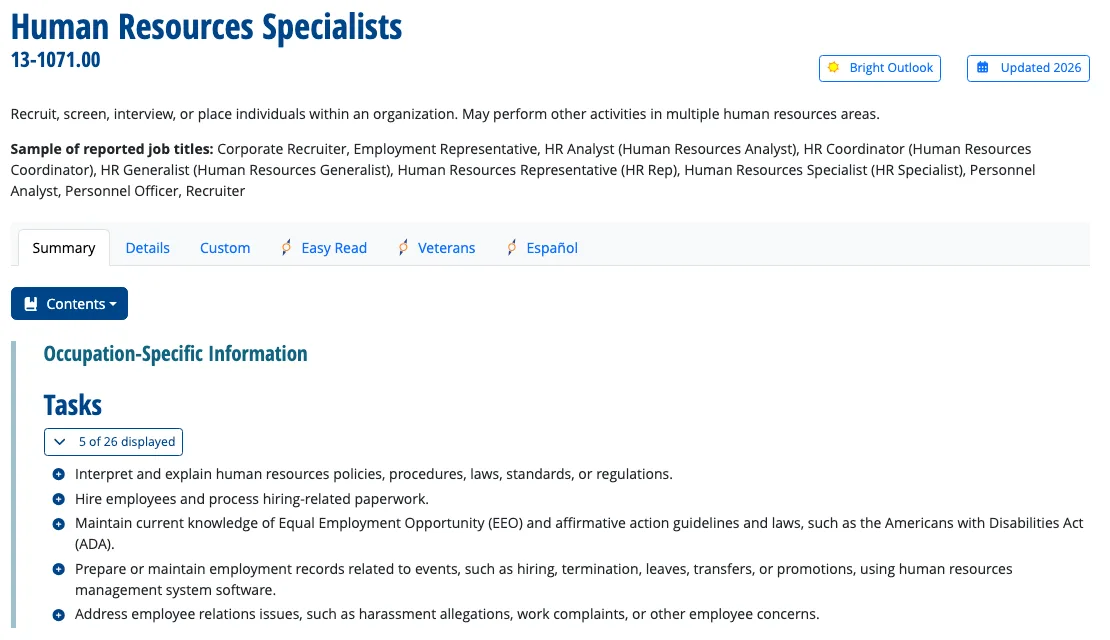
O*NET's task list for HR specialists makes this concrete. Alongside hiring, records and policy interpretation, the core tasks include addressing "employee relations issues, such as harassment allegations, work complaints, or other employee concerns." That work arrives whenever a manager mishandles a conversation or a team falls out, and no HR policy prevents it at the source. In the same database's work-context survey, 40% of HR specialists report conflict situations every day, and more than half of HR managers (54%) say they deal with unpleasant or angry people at least once a week.
This matters for the decision. A better company with a better culture may lower the volume for a while, but the conflict is a feature of the HR role in any organisation that has people in it, so the caseload comes back. If that is what you are leaving, the destination needs to remove the caseload, and changing employer usually does not.
If the drain is recent and you want to try recovering in the role first, the guide to beating burnout without quitting covers what works and when it stops working.
The pattern is not unique to HR. In the Career Changer Index, experienced quiz takers name being stuck or bored far more often than early-career takers, while not knowing which direction to pick still leads the list. If stuck means a promotion that went to someone else, the guide on being passed over for promotion deals with that case directly.
| Answer | Share |
|---|---|
| No idea which direction to pick | 24% |
| Can't tell what they're good at | 22.6% |
| Stuck or bored in current work | 19.1% |
| Too many interests to commit to one | 18.1% |
| Nothing they try feels like a passion | 16.1% |

How HR experience reads outside HR
HR résumés tend to list responsibilities in HR's own vocabulary, and hiring managers outside the function often read that as administration. Rewritten as the capability underneath, the same record reads as business skill:
| HR wording | What a hiring manager outside HR hears | Best fit |
|---|---|---|
| Handled employee relations cases | Investigated disputes and resolved them under policy and law | Labor relations, compliance |
| Ran the annual pay review | Benchmarked pay and managed a compensation budget | Compensation and benefits |
| Designed onboarding and manager training | Designed and delivered learning programmes | Learning and development |
| Ran the engagement survey and action plans | Diagnosed organisational problems from data and led the fix | Organisational development, consulting |
| Managed the HRIS rollout | Led a systems implementation across the business | HR technology, project management |
| Supported restructurings and redundancies | Planned and executed organisational change | Consulting, operations |
| Screened and interviewed candidates | Assessed people against role requirements | Career coaching, recruiting |
The engagement survey row does the most work in consulting interviews. It describes a full cycle of measuring an organisation, finding the problem and changing something, and that sequence is most of what organisational development consultants are hired to do.
Related guides: career change from project management.
Which exits leave the conflict behind
If the daily conflict is your main reason for leaving, O*NET's survey gives a clear sorting. The chart shows the share of each occupation's incumbents who say they face conflict situations every day.
| Answer | Share |
|---|---|
| Career counselors and advisors | 47.5% |
| Mediators and arbitrators | 45% |
| Labor relations specialists | 42.9% |
| HR specialists | 40.1% |
| HR managers | 31.8% |
| Management analysts | 10.5% |
| Compensation and benefits managers | 4.8% |
| Training and development specialists | 4.3% |
| Industrial-organizational psychologists | 3.9% |
| Training and development managers | 0% |
The top of the chart is the surprise. Mediation and career counselling are often suggested to HR people as a way to keep helping people with less stress, and on this measure they are the opposite. Both can be excellent work if the resolving is what you enjoy. If you want out of conflict, the bottom half of the chart is the list.
Question 1
Is the daily conflict the main reason you want out?
Yes: Learning and development, compensation and benefits, or I-O psychology. Skip mediation and career counselling, which keep it.
No: Go to the next question.
Question 2
Do you want to stay in the people function and change the specialism?
Yes: HR technology or people analytics, tested inside your current team first.
No: Go to the next question.
Question 3
Are processes and systems your strength more than people issues?
Yes: Operations, administrative services or project management.
No: Organisational development consulting, or a wider search if HR stopped fitting some time ago.
The first test uses the O*NET conflict chart above. Stop at the first yes.
Pay for eight moves
The table compares both HR baselines with each destination. Wages are the BLS national figures for each occupation and update with every annual release.
| Role | 25th percentile | Median | 75th percentile | What it changes for an HR professional |
|---|---|---|---|---|
| HR specialist (baseline) | $58,610 | $75,940 | $99,380 | Generalist casework, hiring and policy |
| HR manager (baseline) | $111,110 | $149,280 | $199,290 | Leads the function; carries the escalations |
| Training and development manager | $101,850 | $133,000 | $176,870 | Runs learning; near-zero daily conflict in O*NET |
| Training and development specialist | $50,110 | $69,280 | $95,050 | Designs and delivers programmes; below HR pay |
| Compensation and benefits manager | $113,170 | $149,230 | $200,610 | Pay structures and plan design at HR manager pay |
| Compensation and benefits specialist | $60,890 | $78,210 | $100,400 | The analytical entry into total rewards |
| Management analyst (organisational development) | $77,950 | $101,860 | $133,370 | Diagnose and fix the organisation as an adviser |
| Labor relations specialist | $71,920 | $95,420 | $123,420 | Collective bargaining and grievances; keeps the conflict |
| Career counselor / coach | $51,270 | $64,330 | $82,870 | One-to-one career work; below HR pay |
| Industrial-organizational psychologist | $107,310 | $193,950 | $222,280 | Highest pay, graduate degree, tiny field |
Annual wages from the U.S. Bureau of Labor Statistics Occupational Employment and Wage Statistics program, May 2025 release. Half of workers in a role earn more than the median; the 25th to 75th percentile span shows how wide the role pays. To see where your current salary sits in your own occupation, use the free salary benchmark.
For an HR specialist, compensation and benefits and organisational development consulting are the moves that raise pay without a new degree. For an HR manager, training and development management and compensation and benefits management are the lateral moves that keep pay within about 10% while changing the work. Career counselling and training specialist roles pay less than the HR specialist median, so they suit a second career where the work matters more than the number.
The industrial-organizational psychologist figure needs context. The BLS counts about 790 people employed in the occupation nationally, so the high median describes a small, specialised field with few openings.
For the neighbouring move, see career change from sales.
Credentials: one exit needs a graduate degree
No new credential. Learning and development, compensation and benefits, and HR consulting hire on experience. O*NET reports that 86% of compensation and benefits specialists and 76% of compensation and benefits managers say a bachelor's degree is the required level, and 71% of training and development managers say the same. A compensation-focused certification can help an HR generalist show the analytical specialism, but the pay review cycles you have already run are the stronger evidence.
Helpful, sometimes expected. Management consulting, where the MBA route into large firms is the main reason a post-graduate requirement shows up in O*NET's data for management analysts. Organisational development work inside companies and at boutique firms hires on track record more often.
Graduate degree required. Industrial-organizational psychology. Nearly nine in ten incumbents (89%) tell O*NET they needed more than a bachelor's, with 58% naming a master's and 31% a doctorate. Combined with the small size of the field, this is a long route and only worth it if the research side of people science is what draws you.
Learnable on the job. HR technology and people analytics sit between HR and IT, and neither has a single required credential. If you led an HRIS rollout or built the reporting for an engagement survey, you already hold the starting evidence; the gap is usually spreadsheet and query skills, which are cheaper to build than any degree on this page.
Depends on the setting. Career counselling in schools and colleges often requires graduate training (41% of O*NET respondents say post-graduate education is required). Independent career coaching has no licensing requirement, and HR experience in hiring and development is a credible starting point for it.
Before you apply outside, test the move where you are. Most HR teams have a learning, rewards or analytics specialist you can shadow, a pay review you can volunteer to model, or an onboarding programme that needs redesigning. A quarter spent on one of those tells you whether you like the specialism when it is your job, and it gives you the first line of a new résumé. Internal transfers inside the people function also tend to keep your salary and benefits intact while you find out.
Sort by what brought you into HR
People arrive in HR from different directions, and the reason you came tends to predict where you should go. Three common starting points, and where each leads:
You came for the people. Coaching, developing, helping someone through a hard moment. Learning and development and career coaching keep that, and the chart above says learning and development does it with far less conflict.
You came for fairness and structure. You liked that a good policy treats people consistently. Compensation and benefits keeps that and makes it quantitative, and labor relations keeps it with the conflict included. Pay specialists at banks design the deferred-bonus schemes that bankers weigh when they leave, which shows how much the work can shape a career decision.
You came by accident and stayed for the operations. You are good at running processes and systems and the people issues were always the cost. Operations, administrative services and project management move you out of the people function entirely.
The MyPassion quiz formalises this into a matrix: five struggle types crossed with four priorities, which resolve to one of 20 archetypes. Someone who picks stability as the priority and names purpose as the struggle, for example, resolves to the cell highlighted below, and the careers matched to that cell look different from those for an income-first profile with the same HR background.
What you need next →
| Income-Focused | Lifestyle Seeker | Stability First | Experimenter | |
|---|---|---|---|---|
| Career Switcher | Ambitious Pivoter | Freedom Seeker | Strategic Shifter | Curious Transformer |
| Grad Explorer | Rising Achiever | Modern Explorer | Foundation Builder | Open-Minded Starter |
| Multi-Passionate | Renaissance Earner | Creative Polymath | Focused Generalist | Passion Collector |
| Purpose Seeker | Impact Driver | Meaningful Creator | Mission Seeker | Values Explorer |
| Explorer | Emerging Achiever | Authentic Seeker | Grounded Explorer | Curious Adventurer |
↓ What is hardest right now
Highlighted: Purpose Seeker crossed with Stability First resolves to The Mission Seeker. Source: the live MyPassion.ai archetype matrix.
If none of the three starting points describes you, and the honest answer is that HR stopped fitting some time ago, then the question is wider than HR-adjacent roles. The career change guide starts from direction rather than from the jobs your résumé qualifies you for, which is the better place to begin in that case.
Frequently Asked Questions
Ready to find your passion career?
The free under-10-minute quiz maps your childhood patterns and flow triggers to one of 20 archetypes, then gives you matched careers and a 7-day first-step plan.
Take the Free Career QuizRelated Articles
Trusted by 12,200+ career-quiz takers across 165+ countries · Methods covered in