
Alternative Careers for Psychologists: Using the Doctorate
Alternative careers for licensed psychologists with a PhD or PsyD: I-O, UX research, psychometrics, people analytics, clinical research. BLS pay and fit filter.


Contents · 6 sections
Licensed psychologists who leave clinical practice most often move into industrial-organizational and talent assessment work, UX and consumer research, people analytics and data science, psychometrics, clinical research, or university teaching. What separates these from a therapist's exits is the doctorate: years of research design, statistics and assessment that employers outside the clinic pay well for. Most pages ranking for this search are written for psychology undergraduates; this one is for the psychologist with a PhD or PsyD, a license and years of practice. The 14 roles, with the part of your training each uses:
- Industrial-organizational psychologist: assessment, selection and organisational research; the formal title may need I-O training.
- Talent assessment consultant: leadership and selection assessment for someone who loves the test battery.
- Psychometrician or test developer: designing and validating assessments, statistician territory in BLS terms.
- UX researcher: interviewing, usability testing and experiments, where your methods training often beats the team's.
- People analytics analyst: employee listening and attrition modelling built on doctoral statistics.
- Data scientist: experiment design and modelling, once the Python, R or SQL is current.
- Survey researcher: organisational and public opinion surveys.
- Clinical research scientist: outcome measurement and trial design in pharma and digital therapeutics.
- Psychiatric trial rater: structured clinical interviews such as the SCID, used as data collection.
- Management consultant: case conceptualisation across competing hypotheses, sold as problem solving.
- Behavioral scientist on a product or policy team: bias, heuristics and motivation applied at scale.
- Psychology faculty or training director: teaching and supervision; tenure-track posts are scarce.
- Assessment-only practitioner: forensic, neuropsychological or disability evaluations that keep the license and drop the weekly caseload.
- Group practice owner and clinical director: associates carry the caseload while you run the practice.
What doctoral psychologists move into
Industrial-organizational and talent assessment. Selection systems, leadership assessment, competency models, organisational surveys. Clinical psychologists with assessment depth move into consulting firms and in-house talent teams; the formal I-O title usually needs I-O training, though assessment work often does not.
UX and consumer research. Interviewing, usability testing, survey design and behavioral experiments for tech and product companies. Your methods training is often stronger than the team's, and the translation work is learning product vocabulary and speed. Occupational therapists compete for the accessibility and usability end of this market on task-analysis experience, as the OT exits into ergonomics and UX describe.
People analytics and data science. Employee listening, attrition modelling, experiment design. The statistics from your doctorate are the foundation; the tooling (Python, R, SQL) is what most psychologists need to refresh.
Psychometrics and test development. Designing, validating and norming assessments for testing companies, licensing boards, education publishers and health-tech. This is the most direct use of the measurement training that clinicians hold and rarely advertise.
Clinical research. Outcome measurement, trial design and rating-scale work in pharma, digital therapeutics and academic medical centres. Psychologists trained in structured clinical interviews are sought as raters and scientists on psychiatric trials.
Teaching and academic research. Faculty, training director and research scientist roles. Tenure-track posts are scarce; clinical faculty and research scientist roles are more common entry points.
Two hybrid routes deserve a mention because they let you leave the weekly caseload without leaving psychology. The first is assessment-only practice: forensic, neuropsychological, pre-surgical or disability evaluations, contracted by courts, hospitals and insurers, where you see each person once or twice and write the report. The second is owning a group practice and stepping into clinical director and business owner, with associates carrying the caseload. Both keep the license central and change the rhythm of the week, and both are worth pricing before you assume the answer is to leave the field.
The doctorate is the asset: assessment, statistics, design
O*NET's profile of clinical and counseling psychologists lists reading comprehension, active listening, critical thinking, writing and complex problem solving among the core skills, and among the top work activities it names analyzing data or information and evaluating information against standards. Its related-occupations list points to psychiatric nurses, neuropsychologists, social workers, counselors and psychiatrists, all clinical. Social workers start from a list much like it, and the three directions social workers take show how a master's-level clinician reads the same problem. For a psychologist leaving the clinic, the useful signal is the skills list, and the translation is yours to make.
| From your doctoral training and practice | How an employer outside the clinic reads it | Where it counts |
|---|---|---|
| Administering, scoring and interpreting standardised assessments | Measurement design and validation | Psychometrics, talent assessment |
| Dissertation: design, power analysis, multilevel models | Research design and statistical modelling | People analytics, data science, clinical research |
| Structured clinical interviews such as the SCID | Reliable, structured data collection from people | UX research, trial rating |
| Case conceptualisation across competing hypotheses | Hypothesis-driven problem solving | Consulting, research strategy |
| Supervising trainees and writing reports | Leading junior staff, communicating findings to non-experts | Research leadership, consulting |
| Knowledge of bias, heuristics and motivation | Behavioral insight for products and policy | UX, behavioral science teams |
The PhD and PsyD split matters here, though less than most psychologists fear. A PhD from a research-heavy programme usually signals stronger statistics and a publication record, which reads well to data science, psychometrics and research employers. A PsyD usually signals more assessment and clinical hours, which reads well to talent assessment, clinical research sites and applied programme evaluation. Outside academia, hiring managers rarely care which letters you hold once they see work: a validation study you ran, a programme evaluation you designed, a dashboard you built from outcome data. If your doctorate is a PsyD and you want a data role, a short portfolio project closes the gap faster than a second degree.
The master's-level therapist leaving practice brings the listening skills and the relationship work. You bring those plus the research and measurement stack, which is why your exits sit higher on the pay table than most counselors' do.
Psychology has the lowest burnout of its peers, so name your reason carefully
It is tempting to assume every psychologist who wants out is burned out. The data suggests something more specific. In the George Washington University Mullan Institute's survey of 1,290 licensed behavioral health providers, psychology licensees reported the lowest rate of at least moderate burnout of the four license types, 28.5%, and the lowest severe burnout, 6.2%.
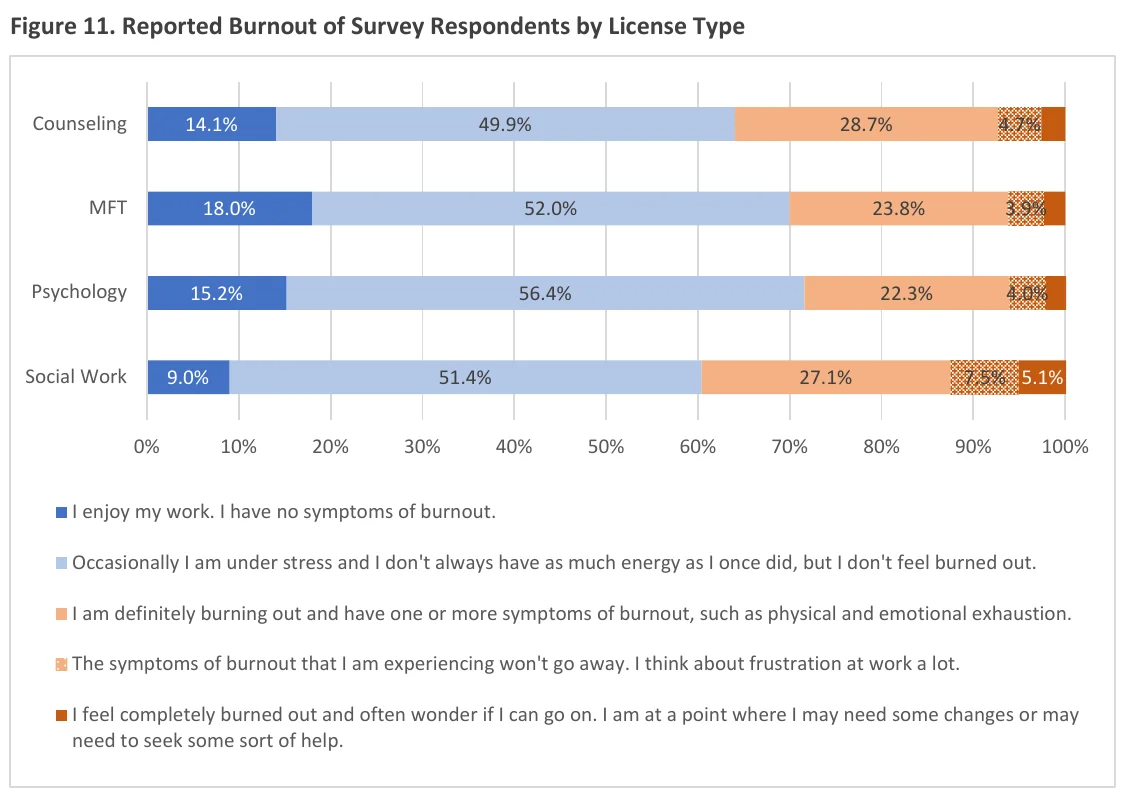
Three other reasons come up again and again among psychologists considering a move, and each points somewhere different. A pay ceiling. Private practice income is capped by the hours you can see clients and the rates payers will reimburse; I-O, data science and industry research break that link. An unused research self. Many psychologists chose a PhD because they loved research and then spent a decade in practice; psychometrics, clinical research and UX research give that self a job. Scale. One client at a time is meaningful and slow; people analytics, product research and public health work change systems that touch thousands.
Insurance deserves a separate note. If reimbursement for testing in your market does not cover the hours a thorough assessment takes, and the paperwork for authorisations and appeals falls on you because you practise solo, the problem may be the business model. Moving to private pay, a group practice with billing staff, or assessment-only contracts can change that without leaving the field. If insurance is one irritant among several, it is a reason to change setting. If it is the whole story, it is a reason to change the business model rather than the career.
If your honest answer is burnout, especially from assessment backlogs or a crisis-heavy caseload, test a setting or caseload change before a career change. Our piece on taking stock of skills halfway through a career shows how to inventory what you would carry into either.
Question 1
Is the honest answer burnout, from assessment backlogs or a crisis-heavy caseload?
Yes: Test a setting or caseload change first, before a career change.
No: Go to the next question.
Question 2
Is insurance reimbursement the whole story?
Yes: Change the business model: private pay, a group practice with billing staff, or assessment-only contracts.
No: Go to the next question.
Question 3
Is it an unused research self from your PhD years?
Yes: Psychometrics, clinical research or UX research.
No: Go to the next question.
Question 4
Is it the pay ceiling, or the wish to work at scale?
Yes: I-O, data science, consulting or people analytics, which break the link between income and client hours.
No: The quiz at the top of this page reads the pull from your history, which helps when none of these four fits.
Burnout comes first because it is the cheapest reason to test, even though psychology licensees reported the lowest burnout of the four license types in the GW Mullan Institute survey above. The other three reasons come from this section. Each yes ends the path; each no moves you on.
Salaries for the doctorate outside the clinic
National Bureau of Labor Statistics wage data for the clinical origin and the destinations with a BLS match. One caution on the I-O row: BLS counts few people under that exact title, because most I-O-trained professionals work as consultants, HR leaders or analysts, so treat its median as a signal rather than a forecast.
| Role | 25th percentile | Median | 75th percentile | Which part of your training it uses |
|---|---|---|---|---|
| Clinical and counseling psychologist (origin) | $73,210 | $100,580 | $135,200 | The baseline you are comparing against |
| Industrial-organizational psychologist | $107,310 | $193,950 | $222,280 | Assessment, selection and organisational research; small BLS headcount |
| Data scientist | $85,660 | $120,230 | $158,880 | Statistics and experiment design; needs current tooling |
| Management analyst | $77,950 | $101,860 | $133,370 | Consulting, including leadership and talent assessment practices |
| Medical scientist | $79,840 | $103,410 | $139,380 | Clinical research and outcome measurement |
| Statistician | $82,220 | $105,650 | $141,490 | Psychometrics and test validation sit closest here |
| Survey researcher | $51,270 | $69,460 | $99,760 | Organisational and public opinion surveys |
| Psychology teacher, postsecondary | $63,400 | $80,340 | $105,920 | Faculty and training director roles |
| UX researcher | not a separate BLS occupation | Interviewing and experiments for product teams | ||
Annual wages from the U.S. Bureau of Labor Statistics Occupational Employment and Wage Statistics program, May 2025 release. Half of workers in a role earn more than the median; the 25th to 75th percentile span shows how wide the role pays. To see where your current salary sits in your own occupation, use the free salary benchmark.
Expect the first role to be priced on your years outside the clinic rather than on your years since the doctorate. A psychologist with ten years of practice who moves into UX research or people analytics can be offered a mid-level title, because the hiring manager is pricing product or business experience you do not have yet. The negotiation that works is to point at comparable work you have already done, such as a validation study, a programme evaluation or a large assessment caseload, and ask to be levelled on that.
The destinations split into two groups. Data science, I-O and consulting usually pay above the clinical median once you are established. Survey research and teaching usually pay below it, with the trade of more control over your week.
The EPPP, the license, and which doors need neither
Your license represents the doctorate, the internship, supervised postdoctoral hours in many states and the Examination for Professional Practice in Psychology. That is a lot to let lapse, and most psychologists who leave keep it active for years.
Needs the license or strongly prefers it: forensic and assessment consulting, some clinical research and rater roles, clinical leadership at health-tech companies, training director posts in doctoral programmes, and any work you describe to clients as psychological services.
Needs neither the license nor a new credential: UX research, people analytics, most psychometrics roles, survey research and most talent assessment work. These hire on the doctorate, a portfolio and, for data roles, demonstrated tooling.
Needs something new: data science roles often expect current Python or R and SQL, which a structured course of a few months can cover. The formal I-O psychologist title may call for I-O coursework or respecialisation, depending on your state and the role. A move into executive leadership may reward an MBA, though it is rarely required.
There is also the title question beyond the law. After years as Dr. and as the person in the room with the most training, a junior researcher title can sting. It is easier to carry if you treat the first year as fieldwork in a new culture, which is a frame your training already gives you, and let the doctorate show through the quality of the questions you ask.
One boundary to respect: using the title "psychologist" in a new role usually requires an active license in that state. If you let the license go, your title becomes researcher, scientist or consultant.
Clinical, research or organisational: which corner you work from
The Holland hexagon is a useful lens here, because most clinical psychologists sit on the Social and Investigative corners, and the destinations above differ mainly in which of those two they lean on and what they add.
| Letter | Type | Core interests |
|---|---|---|
| R | Realistic | Hands-on work: tools, machines, the physical world |
| I | Investigative | Research, analysis, working with ideas |
| A | Artistic | Design, writing, performance, open ends |
| S | Social | Teaching, care, service to people |
| E | Enterprising | Leading, selling, starting things |
| C | Conventional | Systems, data, order, getting details right |
The hexagonal model comes from John Holland’s theory of vocational choice (1959), the framework underneath the U.S. Department of Labor’s O*NET database.
If you are unsure which part of your training you would build on, the career change quiz works on the same question from your history rather than your CV, and returns one of 20 archetypes with matched careers. A filter to run before the first application:
- List the three tasks in your week you would keep. If they are testing and report writing, look at psychometrics and assessment. If they are the research meeting or the data, look at research and analytics. If they are consultation with other professionals, look at I-O and consulting.
- Check the tooling gap. For data roles, try one small analysis in Python or R on a public dataset. If it feels like play, the gap is weeks. If it feels like punishment, pick a destination that uses your statistics without daily coding.
- Run a thirty-day test. Take one survey design contract, one usability study, or one assessment validation project. Evidence from a finished project beats a certificate.
Physicians weighing research and industry roles face a similar decision with different credentials, and master's-level therapists and counselors have their own set of exits.
Related guides: career change for therapists and alternative careers for physicians.
The field-agnostic version of this decision lives in our guide to career change at any stage. Your doctorate means you can run the experiment properly, so treat the first project as a pilot study with a clear outcome measure.
Frequently Asked Questions
Ready to find your passion career?
The free under-10-minute quiz maps your childhood patterns and flow triggers to one of 20 archetypes, then gives you matched careers and a 7-day first-step plan.
Take the Free Career QuizRelated Articles
Trusted by 12,200+ career-quiz takers across 165+ countries · Methods covered in