
Alternative Careers for Nurse Practitioners: Where NPs Go
Alternative careers for nurse practitioners that keep the NP degree earning: utilization review, research, MSL, faculty. BLS pay and the 1,000-hour rule.


Contents · 7 sections
Nurse practitioners who leave direct patient care most often move into utilization management, clinical research, industry roles such as medical science liaison, NP program faculty, clinical informatics, or quality and compliance leadership. The one that fits depends on a question an RN leaving the bedside never has to ask: does the new role still use the advanced practice degree, or does it quietly pay you as a staff nurse? Here are 14 roles NPs move into, with what carries over to each:
- Utilization management NP or clinical reviewer: medical necessity and prior authorisation calls use the chronic disease judgment of a family or acute care NP.
- Telehealth NP: the smallest step, which keeps prescribing and certification hours and drops the clinic building.
- Research NP or sub-investigator: comfort with protocols and adverse events is the draw for trial sites and sponsors.
- Clinical trial manager: suits NPs who liked running the clinic's systems more than seeing its patients.
- Medical science liaison: prescribing depth in one therapeutic area, such as psychiatry, oncology or diabetes.
- Medical information specialist: answers clinicians' drug questions for a manufacturer, close to the pharmacology you already use.
- Clinical educator for a device or pharma company: teaching clinicians to use a product, often paid partly on commission.
- NP program faculty: the natural home for NPs with a strong precepting record.
- Clinical informatics specialist: for the unofficial EHR fixer in the clinic.
- Quality improvement lead: turns years of chart-level decisions into system-level measures.
- Compliance or risk manager: rewards NPs who know scope-of-practice law and credentialing inside out.
- Population health manager: owning outcomes for a defined group, which is what a primary care panel already is.
- Care transitions or case management lead: discharge and handoff decisions, strongest for acute care NPs.
- Practice or service line leader: medical and health services management for NPs who want the budget as well as the decisions.
Where NPs go when the panel gets too heavy
Six destinations cover most NP exits, and each uses a different slice of the training.
Utilization management and clinical review. Payers, hospital systems and review companies hire NPs to assess medical necessity, review prior authorisation requests and manage care transitions. The strongest postings ask for an APRN license and prescribing knowledge; weaker ones are RN roles that will accept an NP and pay RN rates.
Clinical research. Sites, sponsors and contract research organisations hire NPs as sub-investigators, research NPs and clinical trial managers. The diagnostic training and your comfort with protocols and adverse events are the draw.
Industry. Medical science liaisons, clinical educators for device and pharma companies, and medical information specialists. These roles often prefer a doctorate, PharmD or PhD (the routes pharmacists take into industry show what that competition looks like), yet NPs with deep experience in the company's therapeutic area get hired, particularly in psychiatry, oncology, dermatology and diabetes.
Faculty. Clinical faculty and course leads in NP programs. NPs with a strong precepting record are the usual hires, and a doctorate increasingly shapes the offer.
Informatics. EHR optimisation, clinical decision support and order-set design. NPs who were the unofficial EHR fixer in their clinic already do half of this job.
Quality and compliance. Quality improvement, risk management, accreditation readiness and regulatory roles in health systems.
Your population focus shapes which of these doors opens fastest. A family or adult-gerontology primary care NP has the broadest base for utilization management and population health, because payers review exactly the chronic disease decisions you make all day. An acute care NP reads inpatient admissions and lengths of stay fluently, which is the core of hospital-side utilization review and physician advisor support teams. A psychiatric-mental health NP carries the scarcest prescribing expertise in the market, and industry, telepsychiatry platforms and behavioral health payers compete for it. A pediatric NP has fewer industry doors but a strong line into school health, vaccine programmes and pediatric research. Women's health and neonatal NPs tend to find the clearest industry fit in companies whose products serve their population.
Your years matter too. Utilization management and industry postings usually ask for several years of clinical practice, because the job is judging or explaining decisions other clinicians make, and that judgment is what you are being paid for. An NP four years in is usually at the point where those doors start opening, and the question stops being whether you qualify and becomes which one you want.
If your plan is to leave healthcare entirely, the RN-level options and the wider list for nurses are covered in our guide to career change from nursing. This page stays with the question of what the advanced degree is worth outside the exam room.
The autonomy you fought for can be the load that breaks you
The NP profession has spent two decades arguing for full practice authority, and a growing number of states now grant it. The data on burnout suggests the independence comes with a price the advocacy rarely mentions.
A 2024 study in Nursing Outlook surveyed 1,244 primary care NPs across six states. Overall, 26% reported burnout, 90% were satisfied with their job, and 78% had no intention to leave. The split by how they managed patients is where it gets useful for anyone considering a change:
| Answer | Share |
|---|---|
| Own patient panel only | 29% |
| Own panel plus co-management | 24.2% |
| Co-management only | 22.4% |
The practical reading: if your exhaustion is concentrated in owning a panel alone, the first experiment is structural, before it is a career change. A co-management model, a specialty clinic, a 0.8 contract or a telehealth role may fix the part that is wearing you down. Our guide to staying in a job while cutting the burnout covers that route. If you have already changed the structure once and the pull is still away from clinical care, the rest of this page is for you.
What experienced changers want next tends to be control over the week. In the Career Changer Index, flexible or remote work they enjoy is the top six-month priority among quiz takers with four or more years of experience.
| Answer | Share |
|---|---|
| Flexible or remote work they enjoy | 41.7% |
| Passion projects part-time | 24.7% |
| Earn more, even if it means grinding | 17.5% |
| Any stable job to get started | 16.1% |

The certification clock: 1,000 hours in five years
An NP leaving clinical work carries something a physician or a registered nurse does not: a national certification with a practice-hours requirement attached. The rules from the NPCB, the board formerly known as AANPCB, are specific.
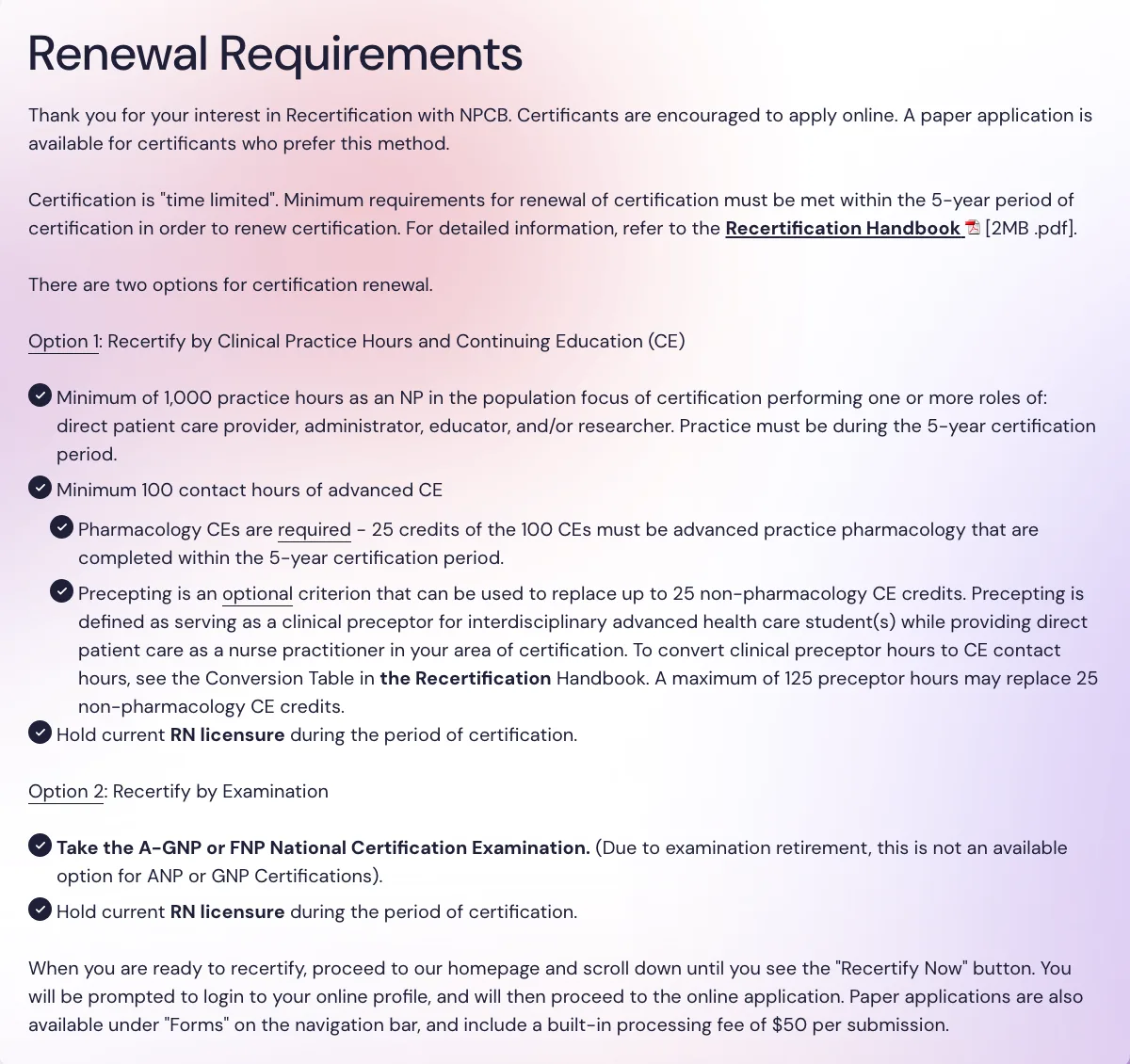
Three things follow. First, before accepting a nonclinical role, ask the employer to confirm in writing that the position is an NP role, with the title and duties to match, because that is what your hours log will need to show. Second, if the new role does not qualify, recertification by examination is the fallback on the NPCB side, though the board notes it is no longer offered for some retired certifications. Third, ANCC-certified NPs follow a different rulebook, so check your own board. Most states tie your APRN license to national certification, which means the certificate is also your prescribing authority.
Telehealth is the most common partial exit for NPs, and it is worth being clear about what it does and does not change. It removes the commute, the rooming and much of the physical exhaustion, and it often allows a schedule you control. It keeps the diagnostic load, the prescribing responsibility and the documentation, and some platforms pay per visit, which recreates the throughput pressure in a new form. For an NP whose problem is the clinic building, telehealth may be the whole answer. For one whose problem is the clinical decision load itself, it is a way to keep certification hours flowing while you move toward something else.
A per diem clinical shift or two a month solves most of this, and doubles as a safety net while you test the new role.
Roles that keep the NP, and roles that quietly demote it
National BLS wage data makes the trap visible. The NP median sits far above the registered nurse median, and several popular exits pay closer to the RN row. The destinations below are chosen from O*NET's profile of nurse practitioners, whose core skills are active listening, critical thinking, reading comprehension, active learning and monitoring, and from where those skills carry the most weight outside clinical care.
| Role | 25th percentile | Median | 75th percentile | Uses the NP degree? |
|---|---|---|---|---|
| Nurse practitioner (origin) | $117,990 | $132,300 | $156,700 | The baseline to beat |
| Registered nurse | $80,330 | $97,550 | $112,350 | What an RN-level review or case management job benchmarks against |
| Medical and health services manager | $94,700 | $123,860 | $166,100 | Yes, when the role owns clinical outcomes; practice and service line leadership |
| Medical scientist | $79,840 | $103,410 | $139,380 | Yes, as a research NP or sub-investigator; the doctorate matters more here |
| Technical and scientific sales representative | $75,030 | $104,920 | $158,160 | Partly; clinical educator and device roles, commission-heavy |
| Nursing instructor, postsecondary | $63,510 | $80,250 | $101,090 | Yes, in NP programs; lower median, better hours |
| Compliance officer | $61,280 | $80,730 | $109,010 | Partly; quality, risk and regulatory work |
| Health information technologist | $48,940 | $68,020 | $95,630 | Rarely at this level; informatics pays more when the title is clinical |
| Medical science liaison | not a separate BLS occupation | Yes; prescribing and therapeutic-area depth are the entry ticket | ||
Annual wages from the U.S. Bureau of Labor Statistics Occupational Employment and Wage Statistics program, May 2025 release. Half of workers in a role earn more than the median; the 25th to 75th percentile span shows how wide the role pays. To see where your current salary sits in your own occupation, use the free salary benchmark.
When comparing an offer, benchmark it against the first row. A utilization management posting paying the RN median to an NP is an RN job with a nicer title, and it will also struggle to count toward your 1,000 hours.
How NP judgment reads on a non-clinical résumé
Most NP résumés list settings and populations. A nonclinical hiring manager wants to know what decisions you made and with what consequences.
| On your clinical résumé | What a non-clinical employer hears | Where it counts |
|---|---|---|
| Managed a panel of 1,800 primary care patients | Owned outcomes for a defined population with limited time | Quality, population health, leadership |
| Prescribed, titrated and deprescribed across complex regimens | Pharmacology depth and risk-benefit judgment | Medical science liaison, drug safety, utilization management |
| Precepted NP students | Curriculum delivery, assessment and feedback | Faculty, clinical education |
| Worked under a collaborative agreement, then independently | Knows scope-of-practice law and credentialing in detail | Compliance, credentialing, payer relations |
| Built templates and smart phrases in the EHR | Workflow design and clinical decision support | Informatics |
| Ordered and interpreted diagnostics | Evidence-based reasoning under uncertainty | Clinical research, utilization review |
Rewrite each bullet to lead with the second column. Your license and specialty go at the top as credentials, and the body of the résumé shows the decisions.
Degrees, certificates and courses: what each move requires
No new credential. Utilization management, clinical research coordinator and sub-investigator roles, most clinical educator positions, and quality roles hire on the MSN or DNP, the certification and your years.
A short course or certificate helps. Clinical research certification, a utilization management or case management credential, a vendor EHR course for informatics, or a healthcare quality certificate. Each is a matter of weeks or months and can be done while you still work clinically.
A degree changes the ceiling. A DNP or PhD matters for faculty leadership and for some industry roles; an MBA or MHA for executive leadership; an MS in informatics for senior informatics jobs. Given that you already paid for a graduate degree once, treat another one as the last step, taken after you have tested the destination and know the degree is what stands between you and the job.
The move that needs the most new paper is leaving healthcare entirely, and that decision deserves the same test-first approach.
Staying adjacent or leaving medicine: a filter
Run through these four questions in order. The first yes tells you which group you belong in.
Question 1
Do you still want to make clinical decisions, just not at a panel's pace?
Yes: Utilization management, telehealth, a specialty clinic or a research NP role.
No: Go to the next question.
Question 2
Do you want to keep your NP certification current?
Yes: Rule out generic RN-level roles. Look at faculty, research, clinical leadership, or a per diem clinical shift alongside anything else.
No: Go to the next question.
Question 3
Is pay the constraint?
Yes: Industry and leadership first, since those hold NP-level income most often.
No: Go to the next question.
Question 4
Is the pull toward work that is not medicine at all?
Yes: The certification question matters less than the direction. Start with the quiz, which reads the direction before the job titles.
No: Revisit question 1 with a structural change in mind, such as co-management or a 0.8 contract.
Question 2 follows the NPCB 1,000-hour rule shown above; question 3 follows the BLS medians in the table. Each yes ends the path; each no moves you on.
Before choosing between those groups, it helps to know which one you are. The career change quiz asks what you would do if money were settled and what the next job has to guarantee, then places you in one of 20 archetypes with careers matched to it.
Physicians face a close cousin of this decision, with boards and medical licenses instead of certification hours, and psychiatric NPs who miss the therapeutic hour more than the prescribing have a parallel set of exits in the therapist guide. Allied health clinicians face the same adjacent-or-out question with fewer years of graduate school at stake, as the guides for occupational therapists weighing a move and respiratory therapists leaving the bedside show.
Related guides: alternative careers for physicians and career change for therapists.
Every profession on this site follows the same broad arc of how to change careers. The NP version adds one step the others skip: keep the certification alive until the new role has proved itself.
Frequently Asked Questions
Ready to find your passion career?
The free under-10-minute quiz maps your childhood patterns and flow triggers to one of 20 archetypes, then gives you matched careers and a 7-day first-step plan.
Take the Free Career QuizRelated Articles
Trusted by 12,200+ career-quiz takers across 165+ countries · Methods covered in