
Alternative Careers for Physicians: Where Doctors Go Next
Where physicians go after clinical practice: utilization management, medical affairs, informatics, leadership, research. BLS pay, debt math and a fit filter.


Contents · 8 sections
Physicians who leave full-time practice mostly move into five areas: utilization management for payers and hospitals, medical affairs in pharma and device companies, clinical informatics and health-tech, medical leadership, and medical education or research. The right one keeps the part of medicine you would still do unpaid, whether that is the diagnostic puzzle, the teaching, or the itch to fix how care gets delivered. Pay, debt and your license decide the timing. These are the 14 roles that come up most, with who each one suits:
- Utilization management physician: hospitalists and emergency physicians who like the diagnostic puzzle and can live without a patient panel.
- Physician advisor: clinicians who enjoy arguing a case with peers and already know admission criteria.
- Medical science liaison: specialists who like explaining trial data to other doctors in their own therapeutic area.
- Medical director in pharma or devices (medical affairs): specialists in the company's therapeutic area who want evidence work at close to clinical pay.
- Drug safety physician: doctors who read adverse event reports the way they read a chart.
- Clinical development lead: physicians who find trial design more interesting than trial enrolment.
- Medical scientist: MDs and MD-PhDs who want clinical or translational research to be the whole job.
- Chief medical information officer or informatics lead: the doctor who was already fixing the EHR for colleagues.
- Clinical advisor at a health-tech company: physicians who can translate between clinicians and engineers.
- Medical and health services manager (medical director, quality lead, CMO): physicians who want budget and authority over how care is delivered.
- Health specialties faculty or residency program director: doctors whose best hours are the ones spent teaching residents.
- Management analyst in healthcare strategy or consulting: systems thinkers who can work to a client's deadline.
- Epidemiologist: doctors more interested in populations than in the patient in front of them; an MPH usually helps.
- Medical writer: the lowest-friction exit, for physicians who write well and want control of their week.
Where doctors go when they stop seeing patients
The nonclinical market for physicians is narrower than the listicles suggest, and deeper in a few places. Five clusters account for most of it.
Utilization management and physician advisor roles. Payers, hospitals and review organisations employ physicians to decide whether an admission, a procedure or a length of stay meets medical necessity criteria. It is chart review and peer-to-peer calls, often remote, and it depends on an active license and years of clinical judgment. For a hospitalist or emergency physician, this is often the shortest step out.
Medical affairs and clinical development. Pharma, biotech and device companies hire physicians as medical directors, medical science liaisons, drug safety physicians and clinical development leads. The work is evidence, trial design and explaining data to other clinicians. Specialists in the company's therapeutic area have the easiest entry. Pharmacists apply for many of the same medical information and drug safety roles, so the routes pharmacists take out of dispensing double as a map of who else is in the applicant pool.
Clinical informatics and health-tech. Chief medical information officers, EHR optimisation leads and clinical advisors at software companies translate between clinicians and engineers. Clinical informatics is also a board-certified subspecialty, which matters if you want the formal credential.
Leadership. Medical director, department chair, vice president of quality, chief medical officer. You keep influence over care delivery and trade patients for budgets, committees and people management.
Education and research. Full-time faculty, residency program leadership, simulation, and continuing medical education. Of the five, it keeps the most of the identity you trained for: you still practise medicine, only through the next cohort of doctors.
A sixth path, expert witness and medical-legal consulting, is usually a side income rather than a full exit, and it works best while you still practise.
Moral injury or burnout: name what you are carrying
Before choosing a destination, it is worth being precise about what you are leaving, because the two most common explanations point in different directions.
Burnout, in the popular sense, implies you ran out of capacity and need rest. Moral injury, the reframe psychiatrist Wendy Dean and surgeon Simon Talbot argued for in a 2019 Federal Practitioner editorial, locates the damage somewhere else: in being repeatedly unable to do what you know the patient needs because of prior authorisations, throughput targets, staffing and billing rules. The fix for the first is a gentler version of the same work. The fix for the second is a role where you have more say over the system, or a role outside the system's pressure points entirely.
This distinction changes the shortlist. A physician carrying moral injury who moves into utilization management may find themselves on the other side of the same prior authorisation that wore them down, now denying the request instead of writing it. Some physicians find that role satisfying because they apply criteria fairly and quickly. Others find it a sharper version of the original wound. Leadership and informatics give you levers over the system. Education and research step outside it.
There is also an identity cost that no other profession in this cluster carries in quite the same way. You will keep the MD and the title, and most nonclinical physician roles trade on both, yet the first months outside practice often feel like a demotion even when the pay holds. Colleagues ask when you are coming back. Family members who were proud of the white coat ask what you do now. It helps to decide in advance what you will say, because a physician who explains the move as an escape gets treated as one, and a physician who explains it as a choice about where their judgment does the most good gets treated as a hire.
The practical test for which one you are carrying: imagine your current job with half the patients and the same rules. If that sounds like relief, you are tired, and a lighter clinical role or a part-time schedule may be enough. If it sounds like the same problem at a slower pace, the rules are the problem, and the exits in this guide are the right conversation.
You are also not alone in leaving work that pays well. In the Career Changer Index, the largest group of experienced quiz takers describes itself as in a well-paying career and seeking change, which is why pay alone rarely explains the decision.
| Answer | Share |
|---|---|
| In a well-paying career, seeking change | 41.2% |
| Stuck or unemployed, going in circles | 30.4% |
| Too many interests, can't pick one | 20% |
| Student or graduate, no clear direction | 8.5% |

What $215,000 of debt does to the timing
Physicians leave later and more carefully than other professionals, and debt is much of the reason. The AAMC's fact card for the Class of 2025 puts the median education debt of indebted medical graduates at $215,000, with 70% of graduates carrying education debt and 59% owing $200,000 or more.
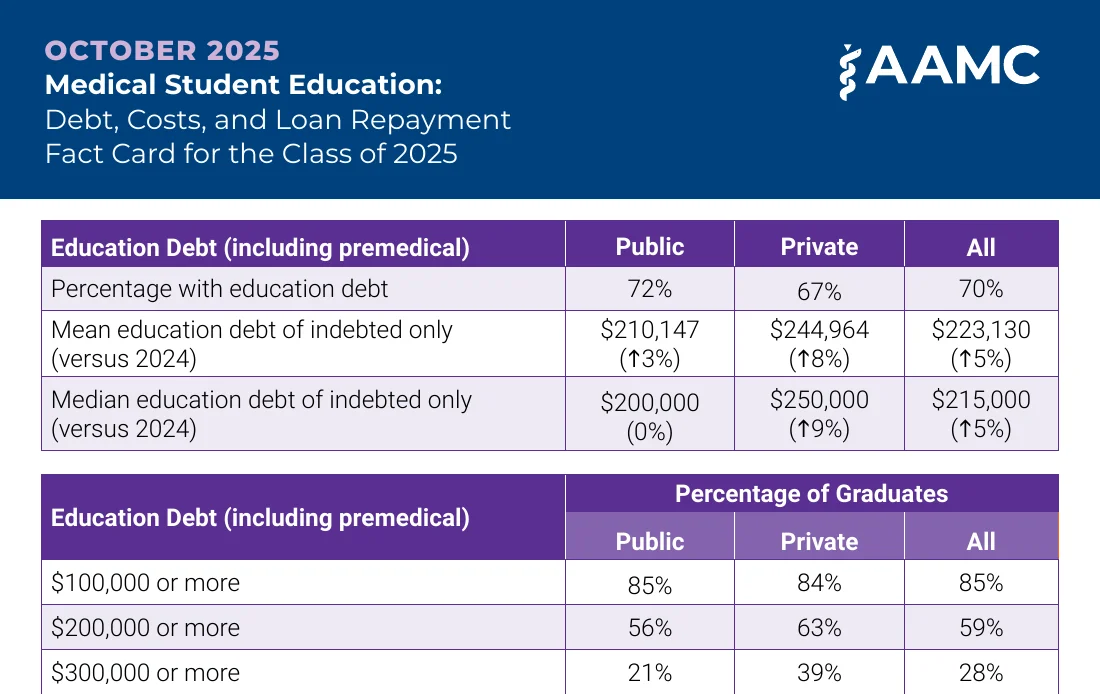
Three practical consequences. First, if you are on an income-driven plan working towards forgiveness at a nonprofit hospital, a move to a for-profit pharma company or payer can end your eligibility, so the timing of the exit matters as much as the destination. Second, a pay cut you could absorb at 55 may be dangerous at 38 with a mortgage and school fees built on clinical income. Third, the claims-made malpractice policy most employed physicians hold usually needs tail coverage when you leave, and whether your employer pays for it is written in your contract. Read it before you hand in notice. Veterinarians face the same sequencing problem on a smaller clinical salary, and the exits open to a vet with a DVM show how that profession plans around it.
None of this argues for staying. It argues for a runway. The same arithmetic, applied to any profession, is in our breakdown of how to absorb a lower salary when you switch fields.
Pay outside the clinic: what BLS tracks and what it misses
Here is the uncomfortable part, shown with national Bureau of Labor Statistics wage data. The trackable destinations sit well below the physician rows. The destinations that pay close to clinical income are mostly not separate BLS occupations, so they appear as rows without figures.
| Role | 25th percentile | Median | 75th percentile | How it fits a physician |
|---|---|---|---|---|
| Family medicine physician (origin) | $162,420 | $244,180 | $334,270 | The baseline you are comparing against |
| General internal medicine physician (origin) | $124,470 | $256,560 | $374,850 | Hospitalists and internists compare here |
| Medical and health services manager | $94,700 | $123,860 | $166,100 | Medical director and quality roles; physician executives are often paid above this range |
| Medical scientist | $79,840 | $103,410 | $139,380 | Clinical research and translational work; an MD is a strong signal |
| Health specialties teacher, postsecondary | $75,690 | $107,310 | $210,370 | Faculty and program leadership; the wide spread reflects clinical faculty |
| Management analyst | $77,950 | $101,860 | $133,370 | Healthcare strategy and consulting |
| Epidemiologist | $71,090 | $87,220 | $112,640 | Public health and population health roles |
| Technical writer | $70,880 | $90,390 | $115,510 | Medical writing and communications; the lowest-friction exit and the lowest ceiling |
| Medical affairs / medical science liaison | not a separate BLS occupation | Industry role not tracked separately by BLS; usually the closest to clinical pay | ||
Annual wages from the U.S. Bureau of Labor Statistics Occupational Employment and Wage Statistics program, May 2025 release. Half of workers in a role earn more than the median; the 25th to 75th percentile span shows how wide the role pays. To see where your current salary sits in your own occupation, use the free salary benchmark.
Read the table as a map of ceilings. The medical and health services manager median is roughly half the family medicine median, yet a chief medical officer at a large system may out-earn the clinicians they lead. Medical writing is the easiest door to open and the one where your MD is least rewarded financially. Industry medical affairs usually pays more than any BLS row except the origin, which is why it attracts so many applicants and asks for specialty fit.
Your license after you leave: keep it, park it, or let it go
Your license is the single most valuable asset you carry out of practice, and three different decisions hide inside it.
The state medical license. It stays active as long as you renew it and complete the continuing medical education your state board requires. Utilization management, physician advisor, medical director and most medical affairs roles either require it or prefer it strongly. Letting it lapse is cheap in the short term and expensive to reverse, so most physicians keep at least one license active for years after leaving.
Board certification. This is where leaving can cost you. Maintenance of certification programs assume ongoing clinical activity, and the rules differ by specialty board. Before your last clinical day, read your board's requirements and decide whether you want to keep the certificate current. Some industry and leadership roles ask for it; many do not.
A foot in practice. A single weekly clinic, occasional locum shifts, or telehealth sessions keep your skills current, keep your options open, and keep an income flowing while you test the new role. Many physicians hold this arrangement for a year before deciding.
What transfers, translated for a hiring manager
Physicians routinely describe their skills in clinical language that a nonclinical hiring manager does not parse. O*NET's profile of family medicine physicians lists critical thinking, active listening, reading comprehension, speaking and writing as the core skills, and its related-occupations list points only to other physician specialties and advanced practice nursing. So the translation is yours to make.
| What you do in clinic | How a nonclinical employer reads it | Where it pays off |
|---|---|---|
| Synthesising a history, labs and imaging into a working diagnosis under time pressure | Structured decision-making with incomplete data | Utilization management, medical affairs |
| Explaining risk to a frightened patient in plain language | Stakeholder communication, translating technical evidence | Medical science liaison, education, health-tech |
| Documenting defensibly in the EHR | Process knowledge of clinical workflow and data capture | Clinical informatics |
| Running a team through a code or a busy shift | Operational leadership under pressure | Medical director, operations |
| Reading and appraising trial evidence for your patients | Evidence evaluation and study design literacy | Clinical development, drug safety, research |
| Peer review, M&M, quality committees | Quality improvement and governance | Quality leadership, physician advisor |
The strongest résumés for nonclinical physician roles lead with outcomes in this second column, and put the specialty and board certification underneath as proof.
Credentials: which moves need new paper and which do not
The honest version, by destination:
No new credential needed. Utilization management and physician advisor roles hire on the license and clinical years. Medical writing hires on writing samples. Entry-level medical affairs roles in your specialty often hire on the MD plus a well-told reason for the move.
A short credential helps. Physician advisor certification through professional societies, a clinical research certification, or a vendor EHR course for informatics can shorten a job search, though none is universally required.
A formal credential for the top of the ladder. Board certification in clinical informatics now runs through a 24-month ACGME-accredited fellowship, which is a serious commitment mid-career, though plenty of informatics roles hire without it. Physician executive roles increasingly ask for an MBA, MMM or MHA. Public health leadership often asks for an MPH. These take one to three years part-time and are worth it only if the destination is clear.
Test the destination before buying the credential. An MBA taken to escape practice, before you know you want to run a department, is an expensive way to delay the decision.
Sorting the exits by what you want next
A physician's reasons for leaving tend to fall into three groups, and each points at a different cluster of exits. A job list cannot tell you which part of medicine you would keep. The career change quiz gets at it from the other side, through the kind of problem that holds your attention and the priority you bring to the move. The archetype matrix below is how it sorts that question: your struggle type crossed with what you are optimising for now.
What you need next →
| Income-Focused | Lifestyle Seeker | Stability First | Experimenter | |
|---|---|---|---|---|
| Career Switcher | Ambitious Pivoter | Freedom Seeker | Strategic Shifter | Curious Transformer |
| Grad Explorer | Rising Achiever | Modern Explorer | Foundation Builder | Open-Minded Starter |
| Multi-Passionate | Renaissance Earner | Creative Polymath | Focused Generalist | Passion Collector |
| Purpose Seeker | Impact Driver | Meaningful Creator | Mission Seeker | Values Explorer |
| Explorer | Emerging Achiever | Authentic Seeker | Grounded Explorer | Curious Adventurer |
↓ What is hardest right now
Highlighted: Purpose Seeker crossed with Stability First resolves to The Mission Seeker. Source: the live MyPassion.ai archetype matrix.
Use this filter before you apply anywhere. The first question is the half-the-patients test from the moral injury section; the rest sort the exits.
Question 1
Would your current job with half the patients and the same rules feel like relief?
Yes: You are tired more than blocked. Try a lighter clinical role, a part-time schedule or a few locum shifts before leaving practice.
No: Go to the next question.
Question 2
Do you want less friction and roughly the same pay?
Yes: Utilization management, physician advisor, or industry medical affairs in your specialty. Expect a license requirement and a remote or hybrid week.
No: Go to the next question.
Question 3
Do you want to fix the system that wore you down?
Yes: Medical director, quality leadership or clinical informatics. Expect committees, budgets and slower change than you hoped.
No: Go to the next question.
Question 4
Do you want to step outside the system's pressure points entirely?
Yes: Education, research or medical writing. Expect the largest pay change and the most control over your week.
No: The quiz above is the better next step: it sorts you by what absorbs you, before the job titles.
Built from the moral injury distinction above (Dean and Talbot, Federal Practitioner, 2019) and the destination clusters on this page. Each yes ends the path; each no moves you to the next question.
Then run a small test. Shadow a physician advisor for a day, take a single chart-review contract, or ask a medical science liaison in your specialty for thirty minutes. One month of that tells you more than a year of reading. Nurse practitioners face a close cousin of this decision, with a certification clock instead of a board, and doctoral psychologists weighing research and assessment roles have their own version too. Physical therapists who prefer the teaching moments to the treatment face the education-versus-informatics choice as well, covered in alternative careers for physical therapists.
Related guides: alternative careers for nurse practitioners and alternative careers for psychologists.
Outside medicine the steps are the same ones every mid-career switcher faces, and the career change guide sets them out in order. What is particular to physicians is the cost of guessing wrong, which is why a month of testing is cheaper than a year's salary.
Frequently Asked Questions
Ready to find your passion career?
The free under-10-minute quiz maps your childhood patterns and flow triggers to one of 20 archetypes, then gives you matched careers and a 7-day first-step plan.
Take the Free Career QuizRelated Articles
Trusted by 12,200+ career-quiz takers across 165+ countries · Methods covered in