
Alternative Careers for Veterinarians: Beyond the Clinic
Alternative careers for veterinarians: animal health industry, public health, food safety, research, relief work. BLS pay, the Merck wellbeing data and a fit filter.

Contents · 7 sections
Veterinarians who leave clinical practice most often go into the animal health industry (technical services, medical affairs, pharmacovigilance and sales at pharma, diagnostics and nutrition companies), government and public health (USDA food safety and animal health, CDC, state veterinarian offices), research and laboratory animal medicine, academia, or practice ownership and consulting. Many take a halfway step first through relief work. Here are 15 alternative careers for veterinarians, with what the DVM brings to each:
| Alternative career | What carries over, or who it suits |
|---|---|
| Technical services veterinarian | Case consultations with practitioners about the company's products |
| Medical affairs or pharmacovigilance | Differential reasoning applied to adverse event cases |
| Animal health sales and key accounts | Explaining medicine to a sceptical buyer; commission-heavy |
| Regulatory affairs or compliance officer | Controlled drug records and documentation discipline |
| USDA public health veterinarian (food safety) | Regular hours and federal benefits, in processing plants |
| Epidemiologist or One Health roles | Herd health thinking applied to populations |
| Medical scientist in pharma R&D | Research and translational work on the DVM science base |
| Laboratory animal veterinarian | A board-certified specialty with its own residencies |
| Veterinary pathologist | For vets who love the diagnostic puzzle more than the client |
| Natural sciences manager | R&D and lab leadership, usually after a research role |
| Veterinary or vet tech school faculty | Teaching, often with a PhD or board certification |
| Animal scientist | Nutrition, genetics and production research |
| Relief veterinarian | Stays clinical, with your own schedule and no fixed clinic |
| Practice owner or practice consultant | Running the surgical day becomes running the business |
| Pet insurance medical roles | Claims and policy medicine, with no exam room |
The six places vets go after general practice
The move that fits you depends on which of three pulls brought you into veterinary medicine and still holds: the animals, the science, or the people who bring the animals in. A companion animal vet who still loves the science and dreads the euthanasia appointments fits industry or diagnostics. One who is drawn to herds, outbreaks and food fits public health. One who is simply exhausted by the schedule may only need relief work.
If you cannot tell which of the three still holds, the career change quiz looks for it in what you did as a child without being told and in the priority you bring to the move, then assigns one of 20 archetypes with matched careers. The six groups below are organised so you can read your result against them.
Animal health industry. Technical services veterinarians at companies such as Zoetis, Merck Animal Health, Elanco and Boehringer Ingelheim support practitioners with product questions, adverse event cases and field trials. Medical affairs, pharmacovigilance, regulatory affairs and key account roles sit alongside. Pharmacists compete for many of the same drug safety and regulatory openings, and how pharmacists break into drug safety shows the route they use. Diagnostics, pet food and pet insurance companies hire vets for similar work.
A technical services week is phone and email consultations with practitioners about cases involving the company's products, adverse event follow-ups, continuing education talks, and field visits in a regional territory. The clinical judgment is the same; the client is now the vet on the other end of the line. The trade-offs are travel, a sales organisation around you, and the fact that your advice has to stay within the product label.
Government. The USDA's Food Safety and Inspection Service employs public health veterinarians in slaughter and processing plants; APHIS works on animal disease control and import and export. State veterinarian offices, the FDA's Center for Veterinary Medicine and the military veterinary corps round out the government options.
Food safety work is the least glamorous and the most misunderstood of these. A public health veterinarian in a processing plant supervises inspection staff, checks humane handling and enforces food safety rules, with regular hours, federal benefits and little client conflict. It asks you to be comfortable with the plant environment, and vets who are leaving because of animal welfare distress should visit a plant before applying.
Public health and epidemiology. Zoonotic disease surveillance, outbreak response and One Health programmes. CDC's Epidemic Intelligence Service is a two-year fellowship that takes veterinarians, and its eligibility rules ask for an MPH or equivalent degree, or at least one year of full-time public health work, plus an active, unrestricted US license.
Research and laboratory animal medicine. Universities, contract research organisations and pharma run animal programmes that need veterinarians; laboratory animal medicine is a board-certified specialty with its own residencies.
Academia. Clinical faculty, anatomic and clinical pathology, and teaching at veterinary and veterinary technology schools.
Ownership and consulting. Practice ownership, practice management consulting, and specialty consulting in areas like toxicology, nutrition or behavior.
Relief work first, or out entirely?
Relief work deserves a section of its own because it solves a specific problem. If the schedule, the staffing, the on-call rota or one practice's culture is what is wearing you down, relief lets you keep practising on your terms while you test what comes next. It also buys time to build an industry network or finish an MPH.
Relief does not solve the problems that follow you from clinic to clinic: the emotional load of euthanasia, especially economic euthanasia when an owner cannot pay for treatment; clients who blame you for costs you do not set; and the gap between the medicine you trained for and the medicine a household budget allows. If those are the reasons, a different clinic will not help, and the industry, public health and research routes are where to look.
Question 1
Is it the schedule, the staffing, the on-call rota or one clinic's culture?
Yes: Try relief work first. It keeps you practising on your terms and buys time to build an industry network or finish an MPH.
No: Go to the next question.
Question 2
Is it euthanasia, especially economic euthanasia, or clients who blame you for costs you do not set?
Yes: Leave the exam room. Industry, research and public health roles remove those appointments; relief and shelter work keep them.
No: Go to the next question.
Question 3
Is the science still what you read about on weekends?
Yes: Technical services, diagnostics, pharmacovigilance or research.
No: Look at public health, food safety or regulatory work, where the DVM is judged on populations and rules.
Relief fixes problems that belong to one clinic. Problems that follow you from clinic to clinic call for leaving the exam room.
It is worth being honest about euthanasia specifically, because it shapes which exits help. Vets are one of the few professions that end lives as a routine part of care, and the hardest cases are rarely the old dog at the end of a good life. They are the treatable animal whose owner cannot pay, and the healthy animal whose owner no longer wants it. Industry, research and public health roles remove those appointments. Relief, shelter medicine and in-home euthanasia services keep them, in some cases concentrate them, and suit vets who find meaning in doing that part of the work well rather than those who are leaving because of it.
The financial side matters too. The AVMA's 2024 senior survey put the average debt-to-income ratio for new graduates entering full-time work at 1.4, as reported by Veterinary Practice News, which means debt of about 1.4 times first-year salary. If you are still repaying, a government employer counts as qualifying employment for Public Service Loan Forgiveness, and an industry role can bring a higher salary; either changes the pace at which you can afford a move. The savings runway calculation shows how many months of cover a move like this needs.
What O*NET thinks you are qualified for
The US Department of Labor's O*NET database lists related occupations for every job, as a guide for career changers. For veterinarians, the list is revealing.
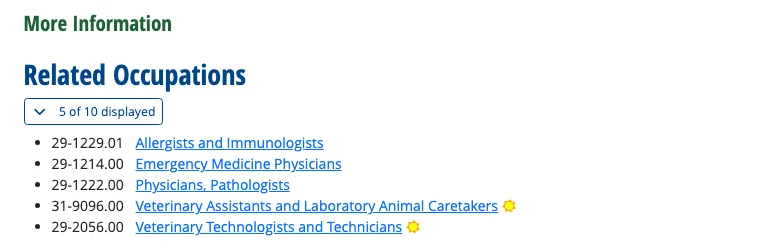
The more useful part of the same O*NET profile is the skill and knowledge list: active listening, reading comprehension, critical thinking and science as core skills, and biology, medicine, chemistry and mathematics as core knowledge. That profile describes a scientist who can talk to non-scientists, which is exactly what the industry, public health and research routes hire.
What the Merck wellbeing data says about who is struggling
The best current evidence on how US veterinarians are doing is the Merck Animal Health Veterinary Wellbeing Study, published in JAVMA in 2024 from a survey of 4,636 veterinarians drawn from an AVMA random sample. Two findings matter for a career decision.
First, burnout overall was close to the general employed population, but it was not evenly spread:
| Answer | Share |
|---|---|
| Under 35 | 26% |
| Companion animal practice | 20% |
| All veterinarians | 18% |
| Aged 55 to 64 | 13% |
| Food animal practice | 8% |
Second, serious psychological distress was more common than in the general population: 10% of veterinarians against 6.3% of employed, college-educated US adults. Yet only about 3% of vets under 55 said they were very likely to leave the profession in the next two years, and 56% were very or extremely satisfied with their job.
Read together, that points to a specific pattern. The strain concentrates in young companion animal vets, and most of them are not leaving veterinary medicine. They are looking for a different version of it. If that describes you, the question is less whether to leave and more which part of the DVM to take somewhere with a different pace, different clients, or no clients at all.
The DVM outside the exam room: pay by destination
National BLS wage data for the origin and destinations that have a clean BLS occupation. Industry technical services has no separate BLS category, so it appears without figures.
| Role | 25th percentile | Median | 75th percentile | How the DVM carries over |
|---|---|---|---|---|
| Veterinarian (origin) | $101,460 | $130,100 | $166,120 | Your baseline; the spread reflects practice type and ownership |
| Medical scientist | $79,840 | $103,410 | $139,380 | Pharma R&D, lab animal medicine and translational research |
| Technical and scientific sales representative | $75,030 | $104,920 | $158,160 | Animal health sales and key accounts; commission-heavy |
| Natural sciences manager | $119,430 | $167,220 | $221,540 | R&D and lab leadership, usually after a research role |
| Epidemiologist | $71,090 | $87,220 | $112,640 | Public health and One Health; CDC EIS is the flagship route |
| Compliance officer | $61,280 | $80,730 | $109,010 | Regulatory affairs and quality in animal health companies |
| Biological science teacher, postsecondary | $64,350 | $84,620 | $126,770 | Teaching at veterinary and vet tech schools |
| Animal scientist | $49,770 | $68,940 | $103,300 | Nutrition, genetics and production research |
| Technical services veterinarian | not a separate BLS occupation | Industry role supporting practitioners; DVM required | ||
Annual wages from the U.S. Bureau of Labor Statistics Occupational Employment and Wage Statistics program, May 2025 release. Half of workers in a role earn more than the median; the 25th to 75th percentile span shows how wide the role pays. To see where your current salary sits in your own occupation, use the free salary benchmark.
Read the table by percentile. Natural sciences management sits above the veterinarian median, and technical sales has a 75th percentile well above it, which is where commission-heavy animal health roles can outpace practice. Most other destinations pay less at the median, and public health and teaching trade the gap for more predictable weeks.
What a new credential buys, and what the DVM already covers
The DVM is enough for: industry technical services and many medical affairs roles, animal health sales, USDA public health veterinarian posts, relief work, practice consulting and pet insurance medical roles. Clinical years count as much as the degree.
A short credential helps: regulatory affairs certification for regulatory roles, a pharmacovigilance course, or a certificate in epidemiology or biostatistics. Each can be done while you still practise.
A degree or residency is expected for: CDC EIS and many public health posts (an MPH, or a year of public health work as the alternative), research scientist and faculty posts (a PhD or board certification), laboratory animal medicine and pathology (a residency and board certification).
Keep your license active. Many non-clinical DVM roles list an active state license in the requirements, including CDC EIS, and it keeps relief work open as income. Renewal is usually continuing education and a fee; lapsing and reinstating costs far more.
A skills translation helps whichever route you choose:
| In the clinic | For an industry or government employer | Where it counts |
|---|---|---|
| Diagnosing across species with limited history | Differential reasoning under uncertainty | Technical services, diagnostics, pharmacovigilance |
| Explaining a treatment plan and its cost to an anxious owner | Translating science for a lay audience and handling objections | Technical services, sales, education |
| Managing controlled drugs and records | Regulatory compliance and documentation | Regulatory affairs, quality |
| Herd health and vaccination programmes | Population-level thinking | Public health, food safety, epidemiology |
| Running a surgical day with a small team | Operations and team leadership | Practice management, R&D operations |
Reading your own pull: animals, science, or people
Veterinarians tend to score high on the Investigative and Realistic corners of the Holland hexagon: science plus hands-on work. The destinations in this guide move you around that corner in different directions.
| Letter | Type | Core interests |
|---|---|---|
| R | Realistic | Hands-on work: tools, machines, the physical world |
| I | Investigative | Research, analysis, working with ideas |
| A | Artistic | Design, writing, performance, open ends |
| S | Social | Teaching, care, service to people |
| E | Enterprising | Leading, selling, starting things |
| C | Conventional | Systems, data, order, getting details right |
The hexagonal model comes from John Holland’s theory of vocational choice (1959), the framework underneath the U.S. Department of Labor’s O*NET database.
Answer these three questions before your first application:
- Would you miss the animals themselves if you never touched one again? Yes points to relief, lab animal medicine, shelter medicine or a food animal role. No opens industry, public health and regulatory work.
- Is the science what you still read about on weekends? Yes points to research, diagnostics, pharmacovigilance or technical services.
- Do you enjoy the owner conversation when it is not about money? Yes points to technical services, education and sales, where explaining the medicine is the job.
Then run a small test: shadow a technical services vet for a day, sit in on a USDA or state public health briefing, or take a single consulting project. Physicians face a similar decision with the same O*NET problem in reverse, since their related-occupations list points only at other physicians. Doctoral psychologists weigh a similar research-or-industry split with a PhD in place of a DVM, laid out in career options for psychologists outside practice.
Related guides: alternative careers for physicians.
The general version of these steps, for any field, is in our walkthrough of how to change careers. For a vet, the shortcut is that the DVM already opens most of the doors in this guide.
Frequently Asked Questions
Ready to find your passion career?
The free under-10-minute quiz maps your childhood patterns and flow triggers to one of 20 archetypes, then gives you matched careers and a 7-day first-step plan.
Take the Free Career QuizRelated Articles
Trusted by 12,200+ career-quiz takers across 165+ countries · Methods covered in