
Jobs for Former Police Officers: Where Cops Go, and When
Where former police officers go: investigations, fraud, compliance, emergency management, training. BLS pay, the pension math at 20 years, and a fit filter.


Contents · 8 sections
Former police officers most often move into investigations outside the badge, compliance and loss prevention, emergency management, training, and security leadership, with a smaller group retraining for cybersecurity. The right one depends on which part of the job you want to keep and how close you are to a pension milestone. Here are 14 roles that suit former officers, with what carries over into each:
- Detective or criminal investigator: keeps the badge and the casework, drops most of the patrol shifts.
- Claims or insurance fraud investigator: interviews, surveillance and reports, with civil stakes instead of arrests.
- Compliance officer: rules, audits and written findings inside a company or a regulator.
- Emergency management director: incident command without the incident, built on planning, drills and coordination.
- Training and development specialist: suits officers whose best shifts were field training duty.
- Private investigator: in states such as California sworn service counts toward the licence hours, and the work fits beside a pension.
- Probation officer: stays inside criminal justice with calmer hours and much of the same exposure to aggressive people.
- Loss prevention manager: retail and warehouse theft investigations that hire on a patrol record.
- Corporate security manager: the security-leadership ladder, where scene management becomes site and travel security.
- Background investigator: records checks and interviews for security clearances and pre-employment screening.
- Workplace (HR) investigator: misconduct and harassment inquiries run on the same interviewing and documentation skills.
- Bailiff or court security officer: a related occupation in O*NET, and a steady daytime schedule for retirees.
- Customs and Border Protection officer: a federal lateral move O*NET lists beside patrol work, with its own hiring process.
- Information security analyst: the highest-paid option here and the only one that needs genuine technical retraining.
Count the pension years before you count job openings
Which of those roles fits you depends on two questions, and neither one is about job titles. The first is how many years you have on the pension clock, because a 12-year officer and a 19-year officer face different arithmetic. The second is which part of the job you are trying to leave: the danger, the schedule, the public, or the institution itself. An officer who still loves an investigation should look at claims or fraud work; one who wants out of confrontation entirely should look at emergency management or training, where almost nobody deals with aggressive people. This page covers both, with BLS pay, O*NET exposure data and the licensing that each move needs, starting with the pension.
Most private-sector workers can leave a job in any year and lose little beyond a bonus. Many police officers cannot, because the pension is built with a step in it. Take one published example, the Pennsylvania State Police retirement fact sheet for officers who entered the academy on or after January 1, 2019:
| Years of state police service | What the plan pays |
|---|---|
| Under 20 | Basic formula: 2% x class multiplier (1.0 or 1.25 for most new officers) x years x final average salary, reduced if drawn before the plan's retirement age, age 55 in most cases |
| 20 to 24.99 | 50% of your highest single year of earnings |
| 25 or more | 75% of your highest single year of earnings |
Run it for an officer on the 1.0 multiplier. At 19 years the basic formula gives 38% of a three-year average salary, and only in full from 55. At 20 it gives 50% of the best single year. That twentieth year can be worth more than any raise a second career will offer in its first five years, which is why so many officers who want out still stay to 20 and then leave the next week.
Your plan will differ in the multiplier, the retirement age and the definition of salary. So the first practical step is unglamorous: ask your pension office for two written estimates, one at your current service and one at your next milestone. If the gap is large and the milestone is close, the job search becomes a two-year project you run while still in uniform. If the gap is small or the milestone is far, the pension stops being a reason to wait. The Golden Handcuffs Index looks at that same trade-off across professions: how much deferred money it takes to keep someone in a job they have stopped wanting.
Resigning mid-career is now the common exit
The officers leaving today are not mostly retirees. In its latest workforce survey of 217 agencies, the Police Executive Research Forum compared 2024 with the last pre-pandemic year and found hiring back above 2019 levels, retirements roughly flat, and resignations well up. Sworn staffing was still 5.2% below January 2020.
| Answer | Share |
|---|---|
| Resignations | 18.4% |
| Hires | 12.5% |
| Retirements | 1.6% |
That matters for you in one specific way. If you are a mid-career officer thinking about resigning, you are in a crowd, and employers who hire from law enforcement have seen a lot of your résumé lately. The ones that hire well from this pool, insurance special investigation units, compliance teams, emergency management offices, tend to know what a patrol record means. The ones that do not will need your résumé to do the translating, which is covered further down.
What sits behind the resignations is harder to count. Pew's 2017 survey of 7,917 officers, Behind the Badge, found that 58% said the work nearly always or often made them feel proud, 51% said it nearly always or often left them frustrated, and 56% said the job had made them more callous. Pride and frustration in the same person is the usual starting point for a career change, and it is why the destination question below starts with what you want to keep.
Six destinations, sorted by how much of the street each keeps
O*NET's related occupations for patrol officers include detectives, private investigators, probation officers and security roles. Add the moves that reuse the same skills in a different setting (claims investigation, compliance, emergency management, training) and the realistic shortlist looks like this. Pay comes straight from the BLS wage survey:
| Role | 25th percentile | Median | 75th percentile | What stays from patrol, what goes |
|---|---|---|---|---|
| Police and sheriff's patrol officer (where you are now) | $59,290 | $76,210 | $97,600 | The baseline: shifts, public contact, physical risk |
| Detective or criminal investigator | $69,330 | $93,790 | $120,520 | Keeps the badge and the casework, loses most of the patrol shifts |
| Claims or insurance fraud investigator | $61,160 | $78,000 | $98,030 | Interviews, surveillance and reports, with civil stakes instead of arrests |
| Compliance officer | $61,280 | $80,730 | $109,010 | Rules, audits and written findings inside a company or regulator |
| Emergency management director | $67,910 | $93,330 | $126,490 | Incident command without the incident: planning, drills, coordination |
| Training and development specialist | $50,110 | $69,280 | $95,050 | Teaching use of force, report writing or de-escalation to other people |
| Private investigator | $40,700 | $51,220 | $73,990 | Self-directed casework; often a second income beside a pension |
| Probation officer | $54,250 | $66,270 | $84,780 | Still inside criminal justice, still dealing with offenders, calmer hours |
Annual wages from the U.S. Bureau of Labor Statistics Occupational Employment and Wage Statistics program, May 2025 release. Half of workers in a role earn more than the median; the 25th to 75th percentile span shows how wide the role pays. To see where your current salary sits in your own occupation, use the free salary benchmark.
The pay column tells you less than the danger column you cannot see in it. O*NET asks workers how often they deal with violent or physically aggressive people, and the answers split these destinations into two groups with almost nothing in between.
| Answer | Share |
|---|---|
| Police patrol officers | 69.2% |
| Probation officers | 61.7% |
| Detectives and criminal investigators | 42.5% |
| Information security analysts | 2% |
| Claims adjusters and investigators | 1.4% |
| Private detectives and investigators | 0.8% |
| Emergency management directors | 0% |
| Training and development specialists | 0% |
Read the chart as a sorting tool. If the physical risk is the reason you are leaving, probation is a sideways step, however calm its hours look on paper. If the risk never bothered you and the schedule or the politics did, detective work keeps what you are good at and changes the parts you are not.
From incident report to business language
For most officers the gap is vocabulary, because the skills themselves carry over. O*NET lists documenting information, working directly with the public and making decisions under pressure as the top activities of patrol work, and its task list includes writing reports that document incidents and testifying in court. Every one of those has a civilian name.
| What you did on patrol | What a civilian hiring manager calls it | Where it counts most |
|---|---|---|
| Wrote incident and arrest reports that survived defence attorneys | Evidence-grade written findings, audit-ready documentation | Compliance, claims, corporate investigations |
| Testified in court and depositions | Expert testimony, presenting findings to legal and executive audiences | Fraud investigation, litigation support |
| Interviewed witnesses and suspects | Structured interviewing, fact-finding, elicitation | Insurance SIU, HR investigations, background screening |
| Ran scenes and traffic incidents | Incident command, on-site coordination across agencies | Emergency management, facilities and security leadership |
| Field training officer duty | Onboarding, curriculum delivery, performance coaching | Training and development, academy instruction |
| Worked under use-of-force and evidence policy | Policy adherence, chain of custody, regulatory controls | Compliance, loss prevention, security management |
Two habits help. Cut the acronyms and the case numbers, which mean nothing outside the department. And quantify the paperwork, because nobody outside policing knows that a patrol officer can write several hundred reports a year. If you want a longer method for this, the guide to transferable skills mid-career walks through the same exercise for any profession.
Licences, clearances and exams: what each move asks of you
Some of these moves need nothing new, some need a licence your experience already qualifies you for, and one needs genuine retraining. Honest sorting:
No new credential needed. Loss prevention, corporate security, background investigation and most training roles hire on your record. Internal HR investigations hire on the same interviewing record, and the page on where people in human resources move next describes that function from the inside. Claims work may need a state adjuster licence depending on where you live, so check your state's insurance department before you apply.
A licence your years already cover. Private investigation is licensed by the state, and the experience hurdle is the hard part. California's Bureau of Security and Investigative Services requires 6,000 hours of paid investigative experience, lists sworn law enforcement officers as a qualifying employer, and then sets a two-hour multiple-choice exam on law, evidence and surveillance. Three years of full-time sworn service can cover the hours on their own.
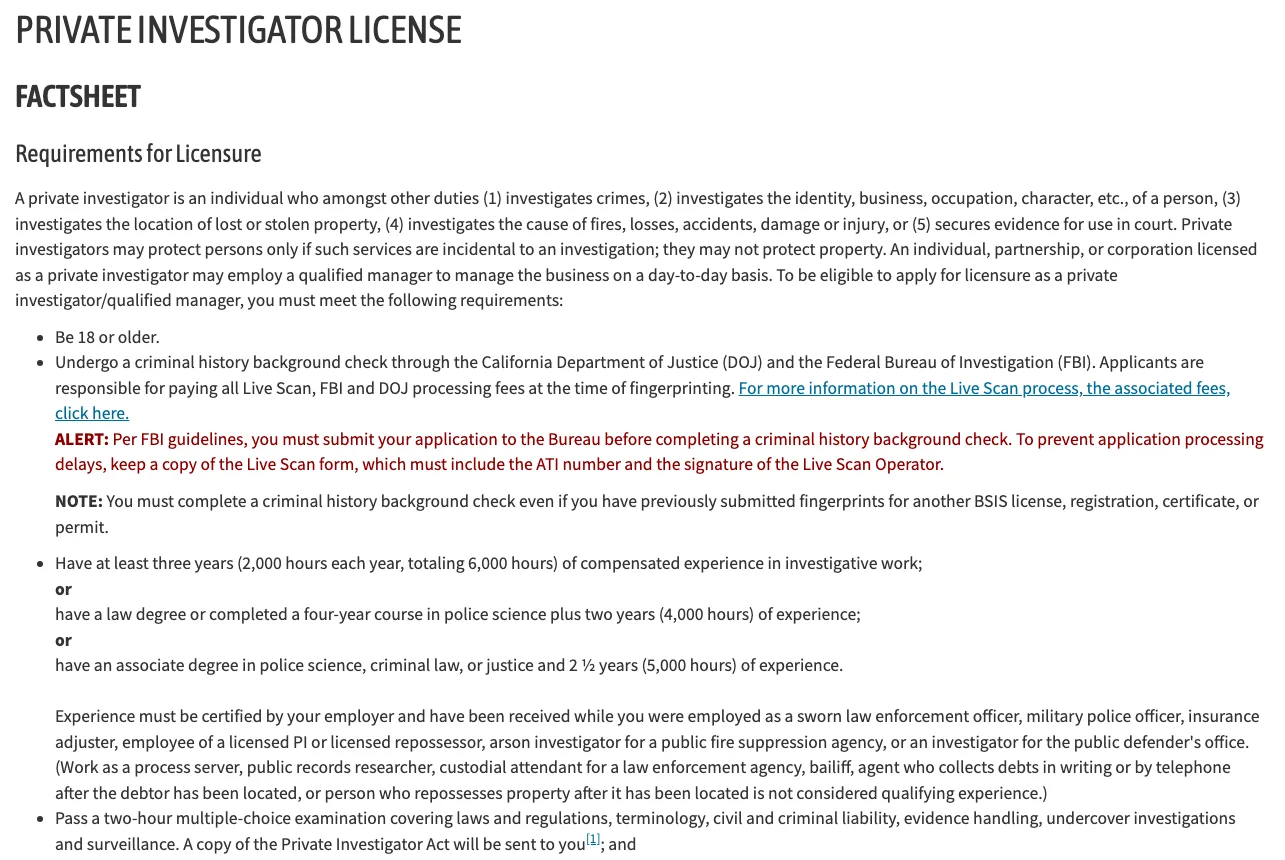
A credential that helps but is not required. Compliance and fraud teams recognise the Certified Fraud Examiner designation, and emergency management offices recognise FEMA's own training courses. Both can be earned after you start.
Genuine retraining. Information security pays the most on the table and needs the most new learning. Your investigative instinct transfers; networking, operating systems and security tooling do not, so plan on a certification path and an entry-level role before the median salary becomes yours.
Still inside the system. Federal investigator roles and detective promotions have their own hiring processes and background checks that can take months. Start them early if they are the target.
Resigning at 12 years and retiring at 25 are different plans
The same destination list serves two different officers, and it helps to know which one you are.
The officer retiring at 20 or 25 has a pension covering part of the bills and often wants less: fewer hours, no nights, work that feels useful. Private investigation, training, part-time emergency management and school or courthouse security fit that shape, because the pay matters less than the schedule. For calmer work outside public safety, the list of low-stress jobs that still pay well is a wider starting point.
The officer resigning at 8 or 12 years needs a full salary and a career with runway. For that officer the better moves are the ones with a ladder: claims into special investigations management, compliance into a compliance lead role, emergency management into a director post, security into a corporate security function. Pay in the first year may dip, and the guide to taking a pay cut for a career change shows how to size that dip before you accept an offer.
Officers who are also veterans often have a second pension clock and a second set of transfer programmes running at the same time, which the military career change guide covers. If the part of policing you want to keep is helping people through the worst week of their lives, the moves open to social workers changing careers overlap with yours more than the uniforms suggest. And if report writing and testimony were your favourite part of the job, the options mapped for lawyers changing careers (compliance, mediation, investigations) sit close to yours.
Test the destination on your days off
Most of these moves can be sampled before you resign, which is the cheapest insurance a mid-career officer has. A few ways officers do it:
- Investigations. Ask your department's fraud or financial crimes unit which insurers' special investigation units they work with, then ask one SIU investigator for a 30-minute call about their week.
- Emergency management. County emergency management offices run volunteer programmes and tabletop exercises. Sitting in on one planning cycle shows you whether the slower, paper-heavy pace feels like relief or like boredom.
- Training. Field training duty and in-service instruction are the trial run. If teaching a block on report writing was the best day of your month, that is evidence worth more than any aptitude test.
- Private investigation. Many licensed investigators subcontract surveillance and interview work. One or two cases on leave days tell you whether the self-employed version suits you before you file for the licence.
Keep a short log of how each trial felt at the end of the day as well as what it paid, and reread it when the pension estimate arrives. To plan the calendar around it, the guide to how long a career change takes breaks a switch into phases you can run while still serving.
A three-question filter before you apply anywhere
Put your answers in writing, because the answers tend to change once you see them next to each other.
Question 1
Is your next pension milestone less than two years away, with a large step in the benefit?
Yes: Stay to the milestone and run a two-year transition while serving: test a destination on days off and get the licence hours or credential in place.
No: Go to the next question.
Question 2
Is physical risk or public hostility the main thing you want to leave?
Yes: Rule out probation and detective work. Look at claims, compliance, emergency management, training or loss prevention, where weekly exposure to aggressive people is near zero.
No: Go to the next question.
Question 3
Do you still want casework: interviews, evidence, a file that has to hold up?
Yes: Detective, claims or fraud investigation, background or workplace investigation, or a private investigator licence.
No: Emergency management, training or security management, where the planning and teaching side of the job becomes the whole job.
The three written questions below, drawn as a sequence. Answer them in order: timing first, then what you are leaving, then what you want to keep.
- Which part of a shift would you do for free? The interview, the scene, the teaching, the paperwork that makes a case stick, or helping someone in crisis. That part points to the destination: investigations, emergency management, training, compliance or a helping role.
- What are you unwilling to repeat? Night shifts, physical risk, public hostility, departmental politics. Cross off every destination on the chart and table that keeps it. If you cannot yet tell whether the problem is your department or policing itself, the guide on what to do when you hate your job helps separate the two.
- What does your pension estimate say about timing? If the next milestone is under two years away and the step is large, your plan is a two-year transition while serving. If not, the plan is a job search now.
When the first answer is vague, which is common after a decade of work defined by calls rather than choices, the filter needs a different input. That is what the career change quiz is for: it asks when you lose track of time and what you would do with money settled, and returns an archetype that says whether you are chasing stability, income or meaning next. A Strategic Shifter should run the pension math first and move carefully. A Freedom Seeker probably wants private investigation or consulting, where the schedule is theirs. For the broader method behind all of this, the guide on how to change careers covers the steps that apply to any profession.
Frequently Asked Questions
Ready to find your passion career?
The free under-10-minute quiz maps your childhood patterns and flow triggers to one of 20 archetypes, then gives you matched careers and a 7-day first-step plan.
Take the Free Career QuizRelated Articles
Trusted by 12,200+ career-quiz takers across 165+ countries · Methods covered in