
Alternative Careers for Social Workers: Three Ways Out
Alternative careers for social workers, in three directions: toward people, systems or the cause. BLS pay, O*NET conflict data, and what to check on PSLF first.


Contents · 8 sections
Social workers who leave the field most often move in one of three directions: toward people (counselling and therapy), toward systems (HR, training, program and operations roles) or toward the cause (community service management, health education, policy). Some only need a new setting inside social work. These 15 roles cover all three, drawn from O*NET's related occupations for social workers and the moves this page prices below:
| Role | Direction | Who it suits, or what carries over |
|---|---|---|
| Marriage and family therapist | Toward people | Keeps the one-to-one work; separate state licence |
| School or career counsellor | Toward people | Assessment and guidance with a school or college calendar |
| Rehabilitation counsellor | Toward people | Case planning for clients returning to work after illness or injury |
| Employee assistance program counsellor | Setting change | Short-term counselling for employees, keeping your licence |
| Healthcare social worker | Setting change | Same licence, hospital or hospice setting, far less daily conflict |
| Mental health and substance abuse social worker | Setting change | Clinical focus with less than half the daily conflict of child welfare |
| Human resources specialist | Toward systems | Case management and documentation, with more conflict than it looks |
| Training and development specialist | Toward systems | The lowest-conflict move here; suits anyone who trained new caseworkers |
| Mediator or conciliator | Toward systems | Structured conflict and de-escalation in place of crisis |
| Program manager or coordinator | Toward systems | Runs the multi-agency plans you already build, at program scale |
| Social and community service manager | Toward the cause | Runs the programs you used to deliver |
| Health education specialist | Toward the cause | Prevention work with low daily conflict |
| Community health worker | Toward the cause | Outreach and navigation close to clients, with no caseload of removals |
| Policy analyst | Toward the cause | Turns years of seeing where the system fails into written proposals |
| Probation officer | Sideways | Court-adjacent casework for those who like structure and the legal side |
How much conflict your current job carries, and which moves cut it
Which direction fits you depends on what you are leaving. Social workers who still love the one-to-one work but are worn down by caseloads and crisis tend to fit the first; those who want structure and calmer days fit the second; those who want more influence over how the system works fit the third. The fastest way to tell them apart is to look at how much conflict each destination carries, the Holland interest code it rewards, and what it does to your licence and your loans. All three are below, starting with conflict.
Burnout in social work has a specific shape. O*NET asks workers in each occupation how often their job puts them in conflict situations, and for child, family and school social workers the answer is stark: about 63% say every day. The same database lets you ask the question of each place you might go next.
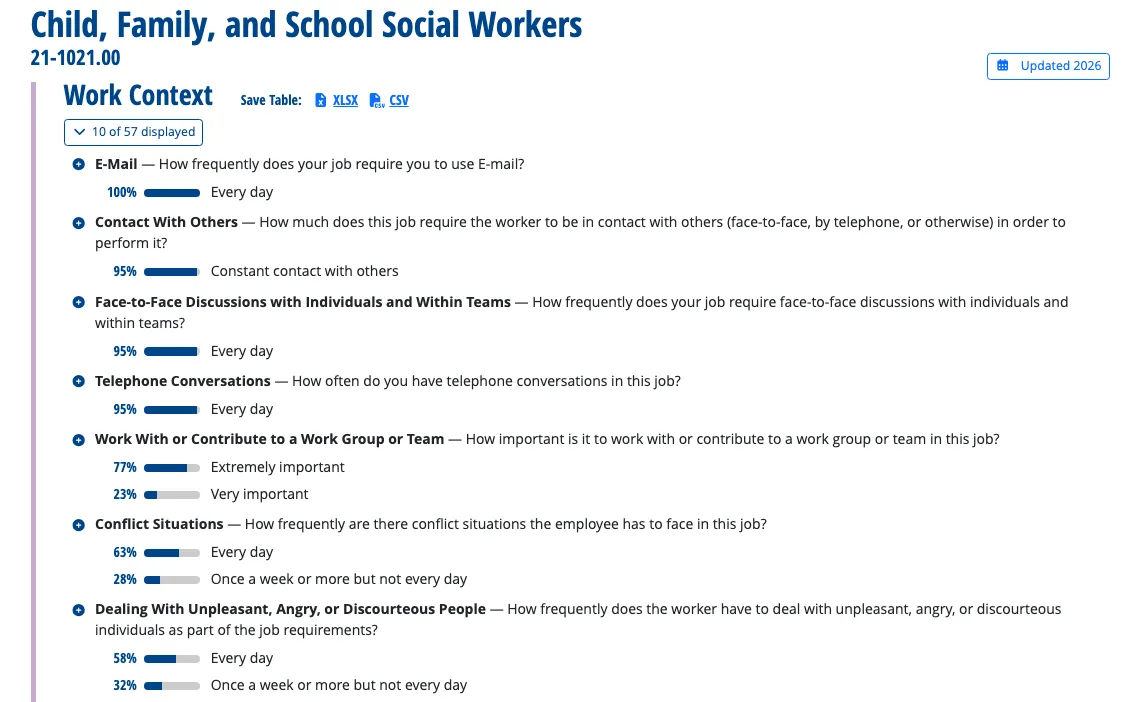
| Answer | Share |
|---|---|
| Child, family and school social workers | 62.9% |
| School and career counsellors | 47.5% |
| Human resources specialists | 40.1% |
| Mental health and substance abuse social workers | 25.1% |
| Marriage and family therapists | 23.6% |
| Social and community service managers | 23.2% |
| Healthcare social workers | 18.5% |
| Health education specialists | 9.9% |
| Training and development specialists | 4.3% |
The second point is worth sitting with. Human resources specialists report daily conflict at a rate far above therapists, because the job is often mediation between employees and management. A social worker leaving for lower conflict who takes an HR generalist role may find the same fights with a corporate logo on them, which is one reason so many HR professionals look for a way out themselves. Training and development, health education and program management inside a healthcare system are the lower-conflict moves on this list.
If what you want to leave is exhaustion more than the work, the guide to beating burnout without quitting covers the changes worth trying inside your current role first, including a transfer to a different setting.
Three directions out of social work
O*NET's related occupations for social workers include marriage and family therapists, educational and career counsellors, health education specialists, rehabilitation counsellors, community health workers, probation officers and social and community service managers. Add the corporate moves that reuse the same skills and the options sort into three groups.
Toward people. Therapy, counselling and coaching keep the one-to-one relationship, which is the part many social workers entered the field for. They trade the system work (court reports, removals, eligibility decisions) for sessions. Most need a clinical licence, and the first years in private practice mean building a referral base as well as seeing clients. It is worth knowing that therapists who leave counselling often name the caseload as the part they want to leave, so test the private practice version before you train for it.
Toward systems. Human resources, training and development, program coordination and operations roles in hospitals, insurers and companies reuse assessment, documentation and case management with lower stakes per decision. None of them need a licence. The adjustment is pace and purpose: the work is measured in quarters and targets, and the person you help is often an employee or a manager instead of a client in crisis.
Toward the cause. Social and community service management, health education, nonprofit program direction and policy analysis move you from serving individual clients to shaping the services themselves. They reward the years you spent seeing where the system fails. They also bring budgets, funders and boards, so the conflict does not disappear; it moves from the client's kitchen to the conference room.
What each direction pays
Pay differs more across the three directions than within them. These are national figures from the BLS wage survey, with your current occupation as the baseline:
| Role | 25th percentile | Median | 75th percentile | Direction, and what it asks |
|---|---|---|---|---|
| Child, family and school social worker (baseline) | $48,270 | $59,550 | $76,070 | Where many social workers start and most burnout happens |
| Marriage and family therapist | $50,070 | $66,940 | $93,840 | Toward people; separate state licence with its own supervised hours |
| School or career counsellor | $51,270 | $64,330 | $82,870 | Toward people; school roles need a state credential |
| Human resources specialist | $58,610 | $75,940 | $99,380 | Toward systems; no licence, more conflict than it looks |
| Training and development specialist | $50,110 | $69,280 | $95,050 | Toward systems; the lowest-conflict move on the chart above |
| Mediator or conciliator | $57,360 | $75,530 | $108,000 | Toward systems; structured conflict in place of crisis |
| Health education specialist | $50,620 | $64,070 | $87,130 | Toward the cause; prevention work, low daily conflict |
| Social and community service manager | $64,290 | $80,390 | $103,200 | Toward the cause; runs the programs you used to deliver |
| Healthcare social worker | $56,710 | $67,880 | $82,240 | Not a direction out: a setting change inside the profession |
Annual wages from the U.S. Bureau of Labor Statistics Occupational Employment and Wage Statistics program, May 2025 release. Half of workers in a role earn more than the median; the 25th to 75th percentile span shows how wide the role pays. To see where your current salary sits in your own occupation, use the free salary benchmark.
Social and community service management and human resources pay the most at the median among these moves. Therapy and counselling pay a little above your current median, but the clinical licence opens private practice, where income depends on your caseload and rates rather than on a salary band.
Moving settings before moving professions
The last row of that table is there on purpose. Some social workers who search for a way out are leaving a setting more than a profession, and the setting is the cheaper thing to change. The conflict chart shows the gap: healthcare social workers report daily conflict at under a third of the rate of child, family and school social workers, and they earn more at the median in the BLS data. Hospital discharge planning, hospice, oncology and dialysis social work, employee assistance programs and school-based roles all keep your licence and your PSLF-eligible employer type while changing the texture of the day.
A setting move is also a test. If you transfer from child protection to a hospital and the exhaustion lifts, the problem was the caseload and the crisis, and a career change would have cost you more than it solved. If six months in a calmer setting leaves you just as flat, the evidence points to the work itself, and the three directions above become the plan. Either result is useful, and a transfer is easier to reverse than a resignation. Before you make it, it is worth writing down what exactly you expect to feel different, so you can check it honestly later.
Question 1
Did the exhaustion start with one caseload, team or setting, such as child protection?
Yes: Try a setting move first: hospital, hospice, EAP or school-based work keeps your licence and your PSLF employer type. Give it six months.
No: Go to the next question.
Question 2
After a calmer setting, or if you have already had one, do you still feel just as flat about the work itself?
Yes: The problem is the work. Pick a direction from the list at the top: toward people, toward systems or toward the cause.
No: Go to the next question.
Question 3
Are you close to 120 qualifying PSLF payments, or partway through clinical licensure with a clinical next step?
Yes: Time the move: finish the count or the hours inside a qualifying employer, then leave.
No: Nothing administrative holds you. Move when the destination is chosen.
The setting test from this section, then the licence and loan checks further down, as one sequence. A transfer answers the first question more cheaply than a resignation.
The Holland code behind each move
Another way to see the three directions is through the Holland interest model, which O*NET uses to code every occupation. Child, family and school social work is coded almost purely Social. The moves differ in what they add to it or swap it for.
| Letter | Type | Core interests |
|---|---|---|
| R | Realistic | Hands-on work: tools, machines, the physical world |
| I | Investigative | Research, analysis, working with ideas |
| A | Artistic | Design, writing, performance, open ends |
| S | Social | Teaching, care, service to people |
| E | Enterprising | Leading, selling, starting things |
| C | Conventional | Systems, data, order, getting details right |
The hexagonal model comes from John Holland’s theory of vocational choice (1959), the framework underneath the U.S. Department of Labor’s O*NET database.
Read it as a compass. Moves toward people keep Social first and add Investigative, the analytical side of assessment and diagnosis. Moves toward systems add Conventional, the order and procedure side. The management and HR moves flip the code so that Enterprising comes first: persuading, deciding and leading become the main work, and helping becomes the means. If you love the helping and dislike the selling, those Enterprising-first roles are the ones to be careful with, however well they pay. The RIASEC test guide explains how to read a three-letter code in more depth.
Case notes, court reports and care plans in business language
A social worker's résumé often undersells the work because the vocabulary is clinical or bureaucratic. O*NET lists active listening, social perceptiveness and documenting information among the core skills and activities of the job. Here is how they read to an employer outside the field:
| What you did as a social worker | How a corporate or nonprofit hiring manager reads it | Best fit |
|---|---|---|
| Carried a caseload of dozens of families at once | Managed a portfolio of concurrent cases with deadlines, risk levels and outcomes | Program management, operations, HR case management |
| Wrote assessments and court reports | Produced evidence-based written assessments that stood up to legal review | Compliance, policy analysis, investigations |
| Built care plans across agencies | Coordinated multi-stakeholder service plans across organisations with competing priorities | Program coordination, health system roles |
| De-escalated clients in crisis | Resolved high-stakes conflict with people under extreme stress | Mediation, employee relations |
| Trained new caseworkers | Designed onboarding and delivered training to new staff | Training and development |
| Tracked outcomes for funders | Reported program metrics to funders and leadership | Community service management, grants |
Replace the language of deficits and cases with the language of scope and outcomes. "Families" becomes "clients" or "stakeholders", "caseload" becomes "portfolio", and every bullet gains a number. The guide to transferable skills mid-career has a fuller version of this exercise.
In interviews, one habit helps more than any résumé edit: tell one case as a project. Pick a family or client whose situation you moved from unstable to stable, strip every identifying detail, and describe it as a problem with a start state, the parties you had to coordinate, the obstacles, the decision you made under uncertainty and the measurable result. A hiring manager in HR, operations or program management hears that story as evidence of judgment. The same case told in clinical language sounds like a job they do not understand.
Check your licence, your supervision hours and your loans first
Three administrative facts shape the timing of a move out of social work, and all three are worth checking before you resign.
Your licence. If you are partway to clinical licensure, finishing it may be the highest-value year of your career even if you then leave front-line work, because it opens therapy and private practice. The hours are substantial: California's Board of Behavioral Sciences requires 3,000 supervised hours over at least 104 weeks, a California law and ethics exam and the ASWB Clinical exam. Other states set their own numbers, so check your board. If your next move is toward systems or the cause, the licence matters much less and finishing it for its own sake is a poor use of two years.
A different licence for therapy. Marriage and family therapy and professional counselling are licensed separately from clinical social work, with their own degree and supervision rules. Before enrolling in anything, ask your state board whether your MSW coursework and hours count toward them, or whether the LCSW is the more direct route to the same therapy work. If assessment and testing appeal more than sessions, the guide to careers psychologists move into shows what the doctoral route leads to and why some leave it.
Keeping the licence alive. If you move toward systems, decide on purpose whether to keep your social work licence active. Renewal usually means continuing education hours and a fee on your board's cycle. Keeping it costs a little each year and preserves a way back into clinical or hospital work; letting it lapse can mean reapplying under the rules of the day. For most people two or three years into a new field, keeping it is the cheaper option.
Your loans. Many social workers are working toward Public Service Loan Forgiveness. The Consumer Financial Protection Bureau sets out the rules: qualifying federal loans are forgiven after 120 qualifying payments (ten years) made while working for government or certain non-profits, and the payments do not have to be consecutive. So a move to a for-profit employer pauses the count without resetting it. If you are at 100 payments, the last 20 months may be worth more than the raise; if you are at 20, they probably are not. Moves toward the cause often stay inside qualifying employers, which keeps the count running.
Sorting yourself into one direction
Four questions, answered honestly, usually point to one of the three directions.
- Which hour of the week do you still look forward to? A session with one client points toward people. Fixing a broken referral process points toward systems. Presenting to a board or funder points toward the cause.
- What would you remove if you could remove one thing? Crisis and conflict: look at training, health education or healthcare settings. Paperwork: look at therapy, though it has its own. Powerlessness: look at management and policy.
- How do you feel about selling? Enterprising-first roles (management, HR, mediation) involve persuading people daily. If that sounds draining, favour the Social-first moves.
- What do your licence and loan counts say about timing? They set the calendar; the first three questions set the destination.
School social workers weighing a move into or out of education will find much of the same ground covered in the career change guide for teachers. And if your work sits close to courts and probation, the moves open to police officers overlap with yours on investigation and compliance, and the guide to jobs for former police officers maps them.
If none of the four questions produces a clear answer, that is common after years of work organised around other people's needs. The career change quiz asks the question the job never did: what you would do with your time if money were settled, and when you lose track of time. It returns an archetype, and two of them show the fork clearly. A Mission Seeker wants to stay close to the cause with more stability, which points to health education or a program role inside a qualifying employer; an Impact Driver wants reach, which points to management or policy. For the broader method, see the guide to changing careers.
Frequently Asked Questions
Ready to find your passion career?
The free under-10-minute quiz maps your childhood patterns and flow triggers to one of 20 archetypes, then gives you matched careers and a 7-day first-step plan.
Take the Free Career QuizRelated Articles
Trusted by 12,200+ career-quiz takers across 165+ countries · Methods covered in