

Best jobs for former teachers: 12 roles ranked by what you want
Pick what matters most. The list re-ranks. Pay is the US median compared with the high school teacher median of $72,040. Open any row for why it fits and the first step.
Pay: US Bureau of Labor Statistics, Occupational Employment and Wage Statistics, May 2025 medians where an occupation exists. “Skills carried over” and “Fit” are our editorial ratings.
Is it your school, or teaching itself?
Some teachers who want out are worn down by one school, one administration or one year group. Others no longer want the classroom at all. The fix is different, so tick what's true for you.
There are no wrong answers. Most teachers tick a mix.
What teachers say about the job
Pew Research Center surveyed 2,531 US public K-12 teachers in late 2023. The work still pulls: 56% said they find it fulfilling often or extremely often. The conditions push the other way, which is why the decision feels so hard.
| Answer | Share |
|---|---|
| Job is frequently stressful | 77% |
| Their school is understaffed | 70% |
| Job is overwhelming | 68% |
| Would not advise a young person to teach | 52% |
| Satisfied with their pay | 15% |
Of the teachers likely to look for a new job, 40% said they would look outside education, 29% for a non-teaching job inside it, and 18% for another public school teaching job. Most teachers who move are leaving the classroom, and many keep their sector.
What 5,905 experienced career changers told us
Government data tells you what each career pays. It can't tell you what holds experienced people back or what they want next. These answers come from 5,905 MyPassion.ai quiz takers with four or more years of work experience, across every profession, January 29, 2026 to October 29, 2026. We publish a single profession only once at least 100 people from it have taken the quiz, and teachers aren't there yet.
What this means for you: not knowing which direction to pick is the most common struggle, ahead of being bored in the current job. The exit finder above narrows the field; the quiz below is built for the direction question.
Source: MyPassion.ai Career Changer Index, rolling window: self-reported answers from quiz takers with 4+ years of experience or returning after a break, January 29, 2026 to October 29, 2026. n = 5,905; each card shows its own base.
The quiz matches what you enjoy and what you're good at to specific careers, with salary data for each. Under 10 minutes, free.
Take the free quiz →Jobs for former teachers outside of education: what your classroom years are worth
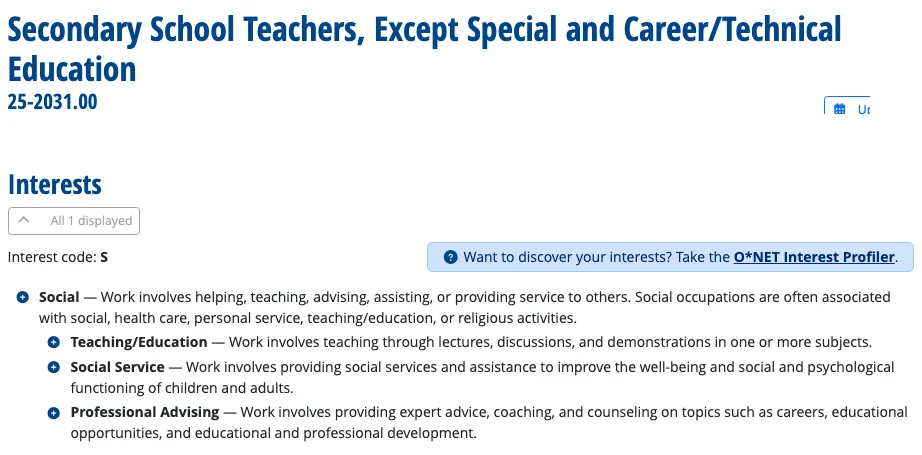
O*NET gives secondary school teaching a single interest letter, S for Social, and the exits sit at different distances from it. Hiring managers outside schools want the same skills, in their vocabulary.
Three ways to make the switch
How you leave matters as much as where you go. Teaching gives you a fixed calendar, so use the summer.
Move to the non-classroom side: edtech, curriculum, advising, adult education. Your classroom years are the qualification. Lead your CV with what students and colleagues achieved.
Stay under contract and build the new skill in the summer and on evenings: contract item writing, a freelance e-learning module, a training gig. Time the resignation to the end of a school year.
A master's for school counseling, a project management certificate for PM roles, or two years in L&D before a manager role. Take it after you have tested the destination.
If you are a decade into teaching, the career change at 40 playbook for a mortgage and a pension works through the runway; earlier on, what a switch at 30 costs is the cheaper version.
Edtech jobs for former teachers, and where the rest are posted
Recruiters rarely write "jobs for former teachers" in a posting. Search by the title and the type of employer instead.
Search "instructional designer", "learning experience designer", "corporate trainer" and "L&D specialist", with a remote filter if you want one.
Search "customer success manager education", "implementation specialist", "curriculum specialist" at companies whose tools your school uses.
Search "item writer", "assessment developer", "content developer" at test publishers and curriculum companies; much of it is contract.
Search "project coordinator", "technical writer", "HR generalist" and lead with a portfolio piece rather than your teaching licence.
Search "academic advisor", "adult education instructor", "ESL instructor" at community colleges and adult learning centers.
Remote jobs for former teachers: lead with the portfolio
A remote posting is open to applicants from every state, so one finished sample does more than a longer CV. Most teacher CVs list schools, subjects and grade levels; show the outcome you want to be hired for instead.
Edtech, curriculum, adult education. Lead with subjects, grade levels and measurable student results.
Corporate training, HR, project roles. Rewrite curriculum, PD sessions and events as programs with stakeholders, deadlines and outcomes.
Instructional design, technical writing, sales. Add an e-learning module, a writing sample or a short case study.
What happened to teachers who left the classroom
Paraphrased from public Reddit threads, usernames removed. Each card links to its thread.
Left after a decade in the same district and moved into sales, at about 10% more than their teacher salary, with fewer hours, less stress and free time again.
Has worked as a project manager and as a corporate trainer since leaving teaching, earns a lot more and works from home.
Took a bank teller job after the classroom and moved up to an analyst role at the same bank within about 10 months, using their teaching skills as leverage.
Questions teachers ask before switching
What are the best jobs for former teachers?
The strongest exits reuse the work you already do: instructional design, corporate training and learning and development, curriculum and assessment writing, customer success or implementation at an edtech company, technical writing, project management, human resources and academic advising. Instructional design is the closest one-to-one translation, because it is lesson design for adults.
What remote jobs can former teachers do?
The roles most often advertised as remote are the ones whose output is a file or a call: instructional designer, learning experience designer, curriculum writer, assessment or test item writer, online tutor, technical writer, and customer success or implementation specialist at an edtech company. Search those exact titles with a remote filter and target remote-first employers.
What edtech jobs hire former teachers?
Edtech companies hire former teachers into customer success (keeping schools using the product), implementation and onboarding (training staff to set it up), curriculum and content (writing what the product teaches), sales and partnerships (selling to districts), and support. Customer success and implementation are the easiest to argue for, because the skills transfer almost without translation.
What are the highest paying jobs for former teachers?
Training and development manager is the highest-paid role on the list, and it is where corporate training usually leads after a few years. Project management, technical writing, instructional design and HR also pay more than the high school teacher median of $72,040 in BLS data, while school counseling, tutoring and adult education usually pay less.
What jobs can former teachers do outside of education?
The corporate jobs for former teachers that hold up best are technical writing, project management, human resources and learning and development. In Pew Research Center's 2023 survey of public K-12 teachers, 40% of those likely to look for a new job said they would look outside education, against 29% who would seek a non-teaching job inside it.
Which jobs suit former math, English or special education teachers?
Start from the subject skill, then pick the role. Former math teachers move most easily into data and analysis roles, math assessment writing and implementation at quantitative edtech products. Former English teachers carry the strongest case for technical writing, content and curriculum writing. Former special education teachers bring individualised planning and documentation under legal requirements, which fits case management, disability services and accessibility work.
Are there part-time jobs for former teachers?
Yes, and they are the cheapest way to test a direction. Online tutoring, item writing, curriculum writing and freelance instructional design are commonly sold per hour or per project, which lets you try the work over a summer before you resign.
How do I change careers from teaching with no experience?
You have the experience without the job title, so the task is translation and proof. Pick one target role, rewrite your CV in its vocabulary, build one piece of evidence such as an e-learning module or a project plan, and talk to people already doing the job. Plan for a search of a few months, timed to the end of a school year.
Is it normal to feel guilty about leaving teaching?
Yes. For many teachers the job is an identity, and leaving feels like abandoning students. The students you helped were helped, and the skills that did it go with you. Choosing work you can sustain is what makes the next decade possible.
Answer a few questions and get matched careers with salary data and a first step for each.
Start the free quiz →Related guides
Sources
- US Bureau of Labor Statistics, Occupational Employment and Wage Statistics, May 2025 (pay)
- O*NET OnLine, Secondary School Teachers (interest code and related occupations)
- Pew Research Center, What's It Like To Be a Teacher in America Today?, April 2024
- Reddit, "To those who left teaching…" (r/Teachers, 2025)
- Reddit, "Former teachers, how different is your life now" (r/Teachers, 2025)
- Reddit, "Teachers who left the profession, what are you doing now?" (r/TeachersInTransition, 2025)
- MyPassion.ai Career Changer Index 2026 (quiz takers with 4+ years of experience)